Thursday, December 1, 2016

“匉檾”的故事

"匉檾"的故事
tertio 2016-11-30 22:09:46 举报
阅读数:34607
一个关于语言意义变迁的虚构故事

一 "匉檾"的故事

(本故事纯属虚构,所使用的"匉檾"一词也纯属虚构)

很久很久以前,有个姓张的人,我们就把他叫张三吧,他没事就拿着个小东西在石头上磨啊磨的,最后磨出来一个尖尖的头,他要拿这个干什么呢?为了把一块新皮子挂到一块木头上,至于到底有什么用,时间这么久了我们也不知道,总之这个方法很好,大家都没干过,甚至都没有一个词来描述这样的事情。

张三就说,我把这个动作叫做"匉檾"好了,以后人们要干这个事情的时候就会说:把鹿皮匉檾起来,或者说:匉檾技术不好的男人不能嫁啊。

有时候人们要挂起来的并不是毛皮,而是自己织出来的一块布,难道又要发明一个词吗?不必了,当张三举着一块布,站在木板前面说:把这块布匉檾到木板上吧。

人们就知道他要干什么。

时间久了,我们要固定的东西,有时是毛皮,有时是一块布,总是就是那样一块软软的东西,大家已经忽略了毛皮和布的不同,把这个意思同样用在了挂起一块布的相似动作上。

日子一天天地过去,大家说话时都开始用这个词,听得懂的人也越来越多。

另一个家伙李四出现了,他发明了帐篷,里面用支架撑住,然后把布的几个角固定在地面上,做为一个小小的发明家,他指挥着大家一起合作,当要固定某个角的时候,他突然觉得没词了,没词就不好指挥了啊。那个张三,估计年龄也很大了吧,叼着烟袋,做为一个发明了匉檾的聪明人,他知道接下来要做什么。

就是要用尖尖的桩子,把帐篷固定到地上,于是他说:用你们手里的木头桩子匉檾住四个角,里面用支架撑起来,就可以啦。

干活的人恍然大悟,噢,原来是这样,于是很顺利的完成了工作。

日子又一天天过去了,这个搭起来的东西,人们一开始叫它房子,不过有个问题,和原来那种房子没法从说话上区别,一个人从家里出发打猎,在外面也搭了个这样的东西,他跟人说的时候就很不方便,他说:我回我房子那了。听的人就不知道他说的是哪个。当然他也可以用更详细的描述,总之会麻烦一点。

人们很讨厌麻烦的事情,我们啊,从本质上来说都是喜欢偷懒的。人们互相称呼的时候,也喜欢偷懒,比如一个人长了红鼻子,以后大家提到他就说,那个红鼻子。那个红鼻子今天打了一只野兔子。人们也不会以为一只鼻子在野地里追啊追,最后把野兔子打死了。

形容一个地点的时候,也喜欢用一个大家都知道的标记带指这个地点,至今留下了很多这样的地名:

公主坟: 话说那一片的人也不是住在公主的坟头上,至少。。。那么多人也住不下吧。

七里坡:离中心城镇七里的路上有个坡很难爬,那里的村子就叫七里坡了,村子也不是真的建在那个坡上对吧。

同样的道理啊,大家对"匉檾"在搭帐篷时的用法记忆犹新,于是开始这样说话了:

我回匉檾那去了。

听的人也不会以为他想把自己扎到地上,当他这样说的时候,我们也会知道,噢,是去那儿了。久而久之,人们看见一个那样的东西的时候,就说:

那有一个匉檾。

匉檾就获得了一个名词的具体含义,专门指这样搭起来的临时帐篷。

又一年一年地过去了,这样搭帐篷的方式已经过时了,年轻人开始用更好的方式,而老人们很是坚持了一阵传统。这个事情甚至起了不小的争执,闹得挺大,导致这个匉檾也出名了。年轻人给新的方式命名为嚲韐,以区别为传统的匉檾,终于有一天,一阵从未见过的风暴袭击了他们,把所有的匉檾都吹倒了,而嚲韐依然屹立。

以后年轻人就用匉檾这个词形容不牢靠的东西,顺便表达了对老一辈人的嘲笑,对老一辈人说:你们的方法太匉檾了。继而开始形容人品,如果觉得一个人看起来又顽固不化,又有点顺风倒,就会说他挺匉檾的,不要和他打交道了。

这个故事讲完了。

在这个故事的开头,"匉檾"的意思,和后面的意思,已经相距很远,但你瞧,通过这个故事,你知道了单词的含义会在怎样的情境下,通过说话者的使用,一步一步地发生变化。

二 语言游戏

我们玩几个关于词义的小游戏,这几个小游戏,是为了帮助我们体会词义变化的有趣之处,为了突出这一点,我甚至超出了文字语言的范围,让字的颜色也和语义发生关联。这居然也是可能的,但需要你沉下心来,仔细体会其中意义变化的规律。

1 分离

我们打算把"跑"这个字的含义分为两种,一种是动物的跑,一种是人的跑,为了平等区分这两个跑的形象,我们用略微不同的字型来代表两种不同的跑,人的跑我们还是用"跑"这个字,动物的跑,我们用"炰",要提醒大家注意的是,我只是取了一个生僻字的字形,不需要理会这个字原本的真实含义。

兔子炰得很快。

鸵鸟炰起来的姿势很奇怪。

我骑的这匹马炰得太快了。

一百米测验我跑了13秒。

你跑不过我。

赶紧追,别让小偷跑了!

然后让自己做几道选择题,请注意要选择正确的字:

我家的猫_____起来比狗快多了。

全世界_____得最快的哺乳动物是什么?

别____啊,还没给钱呐!

小鹿欢快地____向它的妈妈,很快吃起了奶。

我们去操场上比比,看谁____得快!


仔细体会一下,这虽然是虚构的一种词义变化,但当你做完题之后,再看到这两个不同的字时,是否已经有了两种不同的感觉?


2 语义合并

我们能把上和下这两个看起来完全相反的意思,合并为一个新的意思吗?

不信的话我们试试,我再取一个较为生僻的佧字,以代表同时有上和下的含义。

可陈述事实:

气温最近佧动得很厉害

可形容事物:

比如把汽车的减震弹簧叫做"佧簧"

又比如把电梯叫做"佧梯"

还有限制级的用法:

楼上那一对夫妇每天佧得楼板都在响。

说到这我差点忘了,曾经有个"挊"字,不是也风靡一时吗。


最后考考你,如果用来形容人生的话,佧在北京和漂在北京相比,又多了一层什么样的意味?

如果你能感受到这种意味,这种感受又来自何处呢?


3 阴性与阳性

这里我们再做一个更加大胆的尝试,这个尝试甚至超出现有文字语言的界限。

众所周知,汉语中的动词不会因为施动者的性别而发生变化的,那我们是不是也可以玩个小花招,让汉语中加入这样的词汇呢?这次我们不去变化文字本身,而是用蓝色表示阳性动词,红色表示阴性动词,还是看几个例子。

她一百米测验了13秒!

他一百米测验得比她慢多了。

王菲在这次演唱会上了12首歌。

李云迪这次演奏会砸了。


细细体会一下,这里出现的蓝色和粉红色,能成功地和语义挂上钩吗?看下面两个句子:

这样子回去我一定会被()的。

这样子回去我一定会被()的。


感觉如何?

这样的游戏,每天都在现实中发生着,人类的语言如大江大河,在时间之轮的驱动下滚滚向前。人们的情绪,感觉,需要,外化而成的语言,都是这股洪流中无数的小浪花,转瞬即逝,又生生不息。在这样的洪流中定格语言的意义,汇编成册,犹如把河流做成标本,谈何容易。感谢我们的语言学家,他们历经多年,从海量的语料库中抽丝拨茧,分门别类,提炼出词条和例句,这让我们的英语学习,有了详实的资料可以依赖。

然而,语言依然是活着的,如果不深刻认识到这一点,借助词典进行学习就会进入误区。


三、对待词典的正确方式

1 例句提供了单词运用的场景

在我们常用的词典上,关于单词有这样两类主要的信息,定义部分和示例部分。定义部分主要包括词性和释义,示例部分包括短语搭配和例句。

词性和释义的出现,是人们认为需要对一个单词的内涵,做出尽可能精确,严格的定义。然而,这只是一厢情愿的空中楼阁罢了,单词的语义,是无法通过这种方式给予严格规范的。我们并不是先知道了单词的定义,然后再去应用这个定义。我们只是根据自己的感觉,从一种使用方式到另一种使用方式,只要这种变化不超出人的理解,对沟通不造成障碍就可以被人接受甚至流行起来。

如果你读懂了前面的故事,就会知道,单词语义自从使用情境中产生之日起,一直发生着变化。极端的说法是,当你每说出一句话,都会改变单词的语义。有一些语义变化较为显著,又易于传播,经由人群的筛选,逐渐约定俗成下来,并在代际间继承,如此这般最终成为词典上的新词条。

词典的编纂者,是将人们在交谈中,在书写中所使用的语言搜集起来,形成语料库。随后在语料库中进行整理,捕捉单词的含义,提取为词条。每隔一段时间,还要根据人们的使用,对词条进行修订。

语义的源头,是使用语言的人们。每天人们都在不同的情境中大量地使用单词,有时把它们用在从未出现过的场景中,表达新的含义,这是语言的活水,我们要理解一个单词,就必须捕捉到这些情境,体会单词在沟通中所发挥的作用,舍弃语言的使用方式而追求精确的词典定义,完全是舍本逐末,让自己寸步难行。


词典上按词义项分门别类整理出来的短语搭配和例句,才是我们真正需要投入时间去了解,去掌握的内容。

例句虽然只是一个句子,无前因无后果,但一个句子的确包含了非常多的上下文信息,比如这样一句话:

他猛地转过身去,差点摔倒。

这已经有了足够的空间可供我们想象一个可信的上下文,这是一位男性,也许听到了身后的动静,转身动作很急,也许声音让他感觉很害怕,转身时失去了平衡,但还是稳住了,后面他会看见什么呢?还是什么也没看见?

通过对例句所构造的情境的想象,我们就能够获得一个上下文,在这样的上下文中把握单词的含义,最为接近人们在生活中使用语言沟通的现场,同时因为词典编纂者良好的整理,又同时具有系统性。

2 中文释义做为梯子

中文释义已经被很多英语老师批得差不多了,用中文转译英文单词,会给后面的学习和语言应用带来无穷的副作用,这一点我无条件同意。

然而批判中文转译学习时,我也注意到一个事实,直接看中文释义的方法却又让程度较差的学习者难以放弃,看英英释义看得不明就里,看一下中文释义的确有解渴的作用,但多了又成了饮鸩止渴。为了避免副作用,我们需要把中文释义看做一架梯子。这架梯子,是帮助你跨过一条鸿沟,理解例句含义的,一旦理解了例句含义,梯子就不再需要了,得赶紧撤掉,否则你就得一直依赖它了。

你可以像考试作弊那样,偷看一眼单词的中文释义,以及例句的中文释义,一旦理解句子成功,就不要再回过头来背中文释义了。

在有些词典中,有双语例句,对待这些例句的正确态度是,在看懂得的条件下,尽可能地不看中文翻译。如果一定要看,还是要把翻译句当作梯子,用完就扔,切末把翻译和原文逐词对应。

3 英英释义做为辅助

正如前面所说,老师课上批完中文释义,推荐英英词典,但学生一动手,却发现寸步难行。

在前面所讲述的那个例子中,你即使掌握了那个词的各种用法,但你能对每个词义给出精确的定义吗?

事实上,很多单词,母语者自己都未必能给出一个准确的定义出来,而且给出来的描述方式也不一定和词典上的词条解释一致。英英释义的问题就在这里。当然,有的释义属于很好懂的那一类,更多的,一眼是看不出来的。这不能怪学习者,我建议完全放弃对难懂释义的阅读和记忆。在考试中考察英英释义,不如说是在考对那个释义的阅读理解。正如前文所说,在上下文情境中的使用才是词义的源头活水。

4 短语搭配的重要性不亚于例句。

千万不要小看了短语搭配,这是词典中非常重要的一个内容。短语搭配也是语言使用的片段,虽然所提供的上下文不如例句那样具体,但它具有相当的想象空间。通过常用词的搭配短语,你能够很好的了解这个词在句子结构中所处的地位,该词和搭配词的语义关联,这对于记忆和灵活运用都有非常重要的作用。


Evernote helps you remember everything and get organized effortlessly. Download Evernote.

What's Wrong With Literary Studies?

What's Wrong With Literary Studies?

Some scholars think the field has become cynical and paranoid

By Marc Parry NOVEMBER 27, 2016  PREMIUM

In the low-budget realm of humanities grantmaking, a University of Virginia press release this May came as a shock. The Danish National Research Foundation had awarded roughly $4.2 million to a literary-studies project led by an English professor at Virginia, Rita Felski. And this wasn't yet another big-ticket digital-humanities effort to map the social history of the United States or crunch the cultural data stored in five million books. This money would help Felski assemble a team of scholars to investigate the social uses of literature.

For Felski, the windfall validates a nearly decade-long push to change the way literature and other art forms are studied. In a series of manifestoes, she has developed a sophisticated language for talking about our attachments to literature and prodded literary scholars to reconsider their habit of approaching texts like suspicious detectives on the hunt for hidden meanings. Felski's message boils down to prefixes. Literary critics have emphasized "de" words, like "debunk" and "deconstruct." But they've shortchanged "re" words — literature's capacity to reshape and recharge perception.

"There's actually quite a diverse range of intellectual frameworks, politically, theoretically, philosophically," says Felski, who specializes in literary theory and method. "Yet there's an underlying similarity in terms of this mood of vigilance, wariness, suspicion, distrust, which doesn't really allow us to grapple with these really basic questions about why people actually take up books in the first place, why they matter to people."

"If you challenge the idea of suspicion as the only mode of reading, you are then immediately accused of being conservative."
Though the size of her grant may be unique, Felski's sense of frustration is not. Her work joins a groundswell of scholarship questioning a certain kind of critique that has prevailed in literary studies in recent decades. "Critique" can be a blurry word — isn't all criticism critique? — but in Felski's usage it carries a specific flavor. Critique means a negative commentary, an act of resistance against dominant values, an intellectual discourse that defines itself against popular understanding. Felski sketches the shake-up of literary studies that started in the '60s as a shift from criticism ("the interpretation and evaluation of literary works") to critique ("the politically motivated analysis of the larger philosophical or historical conditions shaping these works"). Most frameworks taught today in a literary-theory class, such as feminism, Marxism, deconstruction, structuralism, and psychoanalysis, would count as variants of critique.

Contemporary literary scholarship has never lacked for detractors: Down with politics in the academy! Back to the Great Books! What's different now is that the questioning of critique is coming from people steeped in its theories. Eve Kosofsky Sedgwick, a founder of queer theory and sexuality studies, galvanized this soul-searching with a 2003 essay arguing that theory had spawned a paranoid mood in literary studies. The debate gained momentum with a special issue of the journal Representations in 2009, when Stephen Best and Sharon Marcus challenged a method of interpretation known as symptomatic reading, in which critics read texts like psychoanalysts probing for repressed meanings.

Then, last year, came Lisa Ruddick's essay "When Nothing Is Cool," a hand grenade lobbed at her field. Ruddick, an expert on British literature at the University of Chicago, attacked literary studies for favoring an antihumanist ideology that looks askance at inner life and, in her view, alienates scholars from their own moral intuitions. "I have spoken with many young academics who say that their theoretical training has left them benumbed," she wrote in The Point magazine. "After a few years in the profession, they can hardly locate the part of themselves that can be moved by a poem or novel. It is as if their souls have gone into hiding, to await tenure or some other deliverance."

If you exist outside the bubble of academic literary criticism, some of these ideas, like cultivating the inner life or talking about the pleasures of literature, might seem uncontroversial — obvious, even. But the recent debates over literary method have generated considerable hostility because they touch on existential questions of what English professors do. If they abandon suspicion, does that mean retreating into banal admiring description? Should criticism always have a political aim? Is it really necessary, as one of Felski's allies puts it, for a literary critic to speak truth to power every time she reads Virginia Woolf?

Members of Felski's circle, who sometimes publish under the banner of "postcritical reading," feel a need to emphasize that questioning critique does not mean abandoning one's political commitments, be they Marxist, feminist, or queer. "If you challenge the idea of suspicion as the only mode of reading, you are then immediately accused of being conservative in relation to all those politics," says Toril Moi, a Duke literature professor who contributed to a forthcoming essay collection on critique. "I don't think that's true at all. I still think I'm a feminist." The current "revolt," she says, "is very much against the idea that we all can only read for one reason, namely political critique."

But critics of that "revolt" contend that its advocates offer a distorted picture of what's actually happening in literary studies. These skeptics, in classic critique fashion, also see the methods fight as a displacement of larger economic concerns: an attempt to make a case for literary study as budgets are cut and career opportunities dry up. But no change of methods will appease outside detractors of literary studies, they warn.

"Graduate students who are facing an extremely bad job market — really a collapse of the job market — may look at the ordinary procedures of criticism and say, 'How can people go on performing these critical acts, these interpretive acts, when the world has just fallen apart for us?' " says Bruce Robbins, a professor of English and comparative literature at Columbia University. Referring to Ruddick's essay, which got an emotional response, he adds, "It may be that — and this is perfectly legitimate — there are people who are ripe for that kind of denunciation because they feel betrayed. They were led to think that their talents could lead them into good careers, and all they had to do was keep plugging along. And then they plug along and suddenly the whole structure just collapses around them."

Chris Tyree for The Chronicle Review
Rita Felski: Literary critique puts forth "a rather narrow view of what's going on in aesthetic experience."
Rita Felski is a pillar of that structure, which gives particular weight to her analysis of what ails English departments. The British-born scholar edits New Literary History, an influential journal of theory and criticism that prides itself on redrawing the frameworks of literary studies. Her own writing balances a commitment to high theory with a sympathy for ordinary language and everyday experience. For example, her first bookBeyond Feminist Aesthetics (Harvard University Press, 1989), attempted to defend the value of popular feminist fiction of the '70s and '80s. It challenged efforts to anchor feminist literary criticism in a general notion of female identity or feminine poetic writing. Felski turned instead to the sociological concept of the "public sphere" — a space where people come together for critical discussion and political debate — arguing that popular feminist fiction had created a "feminist counter-public sphere" that spread new scripts and stories for women (a feminist bildungsroman, for example).

Felski's more recent writing arose from her frustration with the limited vocabulary of literary critique, particularly its inability, in her view, to consider fundamental questions about why literature matters. What interested her was how literature creates powerful bonds across space and time: how we become attached to a 300-year-old play, or get transfixed by a novel written in a very different historical or cultural context. When theorists addressed such positive aspects of literature or art, they tended to put forward what Felski felt was "a rather narrow view of what's going on in aesthetic experience." We enjoy art because of the elegance of its form, they might say. We take a disinterested pleasure in beauty. In Felski's opinion, there was a lot more going on. Critics should describe the full range of motivations that drive people to take up literature.

In 2008, Felski gave that a try with a slim manifesto called Uses of Literature (Blackwell). She explored how people read fiction for recognition (its capacity to foster self-understanding); enchantment (the escapism of total absorption in an imaginary world); and shock (that emotional mix of revulsion and fascination you might get from avant-garde theater).

The book did reasonably well. Yet Felski says some people responded with statements like "What you say is very true, but this kind of argument can't really challenge the importance of critique in literary studies." There was a widespread assumption that practicing critique was the only way to be a serious intellectual. Scholars considered it the most rigorous form of thought, Felski says, because of its persistent theoretical interrogation of ideas that are taken for granted: nature, reality, gender, the self, the human. They also saw it as the most radical way of thinking because it allowed them to challenge dominant values.

Felski was unconvinced. So last year she published a gentle polemic called The Limits of Critique(University of Chicago Press). Her book walks a rhetorical tightrope, crediting the contributions of literary theory while deflating its claims to rigor or radicalism. The book's basic thrust is to redescribe critique rather than refute its ideas. It dwells on the mood of literary scholars, their way of relating to texts. "The barbed wire of suspicion holds us back and hems us in, as we guard against the risk of being contaminated and animated by the words we encounter," Felski writes. "The critic advances holding a shield, scanning the horizon for possible assailants, fearful of being tricked or taken in."

But these shield-wielding naysayers are prey to a predictable repertoire of tics, conventions, and assumptions, Felski argues. Like detectives, they search for clues that ordinary people miss, probe those clues for hidden meanings, and come up with a story that explains them. In one move characteristic of an older style of interpretation, feminist critics would argue that female desire was "repressed in the texts of a patriarchal culture," as Felski puts it. Digging down beneath the surface, they found gaps and contradictions that suggested this buried longing. In another trope that has found favor more recently, a feminist critic might stand back from a text to question its basic assumptions, Felski says. Now the critic shows how a text is "part of a larger system of gender conventions and power relations" that she wants to "denaturalize" (that is, to call into question).

Literary critics write a lot about the positive aspects of fiction, Felski says. But they generally root that appreciation in the subversive premises of critique. They value literature because it disrupts, because it challenges identity, because it opposes the status quo — in other words, because it's critical. When Felski talks about the "limits" of critique, she means, in part, that this account of why art matters is inadequate. The critical aspects of creative works are "not the only reason, or the main reason, why people turn to literature or films or paintings," she says.

Felski attacks critique's stature as the most radical form of thought. Here she draws on the work of Bruno Latour, a French anthropologist and sociologist. Latour questions the assumption that being suspicious and critical makes you a progressive thinker, in contrast to the purportedly credulous and complacent masses. He points out that conservative thinkers are now just as likely to draw on the forms of suspicious questioning associated with critique. Think of climate-change deniers, or all those Trump voters so deeply suspicious of elites.

Adam Alexander for The Chronicle Review
Lisa Ruddick: "English, without knowing it, has fallen into an intense version of this kind of professional groupthink."
Like Felski, Lisa Ruddick, who established herself in 1990 with a psychoanalytic study of Gertrude Stein's writing, also takes issue with the suspicious mood in literary studies. But she emphasizes the psychological fallout.

What's wrong, as she sees it, is literary scholars' tendency to condemn certain ideas and beliefs as "humanist." The problem dates to the 1980s, she argues, when literary scholars became enamored of French poststructuralist theories. These ideas held that the "self" was not fully stable or autonomous — that we are formed variously by language, culture, and history. While Ruddick considers that a legitimate point, she argues that the "stigma" of humanism has gradually come to encompass more and more of what makes life meaningful, most notably our very sense of an interior world.

This antipathy to the individual has moral ramifications for the field, Ruddick says. If its initiates lose investment in their inner lives and grow alienated from their moral intuitions, the profession as a collective benefits: People throw themselves into professional satisfactions like status and praise. But the intellectual stagnation, the discouragement against following one's moral feelings — these, in Ruddick's view, foster a deep cynicism. Family is rejected as "provincial," home as a "disciplinary mechanism," and the inner life as a "bourgeois" luxury. At worst, they create an opening for "violent and sadistic ideas." In the most shocking example, an analysis of a Henry James story tries to make the sexual abuse of children look politically progressive. "Today's anti-pedophile," Ruddick writes, summarizing the analysis, "perpetrates the 'potential violence' of 'speaking on [children's] behalf.' " Such ideas violate scholars' private convictions, Ruddick says, but they go unchallenged because they seem to mesh with the ideology of the group.

To reality-check this tale of dysfunction, Ruddick interviewed about 70 young academics, mostly Ph.D. students, at seven major research universities. She found that two types of scholars tended to be satisfied: those with a political commitment to an issue favored by the field of English, and those who, not especially stirred up by theory, study literary-historical questions. But the interviews also strongly confirmed her sense of the discouragement and constraint that students can feel adapting to the discipline. "English, without knowing it, has fallen into an intense version of this kind of professional groupthink," says Ruddick, who is writing a book that expands on her "When Nothing Is Cool" essay. "I believe that the profession can't really move forward until we shed our fear of saying and thinking things that colleagues would call 'humanist.' "

On social media, many responded to Ruddick with appreciation. "This essay felt like I'd been holding my breath, waiting for it for decades," wrote Gardner Campbell, an associate professor of English at Virginia Commonwealth University.

"Stunning piece. Finally thoughtful people, long cowed into silence, are starting to speak up," wroteTerry Castle, a Stanford English professor.

Felski's work has also been widely touted; The Times Literary Supplement called it "perhaps the most ambitious reappraisal of the discipline to appear since theory's heyday." But other scholars are just as passionate in their criticism of Felski and Ruddick. What animates them, often, is a feeling that the reassessments of critique distort what's actually happening in literary studies.

That was the reaction of Columbia's Bruce Robbins, who sees himself as one of the ethical-political critics being taken to task. He dismisses Ruddick as an out-of-touch scholar bent on tarring the entire field with the worst practices of a relatively small number of people. Though Robbins considers Felski a more careful thinker, he finds her portrayal of critique unfair, too, because she represents those who do it primarily as faultfinders. "She's not paying attention to the many varied and extremely interesting ways in which people's positive appreciation is part of their critical practice," he says.

"Our attitudes to artworks are much more unpredictable and surprising than a lot of social theories allow for."
Felski also makes critique seem more dominant than it is, says another skeptic, Lee Konstantinou, an assistant professor of English at the University of Maryland at College Park. "It might be that I just went to graduate school at a different time" — Konstantinou earned his Ph.D. in 2009, while Felski got hers in 1987 — "but I was not told that the only valuable thing that I could be doing as a literary critic would be to debunk or expose the disavowed meanings hidden within literary texts," he says. As a doctoral student at Stanford, he learned to think of himself as a scholar engaged in literary and cultural history — a practice that, while it did involve critiquing, also put a premium on visiting archives and documenting the past. "The picture of criticism that these post-critics create seems a little bit reductive," he says, adding, "Literary critics are not handcuffed to the project of critique."

Konstantinou thinks this debate conceals bigger issues, like the dwindling numbers of English majors and the university funding crisis. He quotes Felski's hope, in The Limits of Critique, to "articulate a positive vision for humanistic thought in the face of growing skepticism about its value." No methods shift will appease outside critics, he says. "It's not the case that if you were just less politicized in your reading of Jane Austen, all of a sudden Scott Walker's going to say, 'Oh, no, I love the University of Wisconsin system.' If the postcritical project is going to survive, it can't just rest on the idea that we have to make literary studies comprehensible to people who don't know a lot about it or don't do the requisite reading."

But to talk about a "postcritical project" implies a cohesiveness that doesn't seem to exist beyond a desire for more diversity of approaches. Among the scholars who have challenged critique — and not all of them accept the label "postcritical" — Ruddick wants to broaden the acceptable palette of psychoanalytic theories. Duke's Moi wants to rethink prevalent notions of language as a self-contained system cut off from the world. Sharon Marcus and Stephen Best introduce "surface reading." This approach "describes works without interpreting or evaluating them," Marcus says, focusing more on what is in a text rather than what it excludes or represses.

Felski is returning to the work she began in Uses of Literature. That book partially inspired the project she'll work on with the $4.2-million Danish grant. Spending her fall semesters at the University of Southern Denmark, she will team up with literary scholars, historians, and social scientists to tackle questions about the social dimensions of literature. For example, the relationship between literature and medicine: Could novels give us new ways of thinking about diseases? Or class: What does literature tell us about the "precariat," that growing segment of society defined by underemployment? Or welfare: Why does that word carry such negative connotations in the United States, and such positive ones in Scandinavia? How do people attach themselves to certain words, making them part of their identity, while disengaging from other ones?

That question of attachments — to novels and films, paintings and music — is at the heart of Felski's next book. She operates from the premise that people's everyday experience of art is much more mysterious than commonly thought. Consider the story of Zadie Smith's changing relationship to Joni Mitchell. The novelist once dismissed Mitchell's music as, in Felski's words, "a white girl's warbling." Then one day Smith could no longer listen to Mitchell's songs without crying. Why? To think about such questions, Felski draws on the philosophical tradition of phenomenology, looking closely at first-person experience. So, in that musical epiphany, Smith is in her 30s. She and her husband are driving to a wedding in Wales, with Mitchell playing on the car radio. They bicker. They spend an afternoon at Tintern Abbey, where Smith gazes out at the green hills. And suddenly she's humming Joni Mitchell. Felski writes about the way such different strands of experience come together to shape perceptions of art.

"Our attitudes to artworks are much more unpredictable and surprising than a lot of social theories allow for," she says. "And therefore we need to look at these specific examples of a relationship to an artwork. A lot of specific examples are going to explode our theories rather than confirm them."

Marc Parry is a senior reporter at The Chronicle.


Evernote helps you remember everything and get organized effortlessly. Download Evernote.

Wednesday, November 30, 2016

Untitled

What's Wrong With Literary Studies?

Some scholars think the field has become cynical and paranoid

By Marc Parry NOVEMBER 27, 2016  PREMIUM

In the low-budget realm of humanities grantmaking, a University of Virginia press release this May came as a shock. The Danish National Research Foundation had awarded roughly $4.2 million to a literary-studies project led by an English professor at Virginia, Rita Felski. And this wasn't yet another big-ticket digital-humanities effort to map the social history of the United States or crunch the cultural data stored in five million books. This money would help Felski assemble a team of scholars to investigate the social uses of literature.

For Felski, the windfall validates a nearly decade-long push to change the way literature and other art forms are studied. In a series of manifestoes, she has developed a sophisticated language for talking about our attachments to literature and prodded literary scholars to reconsider their habit of approaching texts like suspicious detectives on the hunt for hidden meanings. Felski's message boils down to prefixes. Literary critics have emphasized "de" words, like "debunk" and "deconstruct." But they've shortchanged "re" words — literature's capacity to reshape and recharge perception.

"There's actually quite a diverse range of intellectual frameworks, politically, theoretically, philosophically," says Felski, who specializes in literary theory and method. "Yet there's an underlying similarity in terms of this mood of vigilance, wariness, suspicion, distrust, which doesn't really allow us to grapple with these really basic questions about why people actually take up books in the first place, why they matter to people."

"If you challenge the idea of suspicion as the only mode of reading, you are then immediately accused of being conservative."
Though the size of her grant may be unique, Felski's sense of frustration is not. Her work joins a groundswell of scholarship questioning a certain kind of critique that has prevailed in literary studies in recent decades. "Critique" can be a blurry word — isn't all criticism critique? — but in Felski's usage it carries a specific flavor. Critique means a negative commentary, an act of resistance against dominant values, an intellectual discourse that defines itself against popular understanding. Felski sketches the shake-up of literary studies that started in the '60s as a shift from criticism ("the interpretation and evaluation of literary works") to critique ("the politically motivated analysis of the larger philosophical or historical conditions shaping these works"). Most frameworks taught today in a literary-theory class, such as feminism, Marxism, deconstruction, structuralism, and psychoanalysis, would count as variants of critique.

Contemporary literary scholarship has never lacked for detractors: Down with politics in the academy! Back to the Great Books! What's different now is that the questioning of critique is coming from people steeped in its theories. Eve Kosofsky Sedgwick, a founder of queer theory and sexuality studies, galvanized this soul-searching with a 2003 essay arguing that theory had spawned a paranoid mood in literary studies. The debate gained momentum with a special issue of the journal Representations in 2009, when Stephen Best and Sharon Marcus challenged a method of interpretation known as symptomatic reading, in which critics read texts like psychoanalysts probing for repressed meanings.

Then, last year, came Lisa Ruddick's essay "When Nothing Is Cool," a hand grenade lobbed at her field. Ruddick, an expert on British literature at the University of Chicago, attacked literary studies for favoring an antihumanist ideology that looks askance at inner life and, in her view, alienates scholars from their own moral intuitions. "I have spoken with many young academics who say that their theoretical training has left them benumbed," she wrote in The Point magazine. "After a few years in the profession, they can hardly locate the part of themselves that can be moved by a poem or novel. It is as if their souls have gone into hiding, to await tenure or some other deliverance."

If you exist outside the bubble of academic literary criticism, some of these ideas, like cultivating the inner life or talking about the pleasures of literature, might seem uncontroversial — obvious, even. But the recent debates over literary method have generated considerable hostility because they touch on existential questions of what English professors do. If they abandon suspicion, does that mean retreating into banal admiring description? Should criticism always have a political aim? Is it really necessary, as one of Felski's allies puts it, for a literary critic to speak truth to power every time she reads Virginia Woolf?

Members of Felski's circle, who sometimes publish under the banner of "postcritical reading," feel a need to emphasize that questioning critique does not mean abandoning one's political commitments, be they Marxist, feminist, or queer. "If you challenge the idea of suspicion as the only mode of reading, you are then immediately accused of being conservative in relation to all those politics," says Toril Moi, a Duke literature professor who contributed to a forthcoming essay collection on critique. "I don't think that's true at all. I still think I'm a feminist." The current "revolt," she says, "is very much against the idea that we all can only read for one reason, namely political critique."

But critics of that "revolt" contend that its advocates offer a distorted picture of what's actually happening in literary studies. These skeptics, in classic critique fashion, also see the methods fight as a displacement of larger economic concerns: an attempt to make a case for literary study as budgets are cut and career opportunities dry up. But no change of methods will appease outside detractors of literary studies, they warn.

"Graduate students who are facing an extremely bad job market — really a collapse of the job market — may look at the ordinary procedures of criticism and say, 'How can people go on performing these critical acts, these interpretive acts, when the world has just fallen apart for us?' " says Bruce Robbins, a professor of English and comparative literature at Columbia University. Referring to Ruddick's essay, which got an emotional response, he adds, "It may be that — and this is perfectly legitimate — there are people who are ripe for that kind of denunciation because they feel betrayed. They were led to think that their talents could lead them into good careers, and all they had to do was keep plugging along. And then they plug along and suddenly the whole structure just collapses around them."

Chris Tyree for The Chronicle Review
Rita Felski: Literary critique puts forth "a rather narrow view of what's going on in aesthetic experience."
Rita Felski is a pillar of that structure, which gives particular weight to her analysis of what ails English departments. The British-born scholar edits New Literary History, an influential journal of theory and criticism that prides itself on redrawing the frameworks of literary studies. Her own writing balances a commitment to high theory with a sympathy for ordinary language and everyday experience. For example, her first bookBeyond Feminist Aesthetics (Harvard University Press, 1989), attempted to defend the value of popular feminist fiction of the '70s and '80s. It challenged efforts to anchor feminist literary criticism in a general notion of female identity or feminine poetic writing. Felski turned instead to the sociological concept of the "public sphere" — a space where people come together for critical discussion and political debate — arguing that popular feminist fiction had created a "feminist counter-public sphere" that spread new scripts and stories for women (a feminist bildungsroman, for example).

Felski's more recent writing arose from her frustration with the limited vocabulary of literary critique, particularly its inability, in her view, to consider fundamental questions about why literature matters. What interested her was how literature creates powerful bonds across space and time: how we become attached to a 300-year-old play, or get transfixed by a novel written in a very different historical or cultural context. When theorists addressed such positive aspects of literature or art, they tended to put forward what Felski felt was "a rather narrow view of what's going on in aesthetic experience." We enjoy art because of the elegance of its form, they might say. We take a disinterested pleasure in beauty. In Felski's opinion, there was a lot more going on. Critics should describe the full range of motivations that drive people to take up literature.

In 2008, Felski gave that a try with a slim manifesto called Uses of Literature (Blackwell). She explored how people read fiction for recognition (its capacity to foster self-understanding); enchantment (the escapism of total absorption in an imaginary world); and shock (that emotional mix of revulsion and fascination you might get from avant-garde theater).

The book did reasonably well. Yet Felski says some people responded with statements like "What you say is very true, but this kind of argument can't really challenge the importance of critique in literary studies." There was a widespread assumption that practicing critique was the only way to be a serious intellectual. Scholars considered it the most rigorous form of thought, Felski says, because of its persistent theoretical interrogation of ideas that are taken for granted: nature, reality, gender, the self, the human. They also saw it as the most radical way of thinking because it allowed them to challenge dominant values.

Felski was unconvinced. So last year she published a gentle polemic called The Limits of Critique(University of Chicago Press). Her book walks a rhetorical tightrope, crediting the contributions of literary theory while deflating its claims to rigor or radicalism. The book's basic thrust is to redescribe critique rather than refute its ideas. It dwells on the mood of literary scholars, their way of relating to texts. "The barbed wire of suspicion holds us back and hems us in, as we guard against the risk of being contaminated and animated by the words we encounter," Felski writes. "The critic advances holding a shield, scanning the horizon for possible assailants, fearful of being tricked or taken in."

But these shield-wielding naysayers are prey to a predictable repertoire of tics, conventions, and assumptions, Felski argues. Like detectives, they search for clues that ordinary people miss, probe those clues for hidden meanings, and come up with a story that explains them. In one move characteristic of an older style of interpretation, feminist critics would argue that female desire was "repressed in the texts of a patriarchal culture," as Felski puts it. Digging down beneath the surface, they found gaps and contradictions that suggested this buried longing. In another trope that has found favor more recently, a feminist critic might stand back from a text to question its basic assumptions, Felski says. Now the critic shows how a text is "part of a larger system of gender conventions and power relations" that she wants to "denaturalize" (that is, to call into question).

Literary critics write a lot about the positive aspects of fiction, Felski says. But they generally root that appreciation in the subversive premises of critique. They value literature because it disrupts, because it challenges identity, because it opposes the status quo — in other words, because it's critical. When Felski talks about the "limits" of critique, she means, in part, that this account of why art matters is inadequate. The critical aspects of creative works are "not the only reason, or the main reason, why people turn to literature or films or paintings," she says.

Felski attacks critique's stature as the most radical form of thought. Here she draws on the work of Bruno Latour, a French anthropologist and sociologist. Latour questions the assumption that being suspicious and critical makes you a progressive thinker, in contrast to the purportedly credulous and complacent masses. He points out that conservative thinkers are now just as likely to draw on the forms of suspicious questioning associated with critique. Think of climate-change deniers, or all those Trump voters so deeply suspicious of elites.

Adam Alexander for The Chronicle Review
Lisa Ruddick: "English, without knowing it, has fallen into an intense version of this kind of professional groupthink."
Like Felski, Lisa Ruddick, who established herself in 1990 with a psychoanalytic study of Gertrude Stein's writing, also takes issue with the suspicious mood in literary studies. But she emphasizes the psychological fallout.

What's wrong, as she sees it, is literary scholars' tendency to condemn certain ideas and beliefs as "humanist." The problem dates to the 1980s, she argues, when literary scholars became enamored of French poststructuralist theories. These ideas held that the "self" was not fully stable or autonomous — that we are formed variously by language, culture, and history. While Ruddick considers that a legitimate point, she argues that the "stigma" of humanism has gradually come to encompass more and more of what makes life meaningful, most notably our very sense of an interior world.

This antipathy to the individual has moral ramifications for the field, Ruddick says. If its initiates lose investment in their inner lives and grow alienated from their moral intuitions, the profession as a collective benefits: People throw themselves into professional satisfactions like status and praise. But the intellectual stagnation, the discouragement against following one's moral feelings — these, in Ruddick's view, foster a deep cynicism. Family is rejected as "provincial," home as a "disciplinary mechanism," and the inner life as a "bourgeois" luxury. At worst, they create an opening for "violent and sadistic ideas." In the most shocking example, an analysis of a Henry James story tries to make the sexual abuse of children look politically progressive. "Today's anti-pedophile," Ruddick writes, summarizing the analysis, "perpetrates the 'potential violence' of 'speaking on [children's] behalf.' " Such ideas violate scholars' private convictions, Ruddick says, but they go unchallenged because they seem to mesh with the ideology of the group.

To reality-check this tale of dysfunction, Ruddick interviewed about 70 young academics, mostly Ph.D. students, at seven major research universities. She found that two types of scholars tended to be satisfied: those with a political commitment to an issue favored by the field of English, and those who, not especially stirred up by theory, study literary-historical questions. But the interviews also strongly confirmed her sense of the discouragement and constraint that students can feel adapting to the discipline. "English, without knowing it, has fallen into an intense version of this kind of professional groupthink," says Ruddick, who is writing a book that expands on her "When Nothing Is Cool" essay. "I believe that the profession can't really move forward until we shed our fear of saying and thinking things that colleagues would call 'humanist.' "

On social media, many responded to Ruddick with appreciation. "This essay felt like I'd been holding my breath, waiting for it for decades," wrote Gardner Campbell, an associate professor of English at Virginia Commonwealth University.

"Stunning piece. Finally thoughtful people, long cowed into silence, are starting to speak up," wroteTerry Castle, a Stanford English professor.

Felski's work has also been widely touted; The Times Literary Supplement called it "perhaps the most ambitious reappraisal of the discipline to appear since theory's heyday." But other scholars are just as passionate in their criticism of Felski and Ruddick. What animates them, often, is a feeling that the reassessments of critique distort what's actually happening in literary studies.

That was the reaction of Columbia's Bruce Robbins, who sees himself as one of the ethical-political critics being taken to task. He dismisses Ruddick as an out-of-touch scholar bent on tarring the entire field with the worst practices of a relatively small number of people. Though Robbins considers Felski a more careful thinker, he finds her portrayal of critique unfair, too, because she represents those who do it primarily as faultfinders. "She's not paying attention to the many varied and extremely interesting ways in which people's positive appreciation is part of their critical practice," he says.

"Our attitudes to artworks are much more unpredictable and surprising than a lot of social theories allow for."
Felski also makes critique seem more dominant than it is, says another skeptic, Lee Konstantinou, an assistant professor of English at the University of Maryland at College Park. "It might be that I just went to graduate school at a different time" — Konstantinou earned his Ph.D. in 2009, while Felski got hers in 1987 — "but I was not told that the only valuable thing that I could be doing as a literary critic would be to debunk or expose the disavowed meanings hidden within literary texts," he says. As a doctoral student at Stanford, he learned to think of himself as a scholar engaged in literary and cultural history — a practice that, while it did involve critiquing, also put a premium on visiting archives and documenting the past. "The picture of criticism that these post-critics create seems a little bit reductive," he says, adding, "Literary critics are not handcuffed to the project of critique."

Konstantinou thinks this debate conceals bigger issues, like the dwindling numbers of English majors and the university funding crisis. He quotes Felski's hope, in The Limits of Critique, to "articulate a positive vision for humanistic thought in the face of growing skepticism about its value." No methods shift will appease outside critics, he says. "It's not the case that if you were just less politicized in your reading of Jane Austen, all of a sudden Scott Walker's going to say, 'Oh, no, I love the University of Wisconsin system.' If the postcritical project is going to survive, it can't just rest on the idea that we have to make literary studies comprehensible to people who don't know a lot about it or don't do the requisite reading."

But to talk about a "postcritical project" implies a cohesiveness that doesn't seem to exist beyond a desire for more diversity of approaches. Among the scholars who have challenged critique — and not all of them accept the label "postcritical" — Ruddick wants to broaden the acceptable palette of psychoanalytic theories. Duke's Moi wants to rethink prevalent notions of language as a self-contained system cut off from the world. Sharon Marcus and Stephen Best introduce "surface reading." This approach "describes works without interpreting or evaluating them," Marcus says, focusing more on what is in a text rather than what it excludes or represses.

Felski is returning to the work she began in Uses of Literature. That book partially inspired the project she'll work on with the $4.2-million Danish grant. Spending her fall semesters at the University of Southern Denmark, she will team up with literary scholars, historians, and social scientists to tackle questions about the social dimensions of literature. For example, the relationship between literature and medicine: Could novels give us new ways of thinking about diseases? Or class: What does literature tell us about the "precariat," that growing segment of society defined by underemployment? Or welfare: Why does that word carry such negative connotations in the United States, and such positive ones in Scandinavia? How do people attach themselves to certain words, making them part of their identity, while disengaging from other ones?

That question of attachments — to novels and films, paintings and music — is at the heart of Felski's next book. She operates from the premise that people's everyday experience of art is much more mysterious than commonly thought. Consider the story of Zadie Smith's changing relationship to Joni Mitchell. The novelist once dismissed Mitchell's music as, in Felski's words, "a white girl's warbling." Then one day Smith could no longer listen to Mitchell's songs without crying. Why? To think about such questions, Felski draws on the philosophical tradition of phenomenology, looking closely at first-person experience. So, in that musical epiphany, Smith is in her 30s. She and her husband are driving to a wedding in Wales, with Mitchell playing on the car radio. They bicker. They spend an afternoon at Tintern Abbey, where Smith gazes out at the green hills. And suddenly she's humming Joni Mitchell. Felski writes about the way such different strands of experience come together to shape perceptions of art.

"Our attitudes to artworks are much more unpredictable and surprising than a lot of social theories allow for," she says. "And therefore we need to look at these specific examples of a relationship to an artwork. A lot of specific examples are going to explode our theories rather than confirm them."

Marc Parry is a senior reporter at The Chronicle.


Evernote helps you remember everything and get organized effortlessly. Download Evernote.

Monday, October 24, 2016

程应镠百年诞辰︱虞云国:程门立雪记_私家历史_澎湃新闻-The Paper


程应镠百年诞辰︱虞云国:程门立雪记

2016-10-23 14:45 来源:澎湃新闻

上世纪七十年代末与八十年代初,至今令过来人顿生感慨而不胜怀想。那时,"十年浩劫"噩梦乍醒,改革开放大闸初启,万物复苏、人心思治,无不以为中国从此永别"文革"式苦难,诸多愿景似乎都有望实现。当时流行一句时髦口号,叫做"把耽误的十年夺回来"。现在想想,未免自欺欺人,有谁真把那"耽误的十年"夺回来的!
但1978年初,即将成为我业师的程应镠先生却真诚地怀抱着这种感奋,他有诗说:"改地戡天兴未艾,看花跃马互争妍。"后句自注:"时上海高考初放榜。"这年他六十二岁。正是借着1977年高考的机运因缘,一月之后,已入而立之年的我,考入了大学,而后成为程门弟子,彻底改变了人生的路向。如今,当年立雪程门的情境印象,有的已经模糊,有的依然清晰。值此先生百年诞辰之际,我也早过了他当时的年岁,杂乱记些琐忆,权作头白门生对受业师尊的无尽追念。
上世纪八十年代程应镠先生在寓所中
我进上海师大时,校名仍沿袭"文革"时的叫法,原华东师大与上海师院等五校都归在这一校名下。当年4月,上海师院便恢复了建制(六年后又"升格"大学)。先生为我们七七届上过两门课,首先是大一基础课"中国历史文选",其次是大三选修课"魏晋南北朝史"。我所在大学并非名校(我常戏称出身三流大学),当时历史系唯一的中国古代史教授就是先生。他刚"复出"(这个染上时代色彩的政治词汇,意指原任领导职务者有待于重新任命),岁末出任系第一副主任,系主任魏建猷先生身体欠佳,具体系务由先生主持。当时,历史系"百废待兴",先生无疑将七七届教学视为大事,亲授"历史文选"。
先生讲历史文选的细节已无多记忆,只记得好几次兴致勃勃说起标校《宋史》的旧事。从这类旁逸的花絮,约略知道他是中华书局标点本《宋史》的主要决审者,还为《续资治通鉴长编》前一百八十九卷定稿,并推动了《文献通考》的整理。先生还说起,系里已把宋史定为今后发展方向,这将是大可用武的领域。这些不经意的言谈,在我的心上漾起了涟漪:对古代文史尽管饶有兴趣,却从未定过主攻方向,何不选择本系最具空间的宋史呢?
我素来怯于与人交往,但为学宋史,终于在一次课后,鼓起勇气叫住先生,请益如何学宋史。这是与先生第一次当面交谈,时间约在1978年4、5月间,地点在系办公楼前葱茏如盖的梧桐树下。他说,当年在西南联大听张荫麟先生讲宋史,指定参考书就是《宋史纪事本末》,你不妨也由此入手,先了解大概,接着读《宋史》,再读《长编》。他还对我说,他只是校点了《宋史》,材料熟些,还缺乏全面研究,已故张家驹先生才是宋史专家。
这次谈话,对我走上宋史研究之路至关重要。大二那年,基本上读完了《宋史》。其间发现标点本《宋史》仍有当校失校处,也向先生说起过。先生颔首道,读书就应该仔细,要善于发现问题,并嘱我把问题记下来,以便今后修订。这对我来说,无疑是莫大的鼓励。
大二那年,为参加学生学术报告会(这类报告会也是先生为提高七七届与七八届学生科研能力而倡导的),我就南宋初年的"苗刘之变"写了篇小论文呈送给先生。现在想来实欠斟酌,先生系务公干那么繁忙,学术活动那么频密,哪来时间审读一篇本科生的幼稚习作!但他却交代董家骏先生审阅指点,以便我在论文写作上有所进步。这篇文章正式发表已在三十年后,且经过面目全非的增补修改,但在起步阶段,先生点滴关怀却记忆犹新。

也许从大一下学期起吧,先生家的客厅成为七七届晚餐后的向往之地,去那里听先生谈时事政治(那一时期的时事政治也确实值得放谈),谈学林往事,谈学术动态,成为同学间一大快事。我已记不清首次趋谒程门的准确时间,大约不会迟于大二。
大三那年,接着"苗刘之变"的研究路径,我发现在其前后的两宋之交兵变频繁而引人注目,武将势力也在平定兵变中再度坐大。于是,试图作进一步探究。但作为本科生,当时校图书馆与阅览室能借读的宋代史料十分有限。先生当时还主持古籍研究室(现古籍研究所前身),这一研究室是标校宋代史籍的重镇。经他特许,我可去那里自由借阅所藏的典籍,大大方便了史料阅读与搜集。
为在暑假里写出论文初稿,我还必须读完专记两宋之交历史的《建炎以来系年要录》,但古籍研究室不能向历史系本科生开放图书外借权。我遇到先生,说起这事。他当即说,我家里有这套书,你去向李先生拿吧。后来,师母李宗蕖先生多次笑着说起我取书时对先生插架图书的熟悉程度。
从先生闲聊中,得知中国宋史研究会将在我校成立。暑假过后,我把这篇长达三万余字的论文初稿呈送给先生,确像有句唐诗说的那样,想问一句"画眉深浅入时无"?先生只对我说:文章先放在这里,下月宋史研究会在我校成立,你可去旁听。他是会议主要筹备者,由于这一特许,我也许是唯一旁听完宋史研究会成立大会的在读本科生。
会后不久,先生把我叫到家里,将论文退还给我。当时,看到每一页都有他字斟句酌的笔削,我的感动真是无以名状。他却淡淡地交待我再誊一份清稿,以便收入论文集。对我的论文,他说了两点:占有史料要全面,但用一条材料能说明的问题,不要再用第二条;写文章要让人爱看,要干净简练,一句话能说清的,不必说第二句。这两句话,对我醍醐灌顶,让我终生受用。这篇习作后来收入邓广铭先生与他主编的第一届中国宋史研究会论文集,既是我正式刊出的第一篇宋史论文,也是这册论文集中唯一的本科生之作。我在文末特别加了一句"作为一个初入宋史研究之藩篱的学子,奢望本文是他研究两宋兵变以至整个宋史的第一格石级",旨在感念扶持指引我踏上宋史研究第一格石级的授业恩师。

本科毕业,先生留我当助手。先生告诉我,他正忙于《中国历史大辞典·宋史卷》的编撰定稿,让我也投入其中。这年春天,他还把徐规、王曾瑜、朱瑞熙、胡昭曦与张邦炜诸位先生都礼请到师院,共同负责复审工作。
先生给我的任务,一是负责先生与各位专家之间的联络,二是参与词条初审,逐条查核撰稿者开列的参考文献,凡词条释文与参考文献有出入牴啎不仅必须注明,最好还能考定是非正误。前一项工作量不多,先生自己就经常到他们住地交流讨论。后一项工作却烦琐而具体,倘若写稿者文献出处罗列不全,尤费搜考之力。但对我来说,在历时年余的审稿过程中,不仅渐次熟悉了传统目录学的工具书,而且逐步拓宽了宋代文献的知识面,更是有效训练了史料考证的基本功。
交代清任务后,先生不太过问我的工作情况。我审过的词条,直接交他决审,省去了复审环节。但两个月后,先生就因鼻咽癌住院化疗,盛夏才回家养病。春夏之交,礼请的专家陆续离校。其间,我去探望,先生念念不忘的总是《宋史卷》的进度。暑假以后,我援藏离沪一学期,返校继续协助先生工作,持续到1984年初夏。尽管进入《宋史卷》收尾阶段,但具体任务都落在先生身上,我则是他的唯一助手。先生决审时发现有些词条撰稿质量不高却又无法修改,便直接交我重写。在分门别类汇总稿件时,我发现仍有不该遗漏的词条失收,先生嘱我开列拟补词目,经圈定后也让我撰稿,再由他决审。这一过程中,我从先生笔削的决审稿中,揣摩文字表达如何才能臻于简练精准;而汇总稿件、增补词目、遴选插图,也大大有助于我对宋史总体感的把握。
程应镠先生诗笺手迹
留校不久,系里派我赴设在咸阳的西藏民族学院援教。先生与我有过一次谈话,大意说:我知道你的孩子还没满岁,也希望你留在身边协助做点事;但援藏是指派的任务,系里征求过我的意见,我不能只强调自己的需要;教中国通史对你也是个锻炼。谈话很委婉,意思很明确,他的学生尤其应该为系里挑重担。
我去咸阳后,先生仍在养病期间,却挂念着我在异乡的教学与生活。在给我的第一封信中,他说:"你去后久无信,有些挂记,收到信后就放心了。咸阳想已生火,生活上有困难吗?"这年10月,第二届宋史年会在郑州召开,我从咸阳赴会,除了会议组织的考察开封,还专程去洛阳访古。会后向先生汇报了"学史此行欣有获,古都洛邑又开封"的体会,他很快回信:
云国:
来信收到多日,你去洛阳看看,是应该的,车费、宿费都可报销,你向系里报好了。
下月我打算恢复工作,首先是搞大词典,徐先生年内可全部交稿,大概问题也不多了。已开始作范仲淹传的资料长编,编年抄集他的事迹、交游、诗文,已做到宝元元年。因为《长编》不在手头,上班后还要抄《长编》中的材料,可惜你不在这里,没有人帮忙。
严耀宗已毕业,硕士论文答辩也举行过了,系学位委员会已决定授予硕士学位,他自己也正在等着接替你的工作。匆匆,
问好。
应镠 十日
对这封信略作说明:其一,已记不清我是否提及报销,但先生肯定是出于青年教师收入低、负担重的考虑;其二,他养病期间最挂念的还是《宋史卷》定稿;其三,在家休养的半年中,先生已为撰写《范仲淹新传》作资料准备;其四,他同意严耀中兄一毕业就接替我,也出于当时派我的同样考虑。
1983年1月3日,先生又来信,迻录如下:
云国:
耀宗前日来,说得你信告以咸阳不必去了,他很高兴,我也觉得这样好,等正式消息来,他就可以准备为学生讲魏晋南北朝史了。
你回来后,帮我抄《长编》中有关范仲淹的材料,可以省我很多力。我还是希望你能在两年内开宋史,写两三篇论文,将来可以作讲稿的。我的老师和我讲断代史,都是讲问题。陈寅老从来讲的都是自己研究的成果,我则半是寅老的意见,半是自己的研究所得。
年尽时得一老友退居二线的信,有七律一首,附寄一粲。"泽畔"云云,指的是我与他共同的朋友,遭了五七年之祸的。匆匆,
问好!
应镠 一、三
先生结合自己治学与讲课经验,为我树立了鹄的,也对我寄寓了厚望:一是讲课要有研究所得,不能只做搬运工与传声筒;二是强调"讲问题",也就是要有问题意识。先生知道我喜欢旧体诗,信尾特地抄录了他的新作《刘春退居二线远致书问并七十生辰诗时正年尽诗以报之并简天蓝》(此略)。
岁末南归,趋谒程门,转送上一尊仿唐三彩骆驼,告诉先生这是民院学生的临别赠礼,他说这倒蛮有意义的,高兴地收下了。

我留校不久,先生就在历史系创建了宋史研究室,我与同届留校的刘昶兄都成为其成员。为把我们培养成合格的研究者,先生尤其重视我们的业务学习。我手边还保存着一份当时的进修计划,应是先生要求制定的,分理论学习与业务学习两部分,前者包括经典著作与中西史学理论名著的拟读书目,后者包括宋史研读书目与论文写作计划。以后几年里,作为助手,除协助先生编纂《宋史卷》,帮着处理宋史研究会秘书处的杂务,就是读拟定的两类书。
这时,先生已招了几届宋史研究生。他认为,在高校教研还是应该提高学历,就让我们都考他的在职研究生。1984年,他一下子招了八位研究生,包括本科留校的刘昶、范荧与我。于是,我们在程门又开始了研究生学习。先生治史,强调在史料与史识上的通贯性,要求研究生不论搞中国古代史哪个断代,都必须研读完《资治通鉴》,包括司马光的考异与胡三省的注都必须下功夫。研究生入学不久,他找我谈读书计划时说,既然你说已读过《资治通鉴》,那就从《史记》开始,把正史一史一史读下去罢。于是,我不敢偷懒,读完了前四史,还有《左传》。前四史囊括了秦汉以前的历史文化概貌,也是中国传统文史的典故源头,细读一遍,确实受益匪浅。我后来写过《春秋县制新探》等先秦秦汉史文章,就是研究生时读史所得。先生为我规摹的读史计划,既让我的宋史研究拥有较通贯的视野,避免了"只学宋史,学不好宋史"的谫陋,也让我对宋代以前的中国史有了总体的了解。
研究生期间,先生自己讲 "中国古代史研究方法",还请邓广铭、王永兴、胡道静、苏渊雷诸先生来做专题讲座。邓先生讲他的宋史研究,王先生讲敦煌吐鲁番文书与唐史研究,胡先生讲他新创的"广谱目录学",苏先生则讲中华民族文化精华。古籍研究所正在标校《文献通考》,徐光烈先生负总责。先生让他兼顾我的专业与论文。作为研究生实习,我参与其中《四裔考》覆校,任务是复核全部史源出处。这让我在两方面大有获益,一是在文献涉略上更为开阔,一是古籍校勘上初谙门径。
当我选定宋代台谏制度作为论文方向后,前去汇报,他已卧病在床,说这是一个有价值的题目,要在制度复原与理论思考上多下功夫。由于健康原因,先生已不可能直接指导我的论文,却表示相信我能研究好这一课题。1988年,我送上了打印稿,他已完全没有精力审读完这篇长达数万余字的硕士论文了。没能听到他的直接意见,我是深以为憾的。

由于在职读研,仍兼做先生助手,亲聆謦咳的机会依然不少。记得《范仲淹新传》出版不久,我曾问先生,接下去还想写哪个宋人传记,打算写王安石吗?他说,不写王安石,有时间想写写苏东坡。在感性上,先生似乎不太喜欢王荆公;从史学角度论,他对林语堂的《苏东坡》隐含不满。但他接着说,最先想写的还是魏晋南北朝人物系列,不以专著形式,而是一篇篇人物论,每篇有自己的见解。先生对魏晋南北朝史下过大功夫,不多的已刊论文与薄薄的《南北朝史话》远远容纳不下他对这段历史的全部研究。遗憾的是,在《司马光新传》即将杀青之际,他就一病不起,再也不能搦笔述作了。而该书附录《司马光事迹著作编年简录》还只编到治平元年(1064),先生嘱我续编完稿。于是,我领会先生的史见,揣摩先生的文风,勉力完成了这份《编年简录》,补列了参考书目。出书以后,先生已无力在赠书上题笺,让师母钤印以为留念。
《中国历史大辞典·宋史卷》出版后,先生总感到仍有缺憾。他曾说起,《宋史卷》还难称完备,所收词目远不能满足读旧史之需,原因是这部大辞典既以断代分卷,又以专史分卷,所以宋史卷与各专史卷交叉,只能择要收入那些绝不可缺的词目。1985年,先生就决定另编一部《宋史大辞典》,希望编成后能给宋史研究更多助益。但1987年起,先生就卧病不起,这一计划也随之落空。次年,有家出版社准备推出大型系列的《中国文化史大辞典》,约请先生主持宋代卷。他在病榻上与我谈这件事,表示自己已无法工作,但仍打算允诺邀约,希望我能具体负责筹划。见到先生在约稿协议上歪斜的签名,想起他原先那刚直劲峭的笔迹,心里不禁泛起一阵酸楚。我深知先生编《宋史大辞典》的夙愿仍盘亘在心,便表示愿竭尽所能全力以赴。于是,我以先生的名义,由程门弟子为主体,同时约请其他学者,组成了作者队伍。然后,按宋代文化的学科框架,设计条目,组织撰稿,协调进度,审改稿件。三四年间,我心无旁骛地投入其中,不时向先生有所汇报,他总表示,这事只能靠你们。好在有协助先生编《宋史卷》的实践,更兼诸多同门的齐心协力,这部《宋代文化史大辞典》在1994年终于完稿。遗憾的是,出版历尽周折,正式梓行迟至2006年,先生去世已岁星再周了。

好几位宋史前辈都向我转述过先生的话:"虞云国不是我程应镠培养出来的,而是社会造就的。他进大学时水平已经很不错。"先生的话,明显有谦抑成分,而说"社会造就",也不无道理。十年浩劫,家国剧变,让我们这代人对历史有更深的领悟力;尽管文化大革命是"大革文化命",毕竟还读了点书,入学水平超过从中学直考的大学生也是事实,仅此而已。但立雪程门的幸运机缘,却从根本上决定了我其后的学术路向与治学风格。
针对人文学科的学生培养,有学者说过:给大学生常识,给硕士生方法,给博士生视野。这在专业常规训练上确是卓见。我想补充的是,中国师道历来有"经师易求,人师难得"之说,《资治通鉴》卷五十五胡三省注云:"经师,谓专门名家,教授有师法者;人师,谓谨身修行,足以范俗者。"尽管"人师"往往强调以身作则的道德持守者,但也不妨作宽泛的理解。一位光风霁月的人文学者,倘在学术上独具气象、风格与魅力,本身就是标杆式的巨大存在,只要弟子善于参悟领会,学业上便"足以范俗"。
记得研二那年,我写过一篇记先生谈中国古代史研究方法的作业,题为《治史三昧》,他是肯定的,让在《宋史研究通讯》上刊发。那篇文章里,我不仅从他的言传,更从他的身教,概括了先生治史的气象风范,兹摘引要旨如下:
"剖破藩篱是大家"。近来先生不止一次朗吟这句古诗来勉励我们。先生谈治史时强调理论,但反对无学业根底的空疏之论,强调扎实的史料功夫,却也不主张仅以罗列史料为能事,他推重宏观理论与微观研究相结合,而且认为这种结合是可以在一个出色的史学工作者身上就能完成的。只有那样的结合,才有可能剖破藩篱成为大家。先生谈治史方法时,亦相当讲究文字表达,要求我们不断提高驾驭文字的能力,把史学论文写得简洁畅达,富于文采,使人爱读。强调材料,重视理论,讲究文字,这是不是程先生的治史三昧呢?我以为是的。
回顾我的人生轨迹,在"谨身修行"上,不敢说先生的道德人格让我提升了多少高度;但在学术上,他对我去妄纠弊的"范俗"影响不言自明。其间,既有前文所及的提澌与批评,更多却是"桃李不言下自成蹊"式的熏染。在这层意思上,没有先生的培养,就没有作为人文学者的今日之我。
《近思录》记及程门轶事,于小程子有"程门立雪"之典,语弟子恭于执礼;反躬自问,门生自惭不如。于大程子有"如坐春风"之喻,说师尊善于传道;作为人师,先生当之无愧!

(本文刊于2016年10月23日《东方早报·上海书评》)

Evernote helps you remember everything and get organized effortlessly. Download Evernote.

清代江苏为什么会有两个省会?_私家历史_澎湃新闻-The Paper


清代江苏为什么会有两个省会?

2016-10-21 18:17 来源:澎湃新闻

自元代以来,行省制度已有700余年的历史,成为中国历史上最为稳定的高层政区。在现代中国人的认知里,一省仅有一个省会,即省级行政机关驻地。然而,当我们翻阅清代行政区划的史料时,却发现不少资料直言清代江苏有两个省会:一为江宁(南京),一为苏州。如《钦定大清一统志》称苏州府"与江宁并为省会",郭沫若版《中国史稿地图集》和新出版的《江苏建置志》也将江宁与苏州并尊。
《江苏建置志》的清代配图将江宁、苏州同标为省会。
清代江苏是否实行了"双省城"体制?这一设置是否为清廷治理江南的特意安排?其实我们只要细致考察分析清代江南省职官设置变化等史实,就能理清个中头绪。
从钦差大臣到地方官
明代,承宣布政使司为地方最高行政机关,其驻地通常被视为省城。终明一世,十三省的省城都是明确固定的。除了布政使这种地方官,明代还出现了"总督"和"巡抚"两类官职(下文合称"督抚"),作为中央派驻到地方的高级官员,协调中央与地方、地方与地方之间的政务。其中,总督分为专务和军务两种。专务的总督各以所辖专务为职,提督军务、民政为辅,包括漕运总督、河道总督等;军务总督则主管兵事或安抚军民,并兼理民政。下文论述的"总督"主要指后者。巡抚品级一般低于总督,职权虽与总督有较多交叉,但以民政为主,如督理税粮,总理河道,抚治流民,整饬边关,也会有军事任务。明代的督抚职权一般都凌驾于布政使等省级官僚之上,两者辖区上也不完全参照布政使司的边界来设置。起初,督抚只是临时钦差大臣,事毕则被撤废。明中期开始,督抚的设置逐步固化,到任、离任的交接制度日趋完善,职责也囊括了地方上几乎所有政务。除了辖区上不如布政使司稳定,以及富有特色的巡察式施政方式外,督抚已与一般的地方官无异,只是仍带有"钦差大臣"的头衔罢了。
网友"苍天熊猫"所作的《明代巡抚分区》,红色巡抚边界与橙色布政司边界不完全重合。
满清入关以后,全盘继承了明朝包括总督、巡抚、布政使在内的官僚体制。起初,督抚仍被视为"京官",职务撤废、驻地变更仍很频繁,因而只有地方官布政使的驻地才被认为是省城。不过,清廷已经意识到督抚体制地方化的大趋势,不再一味拘泥于原本的钦差属性,并在乾隆十三年(1748)正式承认督抚为最高地方行政长官,而布政使则降为督抚的从官。
同时,清廷着手调整督抚的数量和辖区,从顺治二年的四总督、廿二巡抚逐步调整为清中期八总督、十五巡抚的定制。至此,一省一巡抚对应一布政使,总督节制一省或数省的格局基本形成。其中,直隶巡抚、甘肃巡抚和四川巡抚由对应总督兼任,不再单设,所以十八省共计十五位巡抚。八位总督中,除直隶总督、四川总督仅辖一省外,其他均节制两三个省份,但山西、山东、河南三省巡抚之上无总督节制。
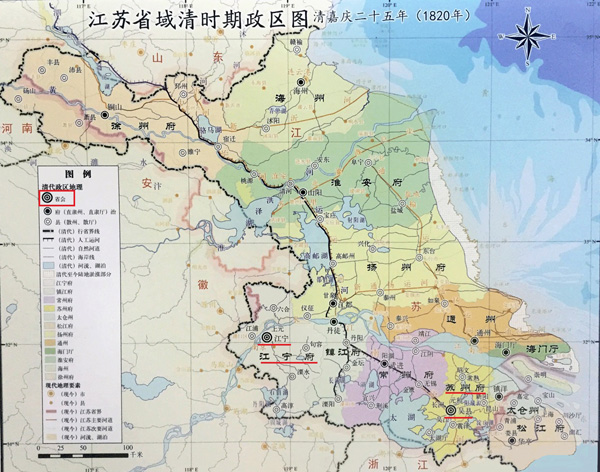
清嘉庆二十五年(1820年)八总督十五巡抚辖区图
管辖多省的总督往往选择与其中一省的巡抚同城而治,即所谓"督抚同城",如湖广总督与湖北巡抚同驻武昌府,闽浙总督与福建巡抚同驻福州府,仅有陕甘总督和两江总督例外。一般认为,清中期督抚取代布政使成为最高地方行政长官之后,巡抚所在地就是省城,如山东巡抚驻地济南府、江西巡抚驻地南昌府等;如一省范围内不单设巡抚的,则以总督驻地为省城,如四川总督驻地成都府、直隶总督驻地保定府;另陕甘总督本身兼职甘肃巡抚,驻地兰州府为甘肃省城。
"江苏"和"安徽"的由来
清朝本部十八省中的十七个省都可以根据督抚驻地推导出其唯一省城所在,但在江苏省总督和巡抚并存的情况下,两江总督所驻的江宁府却并非江苏巡抚所在,这无疑造就了清代督抚关系问题上的一个特例。为了进一步探寻这一特例,我们还须从江苏省的前身——江南省的分治说起。江南省原为明朝龙兴之地南直隶,主要包括今天的上海、江苏和安徽三省市,是一个地域广阔、政治显要、经济突出的地区,入清后仍保有对抗清廷中央的实力,因此分而治之乃是清廷羁束该地的重要手段。江南省的分立并不是一蹴而就的,也没有特别明确的标志性事件或时间点,而是当地各类官职上百年渐进式调整之后的结果。下表显示了清代江南省主要职官配置的变化:
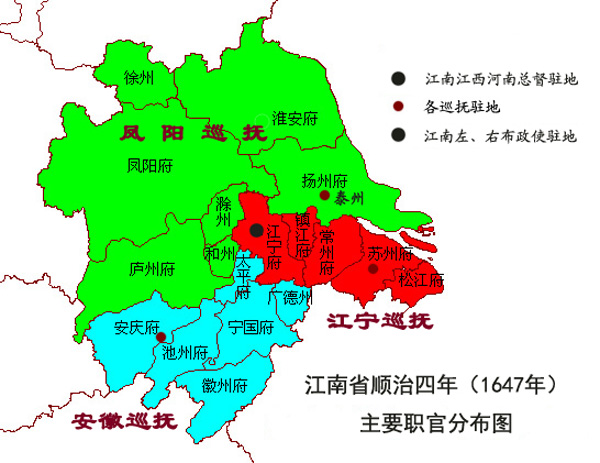
顺治二年(1645),清朝定鼎江南之后,在江南省设左、右两位布政使、一位总督及江宁、凤阳、安庐三巡抚分管地方政事。其中,江宁巡抚又名"苏松巡抚"、"江南巡抚",为江苏巡抚前身,因常驻苏州府,后又有"苏州巡抚"之名;凤阳巡抚则时立时废,立时因分管海防,故驻临海的扬州府属泰州;安庐巡抚中间也有过废立,后称"安徽巡抚",驻安庆府。江南省之上又设有总督一名,因多数时间辖区含江南、江西两省,常常被称作"江南江西总督",后又简称"两江总督"。在清朝初年布政使仍被视为一省之长的情况下,由于江南左、右布政使及两江总督均驻江宁府,江宁府成为当之无愧的江南省省城。
江南省顺治四年(1647年)主要职官分布图
一般认为,各省的左、右两位布政使是一正一副的关系,同治省城,共同管理全省政务。但在顺治十八年(1661年),江南省的布政使驻地也发生了变化:时任江宁巡抚的朱国治要求江南右布政使分驻苏州,使自己和右布政使的辖区(江、苏、松、常、镇五府)重合,以便指挥布政使督催粮款;左布政使仍寄治在江宁府,节制江南省剩下的府州,其辖区内仍有凤阳巡抚、安徽巡抚两位上级。此时,两员布政使管辖的区域面积差异非常悬殊。
江南省康熙二年(1663年)主要职官分布图
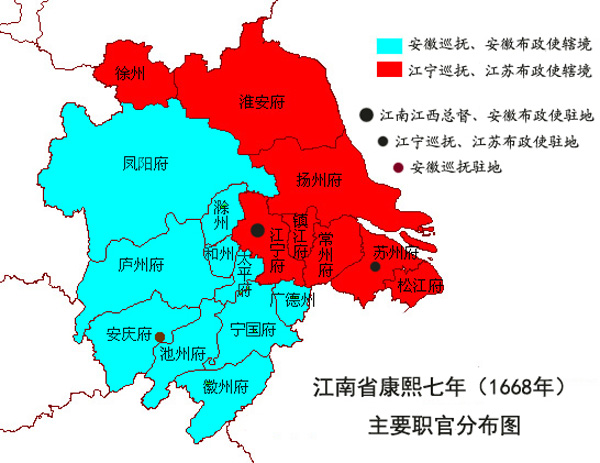
到了康熙四年(1665年),凤阳巡抚因职能与漕运总督重叠较多,终遭裁撤。根据时任江南江西总督的建议,同年十一月戊申(1666年1月1日),原属凤阳巡抚的庐州、凤阳两府,滁州、和州二州分隶安徽巡抚管理;淮安、扬州二府及徐州分隶江宁巡抚管理。之所以选择东西分割凤阳巡抚辖区,主要是考虑将淮安、扬州二府、徐州直隶州的黄河水利及漕运事务统归一位巡抚管理,与此无关的府州则划给安徽巡抚。由此至清朝末年,江宁(江苏)、安徽巡抚驻地和辖区未再变化,奠定了今天江苏和安徽两省的基本格局。考虑到行政便利等因素,巡抚手下重要属官——布政使的辖区也要随之进行调整,于是在康熙五年(1666),江南右布政使增领扬州、淮安二府及徐州。至此,江宁(江苏)巡抚与右布政使、安徽巡抚与左布政使的辖区已完全重合。翌年,清廷贯彻各省只保留一名布政使的方针,对于江南省这种左、右布政使已经分驻两地的既定事实,则只是依照驻地地名修改了布政使称谓,分别改称"江南江苏布政使司布政使" 及"江南安徽布政使司布政使",简称"江苏布政使"和"安徽布政使"。其中"江苏"二字分别取自江宁府和苏州府,"安徽"二字则来源于安庆府和徽州府的首字。可见,清廷在巡抚、布政使等职官改革的过程中,通过辖区和名称调整的方式,不断推动着江南省的分治,并以实际行动认可了巡抚地位高于布政使的事实。
然而,清廷在考量了两江总督施政的需要后,认为"督臣驻江宁, 而无藩(布政使)臬, 则制阃之体统不尊",决定安徽布政使继续寄治江宁府。所谓"寄治",指地方官驻地在其辖区以外,也就是说安徽布政使所驻的江宁府并不属安徽。中国当代的行政体系中,仍偶有寄治情况,如黄河水利委员会所驻的郑州主城区实属淮河流域。安徽布政使寄治江宁府有近百年的时间,再加上兼管安徽的两江总督也在此长期驻跸,于是乎从历史渊源看,当今诸多网友戏谑南京为"安徽省会"或"两省省会"也就不奇怪了。
江南省康熙七年(1668年)主要职官分布图
安徽布政使寄治江宁毕竟会带来施政上的诸多不便,以致后来出现了在总督外巡期间,江宁府发生典铺被焚案,安徽布政使想管却管不了的窘境。到了乾隆二十五年(1760),清廷命安徽布政使"回驻"安庆府,并基于江苏巡抚境内"钱谷殷繁、事宜众多"的实际情况,在江宁府增设布政使一员,以辅佐总督。次年二月正式定制,驻江宁者为"江南江淮扬徐海通等处承宣布政使司布政使",简称"江宁布政使",分管江宁及淮、扬、徐、通、海等处;驻苏州者为"江南苏松常镇太等处承宣布政使司布政使",简称"江苏布政使"或"苏州布政使",分管苏、松、常、镇、太等处。经过本次调整,安徽巡抚、安徽布政使驻地统一为安庆,安徽作为省级行政区得以进一步成型。但江苏的情况变得更为复杂,出现了两江总督、江宁布政使驻江宁府,江苏巡抚、江苏布政使驻苏州府的对峙格局。
江南省乾隆廿六年(1761年)主要职官分布图
康雍两朝的各类记载中,无论是中央文书,还是民间记述,基本仍视江苏、安徽为统一的江南省,可见人们并未将少数职官辖区或称谓的调整等同于"分省"。江宁府因两江总督驻跸之故,仍为江南省的唯一省城。由于江南省特殊的官僚配置,及一直共闱的江南乡试的长期存在,两个新省名取代老省名用了很长时间。直至清末,新老三个省名仍时有混用,甚至到清朝行将灭亡的宣统三年(1911),官方文献中仍有"江南省"这样的表述。不过总体而言,我们可以认为乾隆以后,特别是到19世纪,世人已逐渐接受了江苏、安徽分省的既定事实。
江苏泰兴一块清嘉庆八年的石碑仍有"江南扬州府泰州"字样。
按照总督、巡抚驻地皆可为省城的认同规律,安庆的安徽省城地位似没有异议,江苏省则因督抚分驻之故,理应有江宁和苏州两个省会。其实当时社会上已有了"双省会论",而支持该论调的人当中就包括乾隆皇帝。乾隆曾多次将"江南之江宁、苏州"并称为"省会",与其他省城并尊。还有些"有识之士",在称苏州为"江苏省城"或"苏州省城"的同时,另尊江宁为"江南省城"或"江宁省城",以示两者区别。
"大内斗省"的前世今生
从表面上看,乾隆年间江苏所形成的一总督、一巡抚、二布政使的特殊格局中,江苏布政使和江宁布政使均隶于江苏巡抚。江宁布政使所辖的江宁及江北各府州也在名义上也是江苏巡抚辖区。
江苏高邮一块清光绪三年的石碑仍将"江苏巡抚"视为本地重要官员。
不过,当初增设江宁布政使的一个重要目的,就是防止两江总督公出时,江宁省会落入无大员主持大局的尴尬境地,所以这位布政使实际发挥着总督副手的作用,并不接受江苏巡抚的直接领导。再者,总督虽名义上节制多省,实际则有偏袒所驻省份的畛域之见,往往过度插手驻地政务,而轻视兼管省份;兼领省份之巡抚,如安徽巡抚、江西巡抚等,又常常自行其是,不听总督节制。这不免诱导总督与所驻省份的巡抚"抢地盘",因而"督抚同城"的省会,如武昌府等尤是纷争不断。两江总督和江苏巡抚分驻江宁、苏州,虽不存在"同城之争",但却在相互间的权力斗争中实现了"划江而治"。具体而言,江宁布政使所辖的江、淮、扬、徐四府,通、海二州及海门厅成了两江总督的直辖地;江苏巡抚的"实控区"龟缩至他的属官——江苏布政使所辖的江南四府一州。
江南省嘉庆廿五年(1820年)主要官员实控区示意图
江苏这种"划江而治"的格局贯穿了整个清中后期。这一格局无形中强化了江宁和苏州各自的省会地位,但也不可避免地削弱了江苏各地的"省籍认同"。举例来讲,较之"遥不可及"的苏州巡抚,江北各府州显然更亲近江宁省城,地方志和碑文也倾向于自称"江南"属地,而不乐以"江苏"冠之;同样,江南人民也对江北府州无感。不仅如此,漕运总督、南河总督、盐运使、学政和提督等官员也分驻江苏境内的不同府县,进一步削弱了省内认同。省籍认同的淡薄,也为光绪年间"苏淮分省"埋下了伏笔。由于新设的江淮省触动各方利益太多,特别是漕运总督摇身变为江淮巡抚后,剥夺两江总督直辖地,直接架空其权力,抗议之声自不绝于耳,故该省仅存三月即遭到废止,江苏南北重归统一。
1905年江淮分省形势图
时至今日,江苏省内居民相互认同度仍较低,更被广大网民戏称为"大内斗省",这与清代江苏督抚分驻、官员林立的历史传统可谓不无关系。

参考文献:
姜涛:《清代江南省分治问题——立足于〈清实录〉的考察》,《清史研究》,2009年02期。
段伟:《泛指与特指:明清时期的江南与江南省》,《历史地理》第二十三辑。

Evernote helps you remember everything and get organized effortlessly. Download Evernote.

Why the Best Writing Advice Is Often the Weirdest

  Why the Best Writing Advice Is Often the Weirdest “Three six five,” a new collection of writing exercises, belongs to a venerable traditio...