Sunday, August 23, 2015

Life out loud

Life out loud

As a public intellectual, Gore Vidal was snobbish and hypersensitive, but so eloquent

Aug 22nd 2015 | From the print edition
Fine views

Empire of Self: A Life of Gore Vidal. By Jay Parini. Penguin Random House; 480 pages; $35. Published in the UK as "Every Time A Friend Succeeds Something Inside Me Dies: The Life of Gore Vidal". Little, Brown; £25.

"NEVER lose an opportunity to have sex or be on television" is a familiar Gore Vidal quip—and, as Jay Parini notes in a marvellous new biography, Vidal enthusiastically followed his own advice. The sex was almost always homosexual; invariably "on top"; and usually in the afternoon, to allow for disciplined writing in the morning and extravagant socialising in the evening. For Vidal, television meant a show of eloquent punditry projected on both sides of the Atlantic, but most memorably—as any trawl through YouTube will confirm—in the form of confrontations on American chat shows with William Buckley, editor of the conservative National Review, and with a pugnacious fellow writer, Norman Mailer.

In this section

Vidal died in 2012 at the age of 86. He wrote so many novels, screenplays, television shows, literary commentaries and essays that he ought to defy pigeonholing. Yet that prolific versatility is precisely the reason that often he is dismissed as a social-climbing, publicity-seeking gadfly when, in his own view, he was a groundbreaking novelist superior to contemporaries such as John Updike. Vidal was always ready to give criticism but loth to take it—and was especially angered by the New York Times, which primly refused to review "The City and the Pillar", his bestselling exploration of gay life in America that was published in 1948.

Given Vidal's sensitivity to any slight, real or imagined, Mr Parini wisely declined an offer that he write his story during his lifetime. The wait has allowed the author, whose friendship with Vidal began in the 1980s, to produce a portrait that is both affectionate and balanced. Vidal, knowing everyone who was anyone (from Princess Margaret to Rudolf Nureyev), was certainly a snob. He was also delighted to be rich, having as a young man not known "where the next bottle of champagne might come from," Mr Parini writes. It mattered immensely to Vidal that he could live well, whether in huge homes in America and Italy or in comfortable suites at the best hotels in London, Paris and Bangkok.

Yet Mr Parini's Gore Vidal is a man hiding his shyness with a mask of suave sophistication and with viper-like scorn for his enemies (he called Buckley a "crypto-Nazi" in one TV clash, and said Truman Capote's death was "a wise career move"). Though Vidal accused Buckley of being a "closet queen", this was not the retort of a militant homosexual: Vidal, a "pansexual", always saw "homosexual" and "heterosexual" as adjectives, not nouns.

History, as Mr Parini points out, will give its verdict on Vidal the novelist. What is already beyond doubt, though, is Vidal's importance as a "public intellectual" with a wonderfully contrarian instinct. For Vidal, who failed twice to win elected office and follow in the footsteps of his politician grandfather, his country was "the United States of Amnesia" and there were no longer two political parties: Republicans and Democrats were wings of the "Property Party". Vidal's sympathy for Timothy McVeigh, responsible for the Oklahoma City bombing in 1995, may be hard to accept, but far fewer eyebrows will today be raised by his opposition to the Vietnam war (hence the clashes with Buckley), his scorn for Presidents Reagan and George W. Bush, his hostility to American policy in the Middle East, or even his view that America is an empire always in search of an enemy (following the demise of the Soviet Union, "one billion Muslims and the Arabs in particular" would, he said, "make a fine new evil empire to oppose").

The obvious parallel is with Noam Chomsky—and in September 1991 Mr Parini brought both Mr Chomsky and Vidal together for a television interview. Asked what motivated them, Mr Chomsky replied: "Looking in the mirror in the morning and not being appalled." Vidal, as so often with words, went one better: "For me, it's looking out of the window and not being appalled."

Evernote helps you remember everything and get organized effortlessly. Download Evernote.

Friday, August 14, 2015

L’héritage de la pensée de 68 est-il épuisé ?

L'héritage de la pensée de 68 est-il épuisé ?

Le Monde | 28.07.2015 à 11h53 • Mis à jour le 28.07.2015 à 15h55

Dans quelles conditions avez-vous rencontré ce que l'on appelle « la pensée 68 » ?

Elisabeth Roudinesco : En 1966 paraissaient simultanément Les Mots et les Choses de Michel Foucault et les Ecrits de Jacques Lacan, une avant-garde littéraire et théorique qui proposait une nouvelle lecture de l'histoire à partir des structures. Il y avait quelque chose de novateur et d'équivalent à ce qu'on avait connu en 1945 avec Jean-Paul Sartre : un nouvel engagement. Mais avant d'être politique, celui-ci a d'abord été universitaire, à travers une nouvelle manière d'enseigner. A l'époque, j'étais en licence de lettres à la Sorbonne, or ce secteur était épouvantablement figé dans son académisme. Les professeurs de lettres considéraient que la modernité s'arrêtait à la fin du 19ème siècle. Les étudiants qui, comme moi, lisaient le Nouveau roman et découvraient des approches inédites comme celle de Michel Foucault ou Roland Barthes, étaient en révolte contre ce type d'enseignement poussiéreux. Impossible de prononcer le mot de « Nouveau roman » en classe. Et nous n'étudions même pas Marcel Proust à l'université ! Dès l'année 1967-1968, à la Sorbonne, un sentiment de supériorité des élèves par rapport aux enseignants était né, surtout envers les professeurs de linguistique, qui méprisaient Roman Jakobson ou Claude Lévi-Strauss, alors que nous les admirions. Paradoxalement, nous cherchions de bons maîtres, de vrais maîtres, pas des professeurs à polycopiés qui répétaient sans arrêt le même cours.

Cela dit, la pensée 68 n'existe pas, il s'agit d'une construction après coup. Avec Les mots et les Choses de Michel Foucault, j'ai découvert un auteur à la fois philosophe, historien et écrivain. Il avait un style, quelque chose qui avait un sens. C'était magnifiquement écrit. A l'époque, je lisais également les hellénistes, comme Jean-Pierre Vernant et Pierre Vidal-Naquet. Mais j'avais parfaitement conscience que tous ces auteurs ne se ressemblaient pas, qu'ils avaient des conflits théoriques entre eux. C'était ce qui me plaisait, cette possibilité de faire naître le débat. Pour moi, Mai 68 a été avant tout l'occasion avant de destituer les mauvais professeurs.

Marcel Gauchet : Elisabeth Roudinesco a bien rappelé la dimension universitaire de Mai 68 qui fut aussi une révolte intellectuelle contre des universités complètement fossilisées et décalées par rapport à une scène intellectuelle d'une productivité prodigieuse. Quoique j'aie pu penser de cette galaxie d'auteurs par la suite, ils m'ont fait entrer dans la vie intellectuelle sous le signe de l'enthousiasme. 1966, c'est la date de la percée de la réflexion structuraliste. Elle avait été amorcée de longue date par Lévi-Strauss, mais elle prend à ce moment-là sa force de programme, avec la relance de la psychanalyse par Lacan et la reprise du modèle linguistique par la théorie littéraire, sans parler de l'éclatante nébuleuse philosophique qui gravite autour.

Comme beaucoup d'autres, j'ai eu le sentiment d'assister à l'émergence d'une théorie unifiée des sciences humaines. On avait l'impression que l'on pouvait réunir une théorie du sujet individuel renouvelée par la psychanalyse, une théorie renouvelée de la société à travers le structuralisme lévi-straussien, le tout appuyé sur une science de la production humaine la plus spécifique : le langage. Face à ce monde qui s'ouvrait, l'université officielle faisait figure d'institution sclérosée et dépassée. Mai 68 a été un mouvement placé sous le signe d'un extraordinaire appétit de savoir. Des relais de toutes espèces ont fonctionné pour donner à cet élan théorique une répercussion des plus larges, puisque le mouvement était animé par un esprit ultra-démocratique.

Mêmes éblouissements théoriques, mais importantes divergences politiques. Pour quelle raisons ?

Marcel Gauchet : Là où je me distingue d'Elisabeth Roudinesco, c'est sur le plan politique. Dans tous les auteurs qui ont été cités, il y en a un que j'ai d'abord lu avec intérêt pour vite constater ses limites, c'est Louis Althusser. La grande division politique de l'époque, parmi ceux qui se réclamaient de l'avant-garde intellectuelle, passait entre le communisme, majoritaire, et l'ultragauche, minoritaire. Le hasard des rencontres m'a fait bénéficier de l'héritage de Socialisme ou barbarie, le groupe de Cornelius Castoriadis et de Claude Lefort. De fait, il y a eu deux Mai 68. Un premier politiquement léniniste, qu'il soit communiste, trotskiste ou maoïste, et un second plus difficile à étiqueter mais qu'on peut dire libertaire, avec ses nuances spontanéistes, anarchiste ou ultragauchiste, aux côtés duquel je me situais.

Elisabeth Roudinesco : Quand j'entre au parti communiste, il est déja en voie de déstalinisation. Aragon, par exemple, avait déjà tout critiqué de l intérieur tout en restant membre du parti, tout comme Althusser. Le parti communiste, c'était pour moi l'héritage de la Révolution d'octobre et du Front populaire, de la Révolution française, de tout ce que j'aimais dans l'histoire. En plus, le parti s'ouvrait à des débats sur le structuralisme, à une critique de l'université, notamment avec les colloques de De la Revue La Nouvelle Critique a l'abbaye de Cluny où l on parlait de Jacques Derrida ou Michel Foucault. Le parti s'avançait progressivement vers la signature du programme commun. Paradoxalement, Althusser prônait un retour du léninisme, une nouvelle lecture du marxisme, mais défendait le contraire dans certains de ses écrits . Pourtant, politiquement, le parti était déjà social-démocrate et je pense que cela explique ensuite la rupture avec l'union de la gauche, qui est évidemment une reprise en main du parti. Cela dit, le mot « totalitarisme » n'existait pas dans notre vocabulaire, on parlait de l'échec du communiste. J'ai lu Hannah Arendt très tard, et c'est elle qui m'a fait comprendre ce qu'il était.

Marcel Gauchet : C'est sur ce terme que nous avons divergé existentiellement et intellectuellement, parce que le mot totalitarisme a été pour moi central. Ma question décisive a été celle de la nature des régimes nés du mouvement communiste léniniste. C'est autour de cela que tout mon itinéraire intellectuel a basculé. A l'époque, je ne voyais pas le Parti communiste en déstalinisation mais bien en déconstruction. Le problème qui m'a saisi et qui est devenu le moteur de mon parcours personnel, est celui de l'échec du marxisme à rendre compte des régimes qui se réclamaient d'une inspiration marxiste. J'en suis arrivé très vite à l'idée que la question essentielle était d'élaborer une pensée de l'histoire qui permettrait d'échapper aux impasses du marxisme, en particulier dans son appréciation de la démocratie dite « bourgeoise ». C'est cette question qui m'a séparé de la pensée 68, inutilisable pour ce faire.

A gauche, certains soutiennent que la pensée des sixties a finalement accompagné et justifié celle du néocapitalisme contemporain. Et à droite, on pense que mai 68 est la cause de la déconstruction de la hiérarchie, de l'autorité, de la famille et de l'école, en un mot de la destitution, voire de la destruction de la grandeur de la France. Qu'est-il arrivé à la société française pour qu'elle critique à ce point la pensée 68 ?

Marcel Gauchet : Mai 68 a été un échec politique qui n'a pas eu d'immédiates conséquences pratiques. Il faut rappeler que la gauche est écrasée aux élections de 1969, consécutives au départ du général de Gaulle. L'échec politique s'accompagne cependant d'une formidable réussite culturelle et sociétale. L'esprit de 68 a pénétré et transformé la société française. L'événement démultiplicateur a été la crise de 1974, consécutive au choc pétrolier de l'automne 1973. La mondialisation commence : changement de monde, changement de capitalisme, changement de la société sous le signe de l'individualisation. La politique révolutionnaire est balayée, mais en revanche, la sensibilité libérale-libertaire devient dominante. Ce n'est pas qu'une évolution française, c'est un mouvement général qui touche l'ensemble des sociétés occidentales. C'est ce que ne voit pas une critique de droite comme celle d'Eric Zemmour. Il fait comme si tout sortait de 1968 alors que la transformation est globale. Mai 68 n'a été finalement que la version française de l'entrée dans cette mutation qui a bouleversé à la fois l'économie, les rapports sociaux et les institutions, à commencer par la famille.

Il y a en ce moment un trouble intéressant et révélateur autour du fameux cours de 1979 de Michel Foucault sur la biopolitique. Il permet de saisir sur le vif comment un esprit particulièrement agile accompagne ces transformations. Même les disciples les plus zélés de Foucault sont amenés à le reconnaître, non sans embarras, il se sent en affinité avec le tournant néolibéral en train de se produire. Le cours est exactement contemporain, en effet, de l'élection de Margaret Thatcher en Grande-Bretagne qui précédera de peu celle de Ronald Reagan aux Etats-Unis. Le fait en lui-même ne me gêne pas. Ce que je lui reproche ainsi qu'à ses pairs, c'est de ne pas avoir saisi la portée de ce qui était en train de se produire dans ses aspects positifs et négatifs. C'est justement la grande infirmité de l'équipement intellectuel fourni par cette pensée 68 : elle ne permet pas d'affronter cette nouvelle réalité.

Elisabeth Roudinesco : Ce qu'apportait Foucault, Derrida et toute cette pensée dite 68, c'était l'idée que l'on pouvait critiquer le système communiste par des théories de la subjectivité. Pour moi, elles permettaient au contraire de penser le tournant de la mondialisation, en cherchant une subjectivité qui ne soit pas complice de la domination de l'Etat. Et puis j'étais mondialiste, je ne pouvais pas ne pas être l'être puisque j'étais internationaliste. Le communisme avait apporté l'idée de mondialité avec la révolution. C'était la fin des frontières, de l'Etat nation… J'étais profondément européenne, c'est pour cela que l'idée d'eurocommunisme m'a séduite. L'échec était évident. Jusqu'à Mikhaïl Gorbatchev, j'ai vraiment espéré que les partis communistes allaient se transformer en partis socio-démocrates avec des débats très vifs sur la pensée.

Mais cette pensée 68 n'est-elle pas devenue à son tour nouvel académisme ?

Elisabeth Roudinesco : Plus une pensée est forte, plus elle produit de dogmes et plus il faut les critiquer. Derrida disait que la meilleure façon d'être fidèle à un héritage c'est d'y être infidèle. Je me sentais une infidèle permanente, je ne pouvais pas admettre qu'on me transmette des dogmes, comme ceux du lacanisme notamment. Quand une pensée est si forte, elle produit des épigones, des répétiteurs, des imitateurs, mais cela ne me dérangeait pas. Il fallait les critiquer à partir de cet héritage, mais en étant infidèle.

Prenons deux auteurs dont la postérité politique et universitaire est manifeste, Michel Foucault et Pierre Bourdieu. Leurs pensées sont encore fécondes ou conduisent-elles à des impasses ?

Marcel Gauchet : Le succès des concepts de « rhizome », de « machines désirantes », de « réseaux », de « micropouvoir » ou de « biopouvoir » est très compréhensible. Ces notions et les pensées qui les portent épousent parfaitement le mouvement de nos sociétés. Mais est-ce qu'elles permettent de le comprendre et de l'analyser ? Je ne le crois pas. La pensée foucaldienne fournit une traduction théorique efficace de la sensibilité libertaire qui est le fond de l'air de nos sociétés individualistes. Mais est-ce que les micro-pouvoirs et la gouvernementalité rendent compte de ce qui se passe dans nos sociétés ? Je pense que non.

La sociologie de Bourdieu est considérable et solidement articulée, mais tout aussi peu en prise sur le fonctionnement effectif de notre monde. Sur le cas de l'école par exemple, sa philosophie de la reproduction propose une vision de la domination et de son incorporation au travers d'habitus qui passe à côté du rôle de l'école dans nos sociétés et des problèmes aigus que cette institution rencontre dans le contexte actuel. Le rôle de l'école se réduit-il à la reproduction ? Il y a lieu d'en douter. Ce n'est pas un débat académique : cette critique a fait des dégâts terribles.

Les Héritiers présentait un certain type de culture littéraire comme l'instrument d'une connivence de classe. Pour une fois, la critique a été entendue. Elle a conduit à la mise au pouvoir des mathématiques comme un instrument légitime de classement des esprits. Parce que les mathématiques font appel à la simple logique du raisonnement, elles sont supposées être neutres socialement et n'impliquer aucune connivence culturelle de classe. L'expérience nous a montré exactement le contraire. Les mathématiques sont un instrument de sélection sociale encore plus impitoyable que la culture humaniste. Les problèmes qu'affronte le système scolaire aujourd'hui sont essentiellement le fruit de l'individualisation de la société, celle des familles et celle des élèves, phénomène devant lequel la théorie de Bourdieu nous laisse désarmés. Bref, on est devant une grille d'analyse inopérante. Elle a eu des vertus, mais quand elle devient une manière de dogme, c'est un désastre et il faut reprendre les choses sur de nouvelles bases.

Elisabeth Roudinesco : J'aimais bien chez Pierre Bourdieu la contradiction permanente entre ce qu'il disait et ce qu'il était. Il avait des problèmes avec son origine sociale et la psychanalyse. Reconnaissons tout de même qu'il redécouvrait la « misère du monde », à l'heure où plus personne n'essayait de comprendre le peuple, au moment où une contre-révolution intellectuelle se produisait. En revanche, il n'a pas pensé les questions sociétales en termes d individualités ou de subjectivité, cela ne l'intéressait pas, alors que Foucault et Derrida s'en sont fortement préoccupés. Ma génération a été saisie par les questions d'émancipation individuelle, c'est notamment pour cela que la question de l'homosexualité était capitale. Elle permettait de penser la famille et ses évolutions. Les revendications individualistes me paraissaient être l'aboutissement de la théorie de la subjectivité, telle que Sigmund Freud l'avait apporté. La politique prenait la forme de l'émancipation individuelle. Il est évident que le féminisme s'effondrait parce qu'il devenait trop dogmatique, tout comme la majorité des idéaux des émancipations. Mais le droit des minorités était et demeure un combat.

Assistons-nous à un contre-mouvement de mai 68 dans la France contemporaine, notamment incarnée par la Manif pour tous ?

Elisabeth Roudinesco : On assiste à un mouvement de droitisation radicale. Avec la montée du populisme, le peuple va aujourd'hui davantage vers Marine Le Pen que vers l'extrême gauche. Quand aux manifestations de la Manif pour tous, elles ne ressemblent en rien à mai 68, elles ne reprennent en rien l'esthétisme de mai 68. Il y avait quelque chose d'extrêmement festif et d'esthétique dans les manifestations de mai 68, il a eu de grandes beautés de langage, que je n'ai absolument pas retrouvées dans la Manif pour tous avec ces espèces de monarchistes aux slogans ridicules, homophobes et parfois racistes. Je n'avais jamais vu auparavant des enfants en bas âge dans des poussettes agiter des drapeaux lors des manifestations. Je me demande ce que vont penser ces enfants lorsqu'ils verront qu'ils ont été objet de telles manipulations.

Marcel Gauchet : Mai 68 est devenu à droite un repoussoir absurde qui cache aux gens qui en font une cible les véritables ressorts de l'immense transformation dans laquelle nous sommes tous pris et dont ils participent malgré eux. Le grand problème de la gauche, face à ces évolutions, est qu'elle n'en a aucune analyse qui tienne. Du coup, elle accompagne le mouvement sans le comprendre, tantôt complice, tantôt hostile, en essayant de remédier à ses effets les plus destructeurs du côté de son aile réformiste, ou en se réfugiant dans une protestation incantatoire du côté de son aile radicale. Elle n'a plus de projet de transformation sociale. Le choix, aujourd'hui, est entre une indignation impuissante et la reconstruction d'une grille de lecture de l'histoire en train de se faire en mesure de nous redonner une prise sur la conduite de nos sociétés.

Elisabeth Roudinesco: Attention à l'excès de lucidité critique. Je pense que l'indignation gronde et finira par mener à quelque chose. Bien sûr, cela peut aussi mener au pire, cela peut déboucher sur du fascisme ou du néopopulisme, mais cela ne doit pas nous conduire à l'inaction. Faire de l'histoire rend raisonnable. Mais cette petite flamme qui existe en moi depuis mai 68 demeure. Et quand un mouvement se déclenche, je pense qu'il faut être dans l'événement. On vit dans une époque de capitalisme fou avec pour seul horizon des chiffres. Il faut repolitiser la vie politique et arrêter de parler de l'économie tous les matins, ce n'est pas le seul déterminant. Je ne supporte pas le vocabulaire des experts qui s'est installé partout. Les grands moments peuvent revenir ce qui ne doit pas nous empêcher d agir quotidiennement.

Marcel Gauchet : Je suis sensible à cette imprévisibilité dont vous parlez, mais je pense qu'on peut se donner les moyens de l'accueillir. Pour avoir suivi de près les évolutions de la famille et la libération homosexuelle depuis Mai 68, par exemple, il me semble qu'on pouvait anticiper une demande de redéfinition juridique des rapports dont la nature avait complètement changé sur un plan privé. Nous ne sommes probablement pas au bout de ce mouvement. Ce que l'on tenait pour des invariants anthropologiques pourrait ne pas résister. On peut envisager que l'inceste soit remis en question dans nos sociétés comme tabou absolu. A partir du moment où vous défendez une pure philosophie des individus de droit, la reconnaissance mutuelle sous le signe de l'amour échappe à toute régulation sociale. Je ne dis pas que cela se produira, je dis que c'est dans la logique du mouvement actuel.

Je ne m'indigne pas contre l'indignation. J'en constate les limites et je ne crois pas au surgissement spontané des solutions. Nous devons nous donner les moyens intellectuels de comprendre le mouvement de nos sociétés. Sans quoi nous sommes condamnés à le subir. Nous avons au moins appris qu'il n'y a pas de grand soir à attendre.


Elisabeth Roudinesco est historienne, enseignante associée au département d'histoire de Paris VII-Diderot, chargée d'un séminaire d'histoire de la psychanalyse (ENS-GHSS). Elle a notamment publié « Philosophes dans la tourmente » (Fayard, 2005), « La Part obscure de nous-mêmes. Une histoire des pervers » (Albin Michel, 2007) ; « Histoire de la psychanalyse en France », t. 1 et 2 (1982-86) ; « Jacques Lacan.Esquisse d'une vie, histoire d'un système de pensée » (1993) ; « Lacan envers et contre tout » (Seuil, 2011) et « Sigmund Freud en son temps et dans le nôtre » (Seuil, 2014)


Marcel Gauchet est historien et philosophe, directeur d'études à l'Ecole des hautes études en sciences sociales, au Centre de recherches politiques Raymond Aron et rédacteur en chef de la revue Le Débat (Gallimard), qu'il a fondée avec Pierre Nora en 1980. Il a notamment publié La Condition historique (Stock, 2003) ; Que faire ? Dialogue sur le communisme, le capitalisme et l'avenir de la démocratie, avec Alain Badiou (Philo, 2014) ; L'Avènement de la démocratie, t. 1, La Révolution moderne, t. 2, La Crise du libéralisme (Gallimard, 2007) ; L'Avènement de la démocratie, t. 3, A l'épreuve des totalitarismes, 1914-1974 (Gallimard, 2010).

Evernote helps you remember everything and get organized effortlessly. Download Evernote.

Wednesday, August 12, 2015

Reading Tony Judt in Wartime Ukraine

Reading Tony Judt in Wartime Ukraine

By

The Maidan was the return of metaphysics. It was a precarious moment of moral clarity, an impassioned protest against rule by gangsters, against what in Russian is called proizvol: arbitrariness and tyranny. The Maidan was the return of metaphysics. It was a precarious moment of moral clarity, an impassioned protest against rule by gangsters, against what in Russian is called proizvol: arbitrariness and tyranny. Credit PHOTOGRAPH BY DAVIDE MONTELEONE / VII

Five years ago, a Ukrainian graduate student in history, Mykola Balaban, came across Tony Judt's monumental "Postwar: A History of Europe Since 1945." The book, a breathtaking synthesis of all of Europe—art and war, people and ideas, East and West—in the second half of the twentieth century, is nine hundred and sixty pages long. (Its author, a longtime professor at New York University who never muted his sharp British irony, was a friend of mine.) "I read it almost in one breath," Mykola told me.

Mykola was in the process of conceiving a dissertation proposal: a micro-history of Lviv between June 22nd and July 5th, 1941. These were the first two weeks following Nazi Germany's attack on the Soviet Union; in Lviv, it was a time of anarchy between the retreat of the Red Army and the arrival of the Wehrmacht. Ordinary people looted shops; the N.K.V.D. shot prisoners; nationalists declared Ukrainian independence; Hitler's Einsatzgruppen executed university professors, mostly Poles; Ukrainians murdered Jews. This would not be a popular topic in Ukraine. Mykola was taken with the fearlessness of the author of "Postwar," with Tony's willingness to disregard academic fashion, "to go against the current." Mykola also found in Tony's work a way of understanding Eastern Europe in the context of Europe as a whole, a way of thinking that "precluded the orientalizing of oneself."

Mykola completed part of his graduate studies in Poland, together with his friend Bohdan Solchanyk, another history student from Lviv. In the evenings, they would drink Spanish wine and eat French cheese in the kitchen of the University of Warsaw's student dormitory. They talked about history: about the Soviet Union in comparison to other socialist countries, about the crimes of Stalinism, about the New Left. One night they came up with the idea of organizing a series of discussions about Tony Judt's work.

Then came the Maidan. On November 21, 2013, the Ukrainian president, Viktor Yanukovych, unexpectedly declined to sign an association agreement with the European Union, a reversal of his own stated foreign policy. Around 8 P.M. on that day, a thirty-two-year-old Afghan-Ukrainian journalist, Mustafa Nayyem, posted a note on his Facebook page: "Come on, let's get serious. Who is ready to go out to the Maidan"—Kiev's central square—"by midnight tonight? 'Likes' don't count."

As autumn ended and the winter began, the government's violence against the protesters on the Maidan increased. Yanukovych's riot police were using water cannons in sub-freezing temperatures. Protestors were disappearing, their bodies sometimes found frozen in the forest, signs of torture on the corpses. On Tuesday, February 18, 2014, Yanukovych's riot police started to use live ammunition. Mykola, having spent two weeks on the Maidan, had just then returned home to Lviv to recuperate. In Lviv, he saw Bohdan, who said nothing to him about his intention to go to Kiev that night.

On Thursday, February 20th, another friend found Bohdan's body amidst a pile of corpses in front of a McDonald's. A government sniper had shot the young historian to death. The friend who found Bohdan's body saw that Bohdan's fiancée, Marichka, had called his cell phone seventeen times.

Three months after the massacre on the Maidan, many of Tony Judt's friends and colleagues on both sides of the Atlantic went to Kiev to meet with one another and support the revolution that had begun with Mustafa Nayyem's Facebook post. The effort reflected Tony's insistence on the historian's moral responsibility not only to understand, but also to engage.

The congress was the idea of Leon Wieseltier, whose friendship with Tony ended in 2003, when Tony published "Israel: The Alternative" in The New York Review of Books. In that essay, Tony made a merciless argument: it was contradictory to wish for both a Jewish state and a democracy. His anti-Zionism resembled the anti-communism of Arthur Koestler: a passion that comes from having once been on the inside. After the essay appeared, Leon did not speak to him for years. In August, 2010, Tony died of amyotrophic lateral sclerosis. If Tony were here, Leon told Timothy Snyder, my husband, as they were organizing the Kiev congress, he would have been the first person Leon would have asked to come.

In his opening address in Kiev, Tim evoked "the tradition of Tony Judt, the great historian of Europe of his era, who understood that the West made no sense without the East, and politics no sense without ideas." Tony had come to ideas early, and Eastern Europe much later. Marxism, he once told me, had been the air he had breathed as a child from an Eastern European Jewish immigrant family growing up in postwar Britain. Later, as a Cambridge student, he was among thousands who gathered in Paris in May, 1968, "jump[ing] up and down quite so enthusiastically at the demonstrations as we shouted Ho, Ho, Ho Chi Minh."

Only with time did Tony come to see that, in 1968, history was being made much less in Paris than it was in Warsaw and Prague. He came to understand this through friendships with several of the brightest among his Polish contemporaries, who, precisely at that moment when Tony was jumping up and down shouting "Ho, Ho, Ho Chi Minh," were sitting in communist prison.

"Past Imperfect: French Intellectuals, 1944–1956 ," an excoriating attack on Jean-Paul Sartre, Maurice Merleau-Ponty, and other French philosophers turned Stalinist apologists, is Tony's settling of accounts with himself in that context. For a long time, Sartre was the closest thing European intellectuals had to God; from Tony's point of view, this was why Sartre bore so much responsibility. Sartre's "notable silence," writes Tony, was his silence in the face of "the blood of others"—those tortured and executed during the postwar Stalinist terror in Eastern Europe. The West, Sartre and his friends believed, could not criticize communism because Western intellectuals were distorted by bourgeois capitalist thinking. "Nothing in Sartre's other achievements comes close to me to compensating for his refusal to intervene or even speak out when faced with the show trials in central Europe," Tony insisted to me, nearly two decades after he had written "Past Imperfect."

"We are unwise to laugh too quickly at those who describe the world as a conflict between good and evil," Tony said, in a lecture in 2003. "If you can't use the word 'evil,' you have a real problem thinking about what happened in the world." In February, 2014, the Polish philosopher Marcin Król told an interviewer that Europeans were facing a serious political crisis and a potentially fatal spiritual crisis: they had ceased asking themselves metaphysical questions, questions like "Where does evil come from?" As Król's friend Adam Michnik, the Polish writer and dissident, once said to Václav Havel, "This is a civilization that needs metaphysics."

The Maidan was the return of metaphysics. It was a precarious moment of moral clarity, an impassioned protest against rule by gangsters, against what in Russian is called proizvol: arbitrariness and tyranny. It united Russian-speakers and Ukrainian-speakers, workers and intellectuals, Ukrainians and Jews, parents and children, left and right. The Ukrainian historian Yaroslav Hrytsak, an adviser to both Mykola and Bohdan, described the Maidan as akin to Noah's Ark: it took "two of every kind." For Yaroslav, the wonder of the Maidan was the creation of a truly civic nation, the overcoming of preoccupations with identity in favor of thinking about values. People came to the Maidan to feel like human beings, Yaroslav explained. The feeling of solidarity, he said—it cannot be described.

Two days after Bohdan Solchanyk was shot to death by a sniper, President Yanukovych fled Ukraine. Yet the victory of the Maidan could barely be celebrated: there was not a moment to take a breath before Vladimir Putin sent the Russian Army and Navy to Ukraine's Crimean peninsula. Mykola, who could not forgive himself for not having gone back to the Maidan on February 19th with Bohdan, volunteered for the Ukrainian Army. He was sent to Debal'tseve in Donetsk oblast; he took with him "Thinking the Twentieth Century," a book of conversations between Tony and my husband, Tim. After some time there, Mykola was selected for military intelligence and transferred to a secret location closer to Kiev. (When the war was over, Mykola said, he would be able to talk to me about where he had been and what he had been doing there. The war is not yet over.)

Mykola had already left for the front when Yaroslav shared with him his idea of organizing a graduate seminar called "Reading Tony Judt." Mykola was enthusiastic; it was the same idea he and Bohdan had had before the revolution. He wanted to take part—even if it had to be from afar.

This past March, Yaroslav's graduate students were assigned "Thinking the Twentieth Century," "Israel: An Alternative," and "Past Imperfect." Yaroslav asked me if I would Skype in for these discussions. And so this spring, from my office at Yale, I saw Mykola in uniform on my computer screen, the unmarked walls of a Soviet-built bunker in the background. He had Skyped in as well, from the undisclosed location, and he appeared on one half of my screen; Yaroslav, together with Mykolas's classmates, appeared on the other half. One of the graduate students was Bohdan Solchanyk's fiancée, Marichka.

Another of the students was Yevhenii Monastyrskyi, from Luhansk, who—Mykola told me—knew Soviet dissident literature extraordinarily well. They had met a few years earlier at a conference on the Holocaust. In Luhansk, Yevhenii had been captured by the separatists. Most likely he was tortured; although Yevhenii says little about his time in captivity—other than that he believes that the Russian soldier felt genuinely sorry afterwards for what he had done, when he understood that his prisoner was only a student, and not a spy. (In Dnipropetrovsk, this June, I spoke to the ecologist Pavlo Khazan, who founded an N.G.O. to support Ukrainian soldiers fighting in the Donbas. Among the organization's main activities is negotiating hostage exchanges with the separatists. Many of the hostages whose return he and his colleagues have negotiated had been tortured, Khazan told me.) After Yevhenii's release, Mykola found him and arranged with Yaroslav for Yevhenii to transfer to the Ukrainian Catholic University, in Lviv.

Yaroslav's students read Tony's books in English and discussed them in Ukrainian. When I joined them, some of them spoke to me in English, some in Polish, some, like Mykola, in both languages. Posing a question in one language and listening to the response in another is quite ordinary in Ukraine, where a casual multilingualism is the norm. Vladyslava Moskalets, who knows Hebrew and Yiddish and Polish and English as well as Ukrainian, is writing a dissertation about Jewish businessmen working in Galician oil fields. For Vladyslava, as for Mykola, Tony's books are a model of how to be provocative without playing games. "I was attracted by his irony, his ability to keep balance, and especially by his honesty and courage," she told me, "which seem to be something rare and even noble in the modern world."

"The materialistic and selfish quality of contemporary life is not inherent in the human condition," Tony insisted in "Ill Fares the Land," the manifesto of social democracy he wrote while he was dying. "We cannot go on living like this." For Mykola, Tony's "Ill Fares the Land" is "a guide for a young person." Such guidance means a great deal to Ukrainians like Vladyslava and Mykola and Oleh Hrynchuk, who are struggling to find a balance between condemning communist crimes and believing in some of the ideals of socialism. Oleh, like Mykola and Bohdan, studied in Warsaw, where he discovered "Past Imperfect" in Polish translation. For him, Tony's work represents "a school of responsibility and solidarity," a "resistan[ce] to the illusions of our daily life," and "the desire to search for truth and not close our eyes to the suffering of those weaker than ourselves." What does it mean to be on the left at a time when God is dead and Marxism has failed and there is—as Tony acknowledged—no longer a place for grand narratives and utopian visions? "If we have learned nothing else from the 20th century," Tony wrote, "we should at least have grasped that the more perfect the answer, the more terrifying its consequences." Yet, he insisted, the impossibility of perfection makes it no less imperative to fight for a better world.

Tony's work helps them, Vladyslava explained, not because of the answers he provides, but because of the way of thinking he shows them. Yevhenii agrees. For him, "Ill Fares the Land" is a guide for "how not to be lost in the world," how to take responsibility for searching for the answers. "We're on a boat," he wrote to me, "and that boat is sinking due to our stupidity and indifference. We're searching for something better without understanding what we really need."

"P.S.," Oleh wrote to me after one seminar. He wanted to tell me that, for him, Tony was the historian who wrote just as the nineteenth-century Polish philosopher Stanisław Brzozowski believed one must write: "with blood, poison and bile, with everything that you have . . ."

"There are many bad things that can be said about Ukraine," Yaroslav told me. "But there is one undeniable achievement of Ukrainian independence, and this is a new generation. It was born by the time communism collapsed and matured during the zero years. Intellectually, these years were not so inspiring; plus the Ukrainian educational system remains bad and provincial. To put it differently, this is a generation an sich ("in itself") but not für sich ("for itself"). One has to impregnate them with ideas."

Yaroslav's students wanted to know: What did it mean for Tony to choose—and later reject—Zionism? What did it mean to be a Jew in America? Why was the reaction to "Israel: An Alternative" so bitter—recalling the reaction, forty years earlier, to Hannah Arendt's "Eichmann in Jerusalem"? What was Tony's relationship to Arendt? What were the consequences of grappling with Marxism throughout his entire life? How did he come to believe that some good things excluded other good things, that anti-utopianism was a moral imperative?

Above all, could we change the world for the better? Did intellectuals matter—and how could they matter? Are there any more public intellectuals in the world today, Yaroslav's student Ulyana Krichiv asked me, who can play a role like that of Sartre? For Iryna Dobrohorska, "Thinking the Twentieth Century" was the book that made her believe that, yes, historians did have a role to play in this tumultuous world. When I spoke to her and Ulyana and Marichka and Yevhenii and Vladyslava and Oleh and Mykola and their classmates, I thought: Tony would have loved this. He would have loved that his work mattered to the bright young man in the bunker—and all these students in Ukraine living through revolution and war and thinking about history, about the possibilities for good and the possibilities for evil.

The questions the Ukrainian students are asking are not radically different from the questions my own students on this side of the Atlantic ask when we read Tony's work. The Ukrainians only ask these questions with a greater urgency—as if their sense of what mattered in the world depended on it, as if the stakes might be life or death. "Here in Ukraine," Mykola wrote to me recently, "we see that there is no 'end of history,' that everything is always possible, that there exists no red line that could not be crossed."

Evernote helps you remember everything and get organized effortlessly. Download Evernote.

Reading Tony Judt in Wartime Ukraine

Reading Tony Judt in Wartime Ukraine

By

The Maidan was the return of metaphysics. It was a precarious moment of moral clarity, an impassioned protest against rule by gangsters, against what in Russian is called proizvol: arbitrariness and tyranny. The Maidan was the return of metaphysics. It was a precarious moment of moral clarity, an impassioned protest against rule by gangsters, against what in Russian is called proizvol: arbitrariness and tyranny. Credit PHOTOGRAPH BY DAVIDE MONTELEONE / VII

Five years ago, a Ukrainian graduate student in history, Mykola Balaban, came across Tony Judt's monumental "Postwar: A History of Europe Since 1945." The book, a breathtaking synthesis of all of Europe—art and war, people and ideas, East and West—in the second half of the twentieth century, is nine hundred and sixty pages long. (Its author, a longtime professor at New York University who never muted his sharp British irony, was a friend of mine.) "I read it almost in one breath," Mykola told me.

Mykola was in the process of conceiving a dissertation proposal: a micro-history of Lviv between June 22nd and July 5th, 1941. These were the first two weeks following Nazi Germany's attack on the Soviet Union; in Lviv, it was a time of anarchy between the retreat of the Red Army and the arrival of the Wehrmacht. Ordinary people looted shops; the N.K.V.D. shot prisoners; nationalists declared Ukrainian independence; Hitler's Einsatzgruppen executed university professors, mostly Poles; Ukrainians murdered Jews. This would not be a popular topic in Ukraine. Mykola was taken with the fearlessness of the author of "Postwar," with Tony's willingness to disregard academic fashion, "to go against the current." Mykola also found in Tony's work a way of understanding Eastern Europe in the context of Europe as a whole, a way of thinking that "precluded the orientalizing of oneself."

Mykola completed part of his graduate studies in Poland, together with his friend Bohdan Solchanyk, another history student from Lviv. In the evenings, they would drink Spanish wine and eat French cheese in the kitchen of the University of Warsaw's student dormitory. They talked about history: about the Soviet Union in comparison to other socialist countries, about the crimes of Stalinism, about the New Left. One night they came up with the idea of organizing a series of discussions about Tony Judt's work.

Then came the Maidan. On November 21, 2013, the Ukrainian president, Viktor Yanukovych, unexpectedly declined to sign an association agreement with the European Union, a reversal of his own stated foreign policy. Around 8 P.M. on that day, a thirty-two-year-old Afghan-Ukrainian journalist, Mustafa Nayyem, posted a note on his Facebook page: "Come on, let's get serious. Who is ready to go out to the Maidan"—Kiev's central square—"by midnight tonight? 'Likes' don't count."

As autumn ended and the winter began, the government's violence against the protesters on the Maidan increased. Yanukovych's riot police were using water cannons in sub-freezing temperatures. Protestors were disappearing, their bodies sometimes found frozen in the forest, signs of torture on the corpses. On Tuesday, February 18, 2014, Yanukovych's riot police started to use live ammunition. Mykola, having spent two weeks on the Maidan, had just then returned home to Lviv to recuperate. In Lviv, he saw Bohdan, who said nothing to him about his intention to go to Kiev that night.

On Thursday, February 20th, another friend found Bohdan's body amidst a pile of corpses in front of a McDonald's. A government sniper had shot the young historian to death. The friend who found Bohdan's body saw that Bohdan's fiancée, Marichka, had called his cell phone seventeen times.

Three months after the massacre on the Maidan, many of Tony Judt's friends and colleagues on both sides of the Atlantic went to Kiev to meet with one another and support the revolution that had begun with Mustafa Nayyem's Facebook post. The effort reflected Tony's insistence on the historian's moral responsibility not only to understand, but also to engage.

The congress was the idea of Leon Wieseltier, whose friendship with Tony ended in 2003, when Tony published "Israel: The Alternative" in The New York Review of Books. In that essay, Tony made a merciless argument: it was contradictory to wish for both a Jewish state and a democracy. His anti-Zionism resembled the anti-communism of Arthur Koestler: a passion that comes from having once been on the inside. After the essay appeared, Leon did not speak to him for years. In August, 2010, Tony died of amyotrophic lateral sclerosis. If Tony were here, Leon told Timothy Snyder, my husband, as they were organizing the Kiev congress, he would have been the first person Leon would have asked to come.

In his opening address in Kiev, Tim evoked "the tradition of Tony Judt, the great historian of Europe of his era, who understood that the West made no sense without the East, and politics no sense without ideas." Tony had come to ideas early, and Eastern Europe much later. Marxism, he once told me, had been the air he had breathed as a child from an Eastern European Jewish immigrant family growing up in postwar Britain. Later, as a Cambridge student, he was among thousands who gathered in Paris in May, 1968, "jump[ing] up and down quite so enthusiastically at the demonstrations as we shouted Ho, Ho, Ho Chi Minh."

Only with time did Tony come to see that, in 1968, history was being made much less in Paris than it was in Warsaw and Prague. He came to understand this through friendships with several of the brightest among his Polish contemporaries, who, precisely at that moment when Tony was jumping up and down shouting "Ho, Ho, Ho Chi Minh," were sitting in communist prison.

"Past Imperfect: French Intellectuals, 1944–1956 ," an excoriating attack on Jean-Paul Sartre, Maurice Merleau-Ponty, and other French philosophers turned Stalinist apologists, is Tony's settling of accounts with himself in that context. For a long time, Sartre was the closest thing European intellectuals had to God; from Tony's point of view, this was why Sartre bore so much responsibility. Sartre's "notable silence," writes Tony, was his silence in the face of "the blood of others"—those tortured and executed during the postwar Stalinist terror in Eastern Europe. The West, Sartre and his friends believed, could not criticize communism because Western intellectuals were distorted by bourgeois capitalist thinking. "Nothing in Sartre's other achievements comes close to me to compensating for his refusal to intervene or even speak out when faced with the show trials in central Europe," Tony insisted to me, nearly two decades after he had written "Past Imperfect."

"We are unwise to laugh too quickly at those who describe the world as a conflict between good and evil," Tony said, in a lecture in 2003. "If you can't use the word 'evil,' you have a real problem thinking about what happened in the world." In February, 2014, the Polish philosopher Marcin Król told an interviewer that Europeans were facing a serious political crisis and a potentially fatal spiritual crisis: they had ceased asking themselves metaphysical questions, questions like "Where does evil come from?" As Król's friend Adam Michnik, the Polish writer and dissident, once said to Václav Havel, "This is a civilization that needs metaphysics."

The Maidan was the return of metaphysics. It was a precarious moment of moral clarity, an impassioned protest against rule by gangsters, against what in Russian is called proizvol: arbitrariness and tyranny. It united Russian-speakers and Ukrainian-speakers, workers and intellectuals, Ukrainians and Jews, parents and children, left and right. The Ukrainian historian Yaroslav Hrytsak, an adviser to both Mykola and Bohdan, described the Maidan as akin to Noah's Ark: it took "two of every kind." For Yaroslav, the wonder of the Maidan was the creation of a truly civic nation, the overcoming of preoccupations with identity in favor of thinking about values. People came to the Maidan to feel like human beings, Yaroslav explained. The feeling of solidarity, he said—it cannot be described.

Two days after Bohdan Solchanyk was shot to death by a sniper, President Yanukovych fled Ukraine. Yet the victory of the Maidan could barely be celebrated: there was not a moment to take a breath before Vladimir Putin sent the Russian Army and Navy to Ukraine's Crimean peninsula. Mykola, who could not forgive himself for not having gone back to the Maidan on February 19th with Bohdan, volunteered for the Ukrainian Army. He was sent to Debal'tseve in Donetsk oblast; he took with him "Thinking the Twentieth Century," a book of conversations between Tony and my husband, Tim. After some time there, Mykola was selected for military intelligence and transferred to a secret location closer to Kiev. (When the war was over, Mykola said, he would be able to talk to me about where he had been and what he had been doing there. The war is not yet over.)

Mykola had already left for the front when Yaroslav shared with him his idea of organizing a graduate seminar called "Reading Tony Judt." Mykola was enthusiastic; it was the same idea he and Bohdan had had before the revolution. He wanted to take part—even if it had to be from afar.

This past March, Yaroslav's graduate students were assigned "Thinking the Twentieth Century," "Israel: An Alternative," and "Past Imperfect." Yaroslav asked me if I would Skype in for these discussions. And so this spring, from my office at Yale, I saw Mykola in uniform on my computer screen, the unmarked walls of a Soviet-built bunker in the background. He had Skyped in as well, from the undisclosed location, and he appeared on one half of my screen; Yaroslav, together with Mykolas's classmates, appeared on the other half. One of the graduate students was Bohdan Solchanyk's fiancée, Marichka.

Another of the students was Yevhenii Monastyrskyi, from Luhansk, who—Mykola told me—knew Soviet dissident literature extraordinarily well. They had met a few years earlier at a conference on the Holocaust. In Luhansk, Yevhenii had been captured by the separatists. Most likely he was tortured; although Yevhenii says little about his time in captivity—other than that he believes that the Russian soldier felt genuinely sorry afterwards for what he had done, when he understood that his prisoner was only a student, and not a spy. (In Dnipropetrovsk, this June, I spoke to the ecologist Pavlo Khazan, who founded an N.G.O. to support Ukrainian soldiers fighting in the Donbas. Among the organization's main activities is negotiating hostage exchanges with the separatists. Many of the hostages whose return he and his colleagues have negotiated had been tortured, Khazan told me.) After Yevhenii's release, Mykola found him and arranged with Yaroslav for Yevhenii to transfer to the Ukrainian Catholic University, in Lviv.

Yaroslav's students read Tony's books in English and discussed them in Ukrainian. When I joined them, some of them spoke to me in English, some in Polish, some, like Mykola, in both languages. Posing a question in one language and listening to the response in another is quite ordinary in Ukraine, where a casual multilingualism is the norm. Vladyslava Moskalets, who knows Hebrew and Yiddish and Polish and English as well as Ukrainian, is writing a dissertation about Jewish businessmen working in Galician oil fields. For Vladyslava, as for Mykola, Tony's books are a model of how to be provocative without playing games. "I was attracted by his irony, his ability to keep balance, and especially by his honesty and courage," she told me, "which seem to be something rare and even noble in the modern world."

"The materialistic and selfish quality of contemporary life is not inherent in the human condition," Tony insisted in "Ill Fares the Land," the manifesto of social democracy he wrote while he was dying. "We cannot go on living like this." For Mykola, Tony's "Ill Fares the Land" is "a guide for a young person." Such guidance means a great deal to Ukrainians like Vladyslava and Mykola and Oleh Hrynchuk, who are struggling to find a balance between condemning communist crimes and believing in some of the ideals of socialism. Oleh, like Mykola and Bohdan, studied in Warsaw, where he discovered "Past Imperfect" in Polish translation. For him, Tony's work represents "a school of responsibility and solidarity," a "resistan[ce] to the illusions of our daily life," and "the desire to search for truth and not close our eyes to the suffering of those weaker than ourselves." What does it mean to be on the left at a time when God is dead and Marxism has failed and there is—as Tony acknowledged—no longer a place for grand narratives and utopian visions? "If we have learned nothing else from the 20th century," Tony wrote, "we should at least have grasped that the more perfect the answer, the more terrifying its consequences." Yet, he insisted, the impossibility of perfection makes it no less imperative to fight for a better world.

Tony's work helps them, Vladyslava explained, not because of the answers he provides, but because of the way of thinking he shows them. Yevhenii agrees. For him, "Ill Fares the Land" is a guide for "how not to be lost in the world," how to take responsibility for searching for the answers. "We're on a boat," he wrote to me, "and that boat is sinking due to our stupidity and indifference. We're searching for something better without understanding what we really need."

"P.S.," Oleh wrote to me after one seminar. He wanted to tell me that, for him, Tony was the historian who wrote just as the nineteenth-century Polish philosopher Stanisław Brzozowski believed one must write: "with blood, poison and bile, with everything that you have . . ."

"There are many bad things that can be said about Ukraine," Yaroslav told me. "But there is one undeniable achievement of Ukrainian independence, and this is a new generation. It was born by the time communism collapsed and matured during the zero years. Intellectually, these years were not so inspiring; plus the Ukrainian educational system remains bad and provincial. To put it differently, this is a generation an sich ("in itself") but not für sich ("for itself"). One has to impregnate them with ideas."

Yaroslav's students wanted to know: What did it mean for Tony to choose—and later reject—Zionism? What did it mean to be a Jew in America? Why was the reaction to "Israel: An Alternative" so bitter—recalling the reaction, forty years earlier, to Hannah Arendt's "Eichmann in Jerusalem"? What was Tony's relationship to Arendt? What were the consequences of grappling with Marxism throughout his entire life? How did he come to believe that some good things excluded other good things, that anti-utopianism was a moral imperative?

Above all, could we change the world for the better? Did intellectuals matter—and how could they matter? Are there any more public intellectuals in the world today, Yaroslav's student Ulyana Krichiv asked me, who can play a role like that of Sartre? For Iryna Dobrohorska, "Thinking the Twentieth Century" was the book that made her believe that, yes, historians did have a role to play in this tumultuous world. When I spoke to her and Ulyana and Marichka and Yevhenii and Vladyslava and Oleh and Mykola and their classmates, I thought: Tony would have loved this. He would have loved that his work mattered to the bright young man in the bunker—and all these students in Ukraine living through revolution and war and thinking about history, about the possibilities for good and the possibilities for evil.

The questions the Ukrainian students are asking are not radically different from the questions my own students on this side of the Atlantic ask when we read Tony's work. The Ukrainians only ask these questions with a greater urgency—as if their sense of what mattered in the world depended on it, as if the stakes might be life or death. "Here in Ukraine," Mykola wrote to me recently, "we see that there is no 'end of history,' that everything is always possible, that there exists no red line that could not be crossed."

Evernote helps you remember everything and get organized effortlessly. Download Evernote.

Monday, August 10, 2015

推荐四个可以装在手机上,利用闲暇时间免费学习新东西的应用

推荐四个可以装在手机上,利用闲暇时间免费学习新东西的应用

O'Henry 2015-08-07 17:02:39
推荐四个可以装在手机上,利用闲暇时间免费学习新东西的应用
2015-08-07 Project O'Henry

在上周的书讯里关于冲浪人生《纽约时报》的书评写过,最后决定你走一条怎样的职业道路,乃至你的人生方向的很重要一个因素是,当你能够选择做一点什么事情的时候,你选择什么。

今天我想和大家分享的是4个可以装载在你的手机中的应用,它们都是一个主题:学习新知。其中的三个方向我觉得是任何一个领域的人都可以在业余时间学会,而且能够受益很多。

一个是语言,从英语开始,到其他多语种,它们能帮你打开一扇窗;

第二个是编程,学习计算机和互联网的语言,它帮你更好的利用技术,传达你的想法,打造你的商业;

第三个是在互联网时代的商业和营销,如果你最终选择去创业,它能帮你很多。

你可以在手机上,用哪怕是10分钟的空档去免费学习这些内容,选择不玩游戏,不刷微信,选择去学一些什么新的东西,我总觉得这小小一步可以改变良多。

而且很多人写邮件告诉我说很迷茫,辞职,读书,找工作,都有些不知所措,我觉得,年轻人对职业和人生都迷茫,太正常不过,我从来不相信规划,但我相信你在此时此刻选择做什么很重要,而且我知道,选择读一本书,选择去学点什么新东西,最后,我肯定不会后悔。

[01]学语言
Duolingo
利用闲暇时间免费随时随地学新语言
https://www.duolingo.com/


我用Duolingo学习德语已经有快一年的时间,平均每天只要15-20分钟,都是在iPhone上做的一个个如同游戏般的小测试环节,只要坚持一段时间,你会感觉到你的词汇量的递增,就这样断断续续一年后我大概掌握了1200个左右的德语单词,大概对语法有了个稀里糊涂的大概念,为下一阶段的进阶打了个基础。Duolingo支持的语言还有西班牙语,法语,葡萄牙语,瑞典语等等。这些课程全部都是免费的,你不仅可以在iPhone客户端学习,还可以在桌面浏览器版学,桌面版的好处是可以加入社区讨论,以及做单词卡回顾。

[02]学编程
Lrn
在手机上随时随地免费学编程
http://lrnapp.com/


我开始学习编程语言的时候都是在Code Academy,这是一个非常棒的免费学习编程和代码的平台,我上了HTML和CSS的课程,后来我又发现了另外一个特别棒的平台General Assembly出的Dash,他们的课程大多都是收费的,但Dash是一些免费的基础课,包括了HTML,CSS和JQuery,每个课程的部分是一个实战项目,上完这个课程以后你就可以给自己做一个小网站了。

Lrn是最近发现的,主要可以利用闲暇时间去学习一些编程语言,我觉得你可以在做完Dash的课程,并通过Code Academy熟悉HTML和CSS语言后再来Lrn学习这些编程语言。

另外,在Skillshare上我也有上过一些HTML和CSS课程,可以作为一个补充,但它们的课大概每一个要收20-30美元。

Code Academy:
https://www.codecademy.com/

Dash by General Assembly:
https://dash.generalassemb.ly

Skillshare:
https://www.skillshare.com/

Lrn:
http://lrnapp.com/

[03]学编程
Swifty
手机上学习苹果的新编程语言:Swift
http://swifty-app.com/


去年Swift刚出来的时候我在Udemy上了一个很不错的收费课程,后来发现了这个APP就转到闲暇时候免费学一点了,学习Swift的目标是某一天我也可以自己编一个APP,但结果是这个学习过程还是需要更多的时间投入,不过Swift不是很困难,如果你有恒心,通过这个软件,结合Udemy的课程,一年的业余时间学习,应该可以做简单的APP了,如此来实现你脑海里的创业想法。

Udemy的Swift课程推荐:
https://www.udemy.com/swift-learn-apples-new-programming-language-by-examples/learn/

Swifty
http://swifty-app.com/

[04]学市场营销Marketing
Primer
忙碌事业之余也可以学点商业新思维
https://www.yourprimer.com


这款Google出品的学习软件囊括现代互联网时代的市场营销,品牌,公关,内容营销和社会化媒体等内容。

在大学的时候我也上了讲市场营销的课程,但那些经典的教科书虽然提供了很多不错的思考和解决问题的框架和基础,现实的商业环境中操作还是有很多很多不同,加上现代互联网的发展和新技术的出现,很多关于增长的理论(比如Growth Hacking),病毒传播,Lean的方法,以及创业时代用的市场理论可能和大学那种动不动就研究福特汽车,宝洁案例的历史几百年的有钱有名气的大公司所用的理论不太一样。

所以,我开始疯狂读书,读文章,在Youtube上看各种课程,在Skillshare上找各种行业内人的课程,这些东西构建出来了一个新的框架,而且其中内容都是免费的,但在寻找这些材料需要花费大量的时间和心思,现在好在Google出版了这个App,把所有这些新的东西都整合了,无论你再繁忙,这个App大概可以给你提供一个很好的学习途径。

除此之外,我把我在这个主题的读书推荐分享给你,也包括一些资源链接,还有推荐你去上斯坦福和YC开设的How to start a startup,所有视频资料都在网上免费提供。

Primer
https://www.yourprimer.com

创业书单
http://ohenry.org/startupreadinglist

斯坦福大学公开课:How to start a startup
http://startupclass.samaltman.com/

我上这门课的一些笔记
http://ohenry.org/startup

当然,很多新知是用英语传递的,所以如果你读起来开始比较吃力,那当令之急就是赶快把英语学起来吧,如果你要我的一个建议,那就是千万不要去上新东方什么的英语课。用Duolingo,用扇贝(www.shanbay.com),然后大量的读原文,原版小说,文章,报刊,杂志。

关于免费的学习资源,我还会陆续和大家分享更多,请关注我的微信号(ID:projectohenry)!你也可以选择去"每天读书一小时",关注公众号后你可以点击菜单栏(Henry Book Club)了解和加入这个倡导,每个月通过邮件收取我的当月阅读报告和书籍推荐!

-------------------------
本文首发于公众微信号projectohenry,联系作者projectohenry@gmail.com。转载请注明出处,并将这句话一并带走,谢谢!
Evernote helps you remember everything and get organized effortlessly. Download Evernote.

Machiavelli, Comedian

Machiavelli, Comedian

Most familiar today as the godfather of Realpolitik and as the eponym for all things cunning and devious, the Renaissance thinker Niccolò Machiavelli also had a lighter side, writing as he did a number of comedies. Christopher S. Celenza looks at perhaps the best known of these plays, Mandragola, and explores what it can teach us about the man and his world.

Illustration of Machiavelli featured in the title page to Historie di Nicolo Machiavegli cittadino & secretario fiorentino (1540) – Source.

"Comedian", admittedly, isn't the first word you associate with Machiavelli. And "funny" is not a word normally applied to Lucretius. And yet, through some strange alchemy of time, circumstance, and the rhythms of Renaissance life, those seemingly discordant elements came together in a remarkable way. You could argue that Machiavelli's entire worldview was comic, but comic in a peculiar way: ironic, wry, a little melancholy, punctuated by an earthy vulgarity that, these days, would get him thrown off a university faculty in a minute. More than this, the central premises of what was funny have changed so significantly that it invites us to think about how comedy works and when it's time to say that a comedy, however venerable, just isn't funny anymore.

Take his play, Mandragola, or, in English, "The Mandrake Root." The odd title (and it would have been odd in Machiavelli's day, too) has to do with fertility. The plant appears in the Bible, in contexts where carnal knowledge is in question, like when Leah, one of Jacob's two wives, wants to convince him to lie with her (Gen. 30:14-16), or when, in the Song of Songs, a woman sings a song of her own seductiveness "I am my beloved's, and his desire is toward me … The mandrakes give a smell, and at our gates are all manner of pleasant fruits …." (Song of Songs, 7:10-13). If the lasting biblical associations of the plant had to do with love, the herb also had magical and spell-like connotations. It could be thought to induce a great and powerful sleep, and in some accounts was even thought to cry out when pulled from the earth.

Image from Ibn Butlan's 14th-century Tacuinum sanitatis in Medicina, portraying a favoured medieval method – using a dog and string – for safely extracting a mandrake without enduring its shrieks – Source.

Machiavelli's title enfolded many of these meanings. The play concerns a young man, Callimaco, who though Florentine in origin spent much of his youth in France. From clues in the play we learn he is about thirty years old and that the action is set in the year 1504. At a gathering of friends, all male of course, a debate breaks out over who has the more beautiful women, France or Italy. Though the debaters give the palm to French women, one of his Florentine friends says he has a relative, Lucrezia, whose beauty is unequalled anywhere. Callimaco becomes curious to the point of leaving France and going to Florence. There his curiosity escalates to passion, as he is all but driven mad by love after finally laying eyes on Lucrezia.

As it happens Lucrezia is married to a slow-witted lawyer named Messer Nicia. They have been trying unsuccessfully to have children. Ligurio – a matchmaker and, not coincidentally, a friend of Callimaco – suggests that the couple's troubles may allow Callimaco to get close to Lucrezia. At first, Ligurio suggests that the couple go to the baths, known to improve fertility. Callimaco says he will go, so that he can see Lucrezia and because di cosa nasce cosa – "one thing begets another". He is ready to trust his instincts and improvise as need be to find a way to be with Lucrezia. But then another plan is hatched. This one involves an elaborate scheme whereby Callimaco, posing as a doctor, convinces dull-witted Nicia to have Lucrezia take a special potion to help her conceive.

The catch? The first person to make love with Lucrezia after she takes this potion will die. But thereafter, she will be fertile, children will follow, and all will be well, so the concocted story goes. Nicia agrees to this "solution". Lucrezia's mother agrees to help, as does a corruptible friar named fra Timoteo, and of course Lucrezia is never to know of the fatal consequences of her one-time, absolutely necessary, extra-marital coition.

And who lines up to play the role of that sacrificial, lovemaking lamb? Callimaco (in costume), with Ligurio's eager help. Ligurio tells Callimaco how to break the news of all this to Lucrezia:

Explain the trick to her, show her the love you bring her, tell her how much you love her and how she can be your lover with no dishonor and how she can be your enemy, but with a great loss of her honor. Once she spends the night with you, she won't want it to be the last.
Riverside Shakespeare Company production of The Mandrake, at the Casa Italia, New York, 1979, with a young Tom Hanks centre. Photograph by W. Stuart McDowell – Source (not public domain).

Everything goes according to plan. Lucrezia, having had Callimaco with her for a night and realizing that her honor would be lost if she blew the whistle, as it were, agrees to take Callimaco as a lover in the expectation that, when Nicia (older as he is) eventually passes away, she and Callimaco will marry. Poor old Nicia is fooled into accepting "doctor" Callimaco as a close family friend, and the play closes with Lucrezia being "introduced" to this wonder-working doctor.

And here is where things get complicated. Because the truth is that what is being described in the play is, essentially, a kind of date rape. I had never been quite comfortable with the text for precisely this reason. True, there have been some feminist scholars who have argued that it was Lucrezia's choice to go forward, so that it is really she who has "agency". But we know what the story is: Callimaco and Ligurio found a way to get pure, naïve Lucrezia into bed, laughing all the way.

This comedy, as well as Machiavelli's other comedic works, possesses in many ways a formal unity with the rest of his (better known) oeuvre. All formed part of what we can call the "comedy of life", in which life's randomness, unpredictability (di cosa nasce cosa), and indecipherability take pride of place. Machiavelli himself had suffered outrageous slings of fortune. He went from being a respected public official who participated in over forty diplomatic missions for Florence (from 1498–1512) to coming under unwarranted suspicion for conspiracy, suffering jail time, and being forced into house arrest. The circumstances of his life taught him all he needed to know about life's unpredictability.

Portrait of Machiavelli by Santi di Tito, 16th century – Source.

But there was more to the story. Some time around the year 1498, when a relatively young Machiavelli had not yet entered public life definitively, he took the time to hand copy two texts into a manuscript (that today resides in the Vatican Library). The texts were: Lucretius' On the Nature of Things and Terence's Eunuch.

It is a strange juxtaposition, at least on the surface. Lucretius had become popular in the fifteenth century after Poggio Bracciolini discovered a full version of On the Nature of Things during the Council of Constance. The first-century BCE thinker had written a meditative poem in six books. Its overriding theme was Epicureanism, and the excellence of its Latin entranced Renaissance thinkers always on the alert for stylistic models. As an Epicurean, Lucretius adopted "atomism" as a basis of his natural philosophy. He believed, that is, that all things were made of particles. When the formal unity of any given thing ended — when a tree died, say, or when a human being passed away – the constituent particles then dispersed into the void, to combine and recombine endlessly into other things. This process was totally natural: "…nature is free and uncontrolled by proud masters and runs the universe herself without the aid of gods". And though gods exist, they live in their own realm, utterly unconcerned with human affairs: "…All their wants are supplied by nature, and nothing at any time cankers their peace of mind". Human beings are on their own, and if there is a purpose behind human life it is not obvious: randomness is all.

Detail from the title page of a 1620 edition of Lucretius' De rerum natura (On the Nature of Things) – Source.
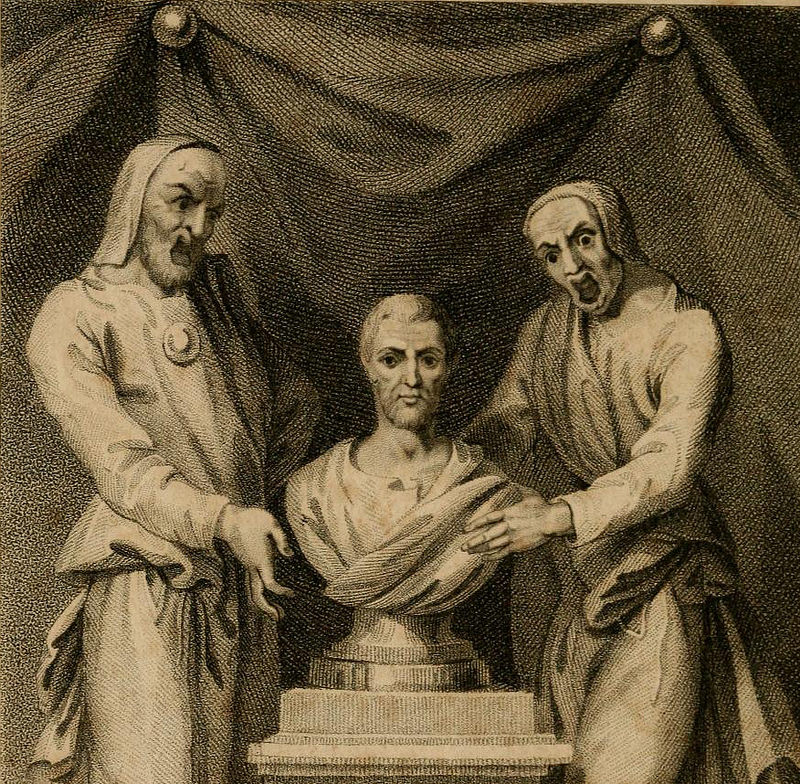
Lucretius is a lot of things. One thing he is not, is funny. But Terence is, at least by the standards of pre-modern Florence. In fact Renaissance thinkers liked Terence quite a bit, both as a model of how to write Latin as people spoke it day-to-day and as a model for comedy. Convoluted plots, love stories, witty servants, love causing "madness" in youth: these things and more served as basic elements of comedy in the ancient world, as they did in the Renaissance.

As to the Eunuch itself, it set fashionably in Athens, where a young man, Phaedria, is madly in love with a foreign-born courtesan and is given hard-nosed advice on love by his wily servant. Sub-plot after sub-plot emerges, and other love struck characters come into play. These include Phaedria's brother posing as a eunuch who uses his feigned status to be alone with a woman with whom he is madly in love and on whom he then forces himself. He runs away but then is forced to come back, whereupon he declares his love for the woman he raped, and they wind up together.

We do not really know why Machiavelli copied those texts by Lucretius and Terence, one after the other, joining them in a single manuscript. We have only the artifact itself. And of course it would be unwise to make too much of the fact. But the juxtaposition is noteworthy, inviting us as it does to look at what the two ancient texts shared and how they may have contributed to Machiavelli's views on the "comedy of life".

Detail from the frontispiece to The Comedies of Terence (1810) – Source.

Returning to Mandragola, we can ask: is it funny? The best I can come up with is … sort of. If it were performed and set well, the many comic asides could make an audience laugh. In their parody of pious religiosity, Timoteo's attempts to convince Lucrezia to go through with what she believes will be a deadly act of extra-marital sex are funny. And the various times fra Timoteo is portrayed as less than pious can engender a wry smile. Example:

LIGURIO TO CALLIMACO: Your friar will want something beyond prayers. CALLIMACO: What? LIGURIO: Money.

But then there is that other thing: not only the date rape, but also the sense that Machiavelli and his male cohort had never once sat down and had a real, person to person conversation with a woman. Take fra Timoteo's monologue in Act 3, scene 9, where he is musing out loud on the plan. The real reason he thinks it will work: "… in the end all women are pretty slow" (tutte le donne hanno alla fine poco cervello). It is like watching a comic slapstick film from the 1940s, laughing at all the perfectly executed pratfalls, and then coming up against that one cringe-inducing scene of a racial caricature, say, or anything else that for its time and place was acceptable but today is so out of bounds that it tends to taint the whole enterprise. Even Lucrezia's decision to sleep with Callimaco is related indirectly. We learn of it only through Callimaco's boastful recounting the day after to his friend Ligurio. Lucrezia is a device, not a person.

In the end the value of Machiavelli's comedies resides not so much in their original purpose – to make people laugh – but in what they can teach us about him and his world. It is striking that despite the manifold differences between Machiavelli's surroundings and ours, there are such similarities between his environment and that of ancient Rome. A comedy like Terence's Eunuch not only spoke to Machiavelli and his cohort, it also served as a source of imitative inspiration. That fact reminds us that, despite the many times we can find traces of ourselves in Machiavelli's work – of the Realpolitik that he helped create, say, or the tendency to observe human motivation shorn of traditional morality – he was also living in a world gone by.

It was a place where it was assumed that women simply were not part of the conversation, where the post-enlightenment notion of universal human rights (imperfectly realized as those have been) was only a dim adumbration, and where a lot of what might have made one laugh was differently situated. None of this is to praise or blame Machiavelli or his ancient Roman sources for what seem to us today like failings. Comedy serves as a kind of retrospective indicator of blind spots. It is our fate not to know what posterity will make of our own age's comic strivings. But wouldn't one like to be a fly on the wall in five hundred years?

Evernote helps you remember everything and get organized effortlessly. Download Evernote.

A new translation of the Iliad

A new translation of the Iliad

Book review: Peter Green's effort is not entirely successful
'Thetis giving Achilles his arms' (fresco), Giulio Romano, 1492–1546

'Thetis giving Achilles his arms' (fresco), Giulio Romano, 1492–1546

The Iliad, Homer: A New Translation Peter Green

University of California Press, pp.580, £19.95, ISBN: 9780520281417

'Why do another translation of Homer?' Richmond Lattimore asked in the foreword to his own great translation of the Iliad first published in 1951. It was a doubt he was grateful his friends and family had refrained from expressing in the long labour of translating the Greek. But he had a response for any who dared: it was 'a question which has no answer for those who do not know the answer already'. Homer exists to be translated, largely for what Peter Green has called 'its uncanny universalist insight into the wellsprings of human nature'. Homer is one of the sources of truth; it demands to be known. The last 200 years have had no shortage of candidates come to drink at that well — more than 40 English Iliads in the 19th century, another 30 in the 20th and eight so far in the 21st, a Victorian level of production, nearly all of them coming out of America. There are several more set to emerge.

Green's is the latest. It is the culmination of a wonderful troubadour life as a journalist, film critic, adventurer, soldier, scholar, novelist, historian, poet and translator of both Latin and Greek. He is now 90 years old, the Dougherty Centennial Professor Emeritus of Classics at the University of Texas at Austin, and it is no criticism to say that the best parts of his book are professorial: generously informed and clarifying footnotes, deft character summaries and subtle plot synopses, all of which are infused with a helping-hand mentality. This is an Iliad which makes something inherently strange and profoundly difficult much less so.

Where it doesn't work is in the poetry. The question is as old as translation itself: do you make the English feel as rich and alien as the Bronze Age words of the Greek, driven along by the sombre and splendid music of their hexa-meters? Or do you drag that strangeness into the light of modern accessibility? Do you cultivate, in other words, the strange or the known, poetry or history, the remote atmosphere of violence and suffering, of fragile beauty and unforgiving force, or do you focus on the explicable facts of the case, the plainest version the words of the Greek can bear?

Green chooses the second. Take for example the moment at the beginning of Book 19 when Thetis, Achilles's mother, delivers to her son the new armour which the smith-god Hephaistos has made for him. It is one of the Iliad's moments of scalding intensity, the point at which the cosmic destruction of revenge about to be wrought by Achilles on the Trojans has its beginnings. The armour itself is a thing of terror and Achilles's men, the Myrmidons, cannot look at it. Only the hero himself can encounter its cosmic power.

12 issues for £12


Alexander Pope wrote smoothly in about 1720:

Unmoved the hero kindles at the show,
And feels with rage divine his bosom glow.
From his fierce eyeballs living flames expire,
And flash incessant like a stream of fire.

This is 18th-century civility and restraint, the passion held quite comfortably within the couplets. Chapman's great loping Elizabethan translation, loved by Keats, is franker, rougher, larger:

Cold tremblings tooke the Myrmidons; none durst sustaine, all fear'd
T'oppose their eyes. Achilles yet, as soon as they appear'd,
Sterne Anger enterd. From his eyes (as if the day-starre rose)
A radiance terrifying did all the state enclose.

The Greek says nothing explicitly of 'the day-star', only of a 'brightness' under Achilles's eyelids, as if of a torch or lightning, but Chapman's vision of a vast sun burning like the sunrise from Achilles's pupils is one of the great moments of English translation.

It is a strange fact that addition in translation reveals more than strict adherence to the original. Christopher Logue's War Music adds, and what he adds is some astonishing kind of urgent reality. His Achilles looked at the armour

Lifted a piece of it between his hands;
Turned it; tested the weight of it; and then
Spun the holy tungsten like a star between his knees,
Slitting his eyes against the flare, some said,
But others thought the hatred shuttered by his lids
Made him protect the metal.

Logue's addition of that acid, etching light emanating from Achilles's glare, takes its place alongside Chapman's sunrise as one of the great moments of English translation. Then Logue adds this: 'His eyes like furnace doors ajar.' That vision of brilliance in the dark, unsourced in the Greek beyond the light seen under Achilles's lids, is nevertheless the poetry of Homer made explicit.

These high tests are the only ones to which it is worth submitting a new translation of the Iliad and this is Green's version:

Trembling swept through the Myrmidons: no Man dared
To look directly at them, but flinched away. As Achilles
viewed them, his wrath swelled further, his eyes glared out
terribly under their lids, like blazing fire.

This is serviceable but scarcely revelatory, unresponsive to the intensity or grip of the original, sensing neither the fear nor grandeur of it. It is, for all its ordinariness, surprisingly inaccurate. Trembling doesn't sweep through the Myrmidons in the Greek but 'holds' them. In the middle of these Greek lines there is a big 'But', a mark of Achilles's distinctness from ordinary men, which Green's 'As Achilles viewed them' simply omits. Lattimore's version was 'Only Achilleus/ Looked, and as he looked the anger came harder upon him/And his eyes glittered terribly under his lids, like sunflare.' Besides, for Achilles to 'view' this armour as if casting his eye over it in Selfridges is scarcely adequate. Nor is 'flinched' right; the Greek means to shrink or back away, a withdrawal from the realm of terrifying greatness, a scale of fear which the word 'terribly' can also no longer convey in English. A 'blazing fire' might be the sort of thing one has in a Cotswold fireplace on a cold evening but it does not have the qualities of irreducible otherness which have burned in Achilles's heart and eye for the past three or four thousand years.

Available from the Spectator Bookshop, £14 Tel: 08430 600033

Evernote helps you remember everything and get organized effortlessly. Download Evernote.

Why the Best Writing Advice Is Often the Weirdest

  Why the Best Writing Advice Is Often the Weirdest “Three six five,” a new collection of writing exercises, belongs to a venerable traditio...