Monday, October 24, 2016

清代江苏为什么会有两个省会?_私家历史_澎湃新闻-The Paper


清代江苏为什么会有两个省会?

2016-10-21 18:17 来源:澎湃新闻

自元代以来,行省制度已有700余年的历史,成为中国历史上最为稳定的高层政区。在现代中国人的认知里,一省仅有一个省会,即省级行政机关驻地。然而,当我们翻阅清代行政区划的史料时,却发现不少资料直言清代江苏有两个省会:一为江宁(南京),一为苏州。如《钦定大清一统志》称苏州府"与江宁并为省会",郭沫若版《中国史稿地图集》和新出版的《江苏建置志》也将江宁与苏州并尊。
《江苏建置志》的清代配图将江宁、苏州同标为省会。
清代江苏是否实行了"双省城"体制?这一设置是否为清廷治理江南的特意安排?其实我们只要细致考察分析清代江南省职官设置变化等史实,就能理清个中头绪。
从钦差大臣到地方官
明代,承宣布政使司为地方最高行政机关,其驻地通常被视为省城。终明一世,十三省的省城都是明确固定的。除了布政使这种地方官,明代还出现了"总督"和"巡抚"两类官职(下文合称"督抚"),作为中央派驻到地方的高级官员,协调中央与地方、地方与地方之间的政务。其中,总督分为专务和军务两种。专务的总督各以所辖专务为职,提督军务、民政为辅,包括漕运总督、河道总督等;军务总督则主管兵事或安抚军民,并兼理民政。下文论述的"总督"主要指后者。巡抚品级一般低于总督,职权虽与总督有较多交叉,但以民政为主,如督理税粮,总理河道,抚治流民,整饬边关,也会有军事任务。明代的督抚职权一般都凌驾于布政使等省级官僚之上,两者辖区上也不完全参照布政使司的边界来设置。起初,督抚只是临时钦差大臣,事毕则被撤废。明中期开始,督抚的设置逐步固化,到任、离任的交接制度日趋完善,职责也囊括了地方上几乎所有政务。除了辖区上不如布政使司稳定,以及富有特色的巡察式施政方式外,督抚已与一般的地方官无异,只是仍带有"钦差大臣"的头衔罢了。
网友"苍天熊猫"所作的《明代巡抚分区》,红色巡抚边界与橙色布政司边界不完全重合。
满清入关以后,全盘继承了明朝包括总督、巡抚、布政使在内的官僚体制。起初,督抚仍被视为"京官",职务撤废、驻地变更仍很频繁,因而只有地方官布政使的驻地才被认为是省城。不过,清廷已经意识到督抚体制地方化的大趋势,不再一味拘泥于原本的钦差属性,并在乾隆十三年(1748)正式承认督抚为最高地方行政长官,而布政使则降为督抚的从官。
同时,清廷着手调整督抚的数量和辖区,从顺治二年的四总督、廿二巡抚逐步调整为清中期八总督、十五巡抚的定制。至此,一省一巡抚对应一布政使,总督节制一省或数省的格局基本形成。其中,直隶巡抚、甘肃巡抚和四川巡抚由对应总督兼任,不再单设,所以十八省共计十五位巡抚。八位总督中,除直隶总督、四川总督仅辖一省外,其他均节制两三个省份,但山西、山东、河南三省巡抚之上无总督节制。
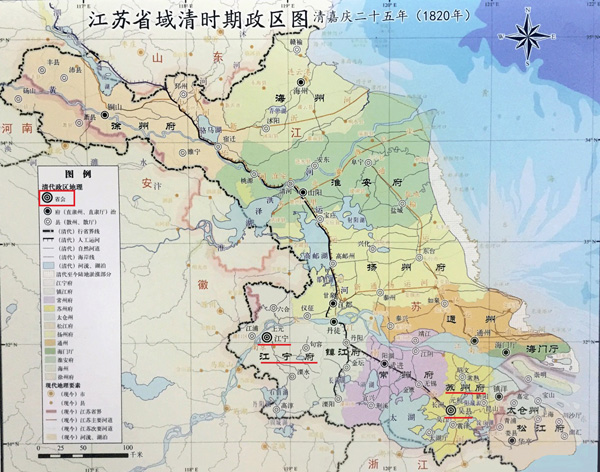
清嘉庆二十五年(1820年)八总督十五巡抚辖区图
管辖多省的总督往往选择与其中一省的巡抚同城而治,即所谓"督抚同城",如湖广总督与湖北巡抚同驻武昌府,闽浙总督与福建巡抚同驻福州府,仅有陕甘总督和两江总督例外。一般认为,清中期督抚取代布政使成为最高地方行政长官之后,巡抚所在地就是省城,如山东巡抚驻地济南府、江西巡抚驻地南昌府等;如一省范围内不单设巡抚的,则以总督驻地为省城,如四川总督驻地成都府、直隶总督驻地保定府;另陕甘总督本身兼职甘肃巡抚,驻地兰州府为甘肃省城。
"江苏"和"安徽"的由来
清朝本部十八省中的十七个省都可以根据督抚驻地推导出其唯一省城所在,但在江苏省总督和巡抚并存的情况下,两江总督所驻的江宁府却并非江苏巡抚所在,这无疑造就了清代督抚关系问题上的一个特例。为了进一步探寻这一特例,我们还须从江苏省的前身——江南省的分治说起。江南省原为明朝龙兴之地南直隶,主要包括今天的上海、江苏和安徽三省市,是一个地域广阔、政治显要、经济突出的地区,入清后仍保有对抗清廷中央的实力,因此分而治之乃是清廷羁束该地的重要手段。江南省的分立并不是一蹴而就的,也没有特别明确的标志性事件或时间点,而是当地各类官职上百年渐进式调整之后的结果。下表显示了清代江南省主要职官配置的变化:
顺治二年(1645),清朝定鼎江南之后,在江南省设左、右两位布政使、一位总督及江宁、凤阳、安庐三巡抚分管地方政事。其中,江宁巡抚又名"苏松巡抚"、"江南巡抚",为江苏巡抚前身,因常驻苏州府,后又有"苏州巡抚"之名;凤阳巡抚则时立时废,立时因分管海防,故驻临海的扬州府属泰州;安庐巡抚中间也有过废立,后称"安徽巡抚",驻安庆府。江南省之上又设有总督一名,因多数时间辖区含江南、江西两省,常常被称作"江南江西总督",后又简称"两江总督"。在清朝初年布政使仍被视为一省之长的情况下,由于江南左、右布政使及两江总督均驻江宁府,江宁府成为当之无愧的江南省省城。
江南省顺治四年(1647年)主要职官分布图
一般认为,各省的左、右两位布政使是一正一副的关系,同治省城,共同管理全省政务。但在顺治十八年(1661年),江南省的布政使驻地也发生了变化:时任江宁巡抚的朱国治要求江南右布政使分驻苏州,使自己和右布政使的辖区(江、苏、松、常、镇五府)重合,以便指挥布政使督催粮款;左布政使仍寄治在江宁府,节制江南省剩下的府州,其辖区内仍有凤阳巡抚、安徽巡抚两位上级。此时,两员布政使管辖的区域面积差异非常悬殊。
江南省康熙二年(1663年)主要职官分布图
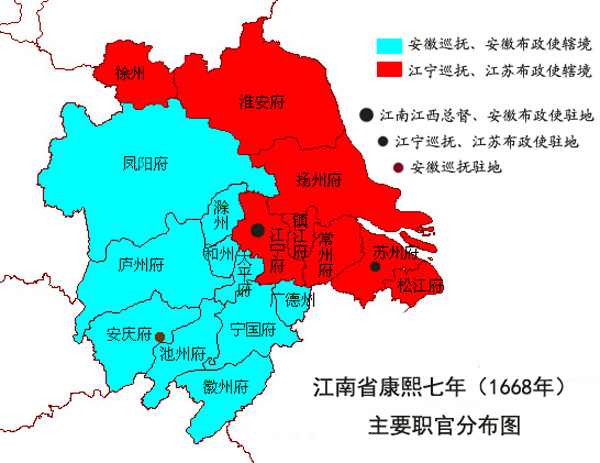
到了康熙四年(1665年),凤阳巡抚因职能与漕运总督重叠较多,终遭裁撤。根据时任江南江西总督的建议,同年十一月戊申(1666年1月1日),原属凤阳巡抚的庐州、凤阳两府,滁州、和州二州分隶安徽巡抚管理;淮安、扬州二府及徐州分隶江宁巡抚管理。之所以选择东西分割凤阳巡抚辖区,主要是考虑将淮安、扬州二府、徐州直隶州的黄河水利及漕运事务统归一位巡抚管理,与此无关的府州则划给安徽巡抚。由此至清朝末年,江宁(江苏)、安徽巡抚驻地和辖区未再变化,奠定了今天江苏和安徽两省的基本格局。考虑到行政便利等因素,巡抚手下重要属官——布政使的辖区也要随之进行调整,于是在康熙五年(1666),江南右布政使增领扬州、淮安二府及徐州。至此,江宁(江苏)巡抚与右布政使、安徽巡抚与左布政使的辖区已完全重合。翌年,清廷贯彻各省只保留一名布政使的方针,对于江南省这种左、右布政使已经分驻两地的既定事实,则只是依照驻地地名修改了布政使称谓,分别改称"江南江苏布政使司布政使" 及"江南安徽布政使司布政使",简称"江苏布政使"和"安徽布政使"。其中"江苏"二字分别取自江宁府和苏州府,"安徽"二字则来源于安庆府和徽州府的首字。可见,清廷在巡抚、布政使等职官改革的过程中,通过辖区和名称调整的方式,不断推动着江南省的分治,并以实际行动认可了巡抚地位高于布政使的事实。
然而,清廷在考量了两江总督施政的需要后,认为"督臣驻江宁, 而无藩(布政使)臬, 则制阃之体统不尊",决定安徽布政使继续寄治江宁府。所谓"寄治",指地方官驻地在其辖区以外,也就是说安徽布政使所驻的江宁府并不属安徽。中国当代的行政体系中,仍偶有寄治情况,如黄河水利委员会所驻的郑州主城区实属淮河流域。安徽布政使寄治江宁府有近百年的时间,再加上兼管安徽的两江总督也在此长期驻跸,于是乎从历史渊源看,当今诸多网友戏谑南京为"安徽省会"或"两省省会"也就不奇怪了。
江南省康熙七年(1668年)主要职官分布图
安徽布政使寄治江宁毕竟会带来施政上的诸多不便,以致后来出现了在总督外巡期间,江宁府发生典铺被焚案,安徽布政使想管却管不了的窘境。到了乾隆二十五年(1760),清廷命安徽布政使"回驻"安庆府,并基于江苏巡抚境内"钱谷殷繁、事宜众多"的实际情况,在江宁府增设布政使一员,以辅佐总督。次年二月正式定制,驻江宁者为"江南江淮扬徐海通等处承宣布政使司布政使",简称"江宁布政使",分管江宁及淮、扬、徐、通、海等处;驻苏州者为"江南苏松常镇太等处承宣布政使司布政使",简称"江苏布政使"或"苏州布政使",分管苏、松、常、镇、太等处。经过本次调整,安徽巡抚、安徽布政使驻地统一为安庆,安徽作为省级行政区得以进一步成型。但江苏的情况变得更为复杂,出现了两江总督、江宁布政使驻江宁府,江苏巡抚、江苏布政使驻苏州府的对峙格局。
江南省乾隆廿六年(1761年)主要职官分布图
康雍两朝的各类记载中,无论是中央文书,还是民间记述,基本仍视江苏、安徽为统一的江南省,可见人们并未将少数职官辖区或称谓的调整等同于"分省"。江宁府因两江总督驻跸之故,仍为江南省的唯一省城。由于江南省特殊的官僚配置,及一直共闱的江南乡试的长期存在,两个新省名取代老省名用了很长时间。直至清末,新老三个省名仍时有混用,甚至到清朝行将灭亡的宣统三年(1911),官方文献中仍有"江南省"这样的表述。不过总体而言,我们可以认为乾隆以后,特别是到19世纪,世人已逐渐接受了江苏、安徽分省的既定事实。
江苏泰兴一块清嘉庆八年的石碑仍有"江南扬州府泰州"字样。
按照总督、巡抚驻地皆可为省城的认同规律,安庆的安徽省城地位似没有异议,江苏省则因督抚分驻之故,理应有江宁和苏州两个省会。其实当时社会上已有了"双省会论",而支持该论调的人当中就包括乾隆皇帝。乾隆曾多次将"江南之江宁、苏州"并称为"省会",与其他省城并尊。还有些"有识之士",在称苏州为"江苏省城"或"苏州省城"的同时,另尊江宁为"江南省城"或"江宁省城",以示两者区别。
"大内斗省"的前世今生
从表面上看,乾隆年间江苏所形成的一总督、一巡抚、二布政使的特殊格局中,江苏布政使和江宁布政使均隶于江苏巡抚。江宁布政使所辖的江宁及江北各府州也在名义上也是江苏巡抚辖区。
江苏高邮一块清光绪三年的石碑仍将"江苏巡抚"视为本地重要官员。
不过,当初增设江宁布政使的一个重要目的,就是防止两江总督公出时,江宁省会落入无大员主持大局的尴尬境地,所以这位布政使实际发挥着总督副手的作用,并不接受江苏巡抚的直接领导。再者,总督虽名义上节制多省,实际则有偏袒所驻省份的畛域之见,往往过度插手驻地政务,而轻视兼管省份;兼领省份之巡抚,如安徽巡抚、江西巡抚等,又常常自行其是,不听总督节制。这不免诱导总督与所驻省份的巡抚"抢地盘",因而"督抚同城"的省会,如武昌府等尤是纷争不断。两江总督和江苏巡抚分驻江宁、苏州,虽不存在"同城之争",但却在相互间的权力斗争中实现了"划江而治"。具体而言,江宁布政使所辖的江、淮、扬、徐四府,通、海二州及海门厅成了两江总督的直辖地;江苏巡抚的"实控区"龟缩至他的属官——江苏布政使所辖的江南四府一州。
江南省嘉庆廿五年(1820年)主要官员实控区示意图
江苏这种"划江而治"的格局贯穿了整个清中后期。这一格局无形中强化了江宁和苏州各自的省会地位,但也不可避免地削弱了江苏各地的"省籍认同"。举例来讲,较之"遥不可及"的苏州巡抚,江北各府州显然更亲近江宁省城,地方志和碑文也倾向于自称"江南"属地,而不乐以"江苏"冠之;同样,江南人民也对江北府州无感。不仅如此,漕运总督、南河总督、盐运使、学政和提督等官员也分驻江苏境内的不同府县,进一步削弱了省内认同。省籍认同的淡薄,也为光绪年间"苏淮分省"埋下了伏笔。由于新设的江淮省触动各方利益太多,特别是漕运总督摇身变为江淮巡抚后,剥夺两江总督直辖地,直接架空其权力,抗议之声自不绝于耳,故该省仅存三月即遭到废止,江苏南北重归统一。
1905年江淮分省形势图
时至今日,江苏省内居民相互认同度仍较低,更被广大网民戏称为"大内斗省",这与清代江苏督抚分驻、官员林立的历史传统可谓不无关系。

参考文献:
姜涛:《清代江南省分治问题——立足于〈清实录〉的考察》,《清史研究》,2009年02期。
段伟:《泛指与特指:明清时期的江南与江南省》,《历史地理》第二十三辑。

Evernote helps you remember everything and get organized effortlessly. Download Evernote.

Wednesday, August 31, 2016

Weekly Book List, September 2, 2016


Weekly Book List, September 2, 2016

August 28, 2016


ANTHROPOLOGY

Mourning Animals: Rituals and Practices Surrounding Animal Death edited by Margo DeMello (Michigan State University Press; 272 pages; $44.95). Topics include burials, taxidermy, grieving, and other practices for animals we mourn, as well attitudes toward "road kill" and other animal deaths not generally commemorated.

Sanctuary and Asylum: A Social and Political History by Linda Rabben (University of Washington Press; 433 pages; $90 hardcover, $30 paperback). Combines anthropological and historical perspectives in a study of ideas of sanctuary from ancient times to the modern legal concept of asylum; pays particular attention to the refugee crisis in Europe today, and Central Americans seeking asylum in the United States.

ARCHAEOLOGY

Southeast Inka Frontiers: Boundaries and Interactions by Sonia Alconini (University Press of Florida; 228 pages; $79.95). Discusses a region of Bolivia that was once a frontier territory of the Inca empire, very distant from the capital, Cuzco.

ART AND ARCHITECTURE

Welcome to Painterland: Bruce Conner and the Rat Bastard Protective Association by Anastasia Aukeman (University of California Press; 352 pages; $49.95). A study of a community of artists, centered around Bruce Conner, which in the 1950s and 60s lived and worked together in a building in the Fillmore area of San Francisco.

BIOLOGY

Not So Different: Finding Human Nature in Animals by Nathan H. Lents (Columbia University Press; 349 pages; $35). Documents affinities in human and non-human animal behavior as shaped by the evolutionary forces of cooperation and competition; topics include sex, morality, play, envy, jealousy, and greed.

CLASSICAL STUDIES

Ovid's Women of the Year: Narratives of Roman Identity in the "Fasti" by Angeline Chiu (University of Michigan Press; 240 pages; $70). Examines the varied figures of women, old and young, goddess and mortal, in Ovid's six-book poem on the Roman calendar.

COMMUNICATION

Civic Media: Technology, Design, Practice edited by Eric Gordon and Paul Mihailidis (MIT Press; 648 pages; $53). Offers theoretical and applied perspectives on using digital media for activism, policy coordination, such as disaster relief, and similar endeavors; case studies include the success of the "It Gets Better" anti-suicide campaign for LGBTQ youth, and the hijacking of the New York City Police Department's #MyNYPD Twitter campaign.

DANCE

Flowers Cracking Concrete: Eiko & Koma's Asian/American Choreographies by Rosemary Candelario (Wesleyan University Press, distributed by University Press of New England; 272 pages; $80 hardcover, $26.95 paperback). A study of Eiko Otake and Taskashi Koma Otake, two Japanese dancers and choreographers who have lived and worked in New York City since the mid-1970s.

ECONOMICS

Complexity and Evolution: Toward a New Synthesis for Economics edited by David S. Wilson and Alan Kirman (MIT Press; 395 pages; $50). Writings on the integration of concepts from complexity theory and evolutionary theory to enhance the understanding of economics and public policy.

The Curse of Cash by Kenneth S. Rogoff (Princeton University Press; 296 pages; $29.95). Argues for phasing out most paper money in light of how cash figures, among other things, in crime, terrorism, tax evasion, and monetary instability

The Guidance of an Enterprise Economy by Martin Shubik and Eric Smith (MIT Press; 592 pages; $65). Draws on game theory, evolutionary theory, and and methods of physics and experimental gaming in a study of the control, guidance, and coordination problems of an enterprise economy.

EDUCATION

A Curriculum of Fear: Homeland Security in U.S. Public Schools by Nicole Nguyen (University of Minnesota Press; 291 pages; $91 hardcover, $26 paperback). An ethnographic study of a public high school in the greater Washington DC area that has established a specialized Homeland Security program, including security-themed classes and internships with defense contractors and such agencies as the N.S.A.

ENVIRONMENTAL STUDIES

Lake Mead National Recreation Area: A History of America's First National Playground by Jonathan Foster (University of Nevada Press; 176 pages; $21.95). Examines Park Service management of reservoir-based recreation in what became the first U.S. National Recreation Area.

FILM STUDIES

Militant Visions: Black Soldiers, Internationalism, and the Transformation of American Cinema by Elizabeth Reich (Rutgers University Press; 272 pages; $90 hardcover, $27.95 paperback). Discusses the figure of the proud and powerful black soldier in cinema across a range of genres from the 1940s to the 1970s.

FOLKLORE

Chol (Mayan) Folktales: A Collection of Stories From the Modern Maya of Southern Mexico by Nicholas A. Hopkins and J. Kathryn Josserand (University Press of Colorado; 199 pages; $27.95). Transcription of 11 stories with commentary and facing Chol (Mayan) and English text.

Inuit Poems and Songs: Folk Poetry of East Greenland collected by William Thalbitzer, translated by Torben Hutchings (International Polar Institute, distributed by University Press of New England; 128 pages; $19.95). Songs and poems collected by Thalbitzer, a Danish philologist and scholar of the Inuit (1873-1958).

Packy Jim: Folklore and Worldview on the Irish Border by Ray Cashman (University of Wisconsin Press; 312 pages; $69.95). Draws on interviews with Packy Jim McGrath, a Donegal storyteller who grew up on a smuggling route on the border of the Republic and Northern Ireland.

HISTORY

Beer of Broadway Fame: The Piel Family and Their Brooklyn Brewery by Alfred W. McCoy (State University of New York Press; 448 pages; $29.95). Traces the history of a brewery founded by a German-American family in 1884.

Braxton Bragg: The Most Hated Man of the Confederacy by Earl J. Hess (University of North Carolina Press; 341 pages; $35). A biography of the Confederate general (1817-76) that casts him as flawed, but also as the subject of "unwarranted infamy."

Convict Cowboys: The Untold History of the Texas Prison Rodeo by Mitchel P. Roth (University of North Texas Press; 436 pages; $32.95). Combines historical and criminological perspectives in a study of inmate cowboy competitors and the Huntsville-based prison rodeo, which happened annually from 1931 to 1986.

Decolonizing the Republic: African and Caribbean Migrants in Postwar Paris, 1946--1974 by Felix F. Germain (Michigan State University Press; 256 pages; $39.95). Discusses black working-class migrants in Paris as agents of social change and decolonization during the period.

Distinguishing the Righteous from the Roguish: The Arkansas Supreme Court, 1836--1874 by J.W. Looney (University of Arkansas Press; 285 pages; $59.95). A study of the court's rulings that shows how preservation of the status quo hindered economic development in the state.

Executing the Rosenbergs: Death and Diplomacy in a Cold War World by Lori Clune (Oxford University Press; 288 pages; $29.95). Uses previously untapped State Department documents to examine how the case affected global perceptions of the United States; topics include protests in 80 cities and 48 countries.

Imagining Asia in the Americas edited by Zelideth Maria Rivas and Debbie Le-DiStefano (Rutgers University Press; 203 pages; $90 hardcover, $27.95 paperback). Writings by anthropologists, historians, literary scholars, and others on Asian identities across the Americas; topics include Chinese influence and heritage in Afro-Cuban religiosity.

The Information Nexus: Global Capitalism from the Renaissance to the Present by Steven G. Marks (Cambridge University Press; 292 pages; $74.99 hardcover, $27.99 paperback). Argues that what makes capitalism distinct from other systems is the drive by business to collect and analyze information.

Middle Kingdom and Empire of the Rising Sun: Sino-Japanese Relations, Past and Present by June Teufel Dreyer (Oxford University Press; 454 pages; $34.95). Sets the contemporary rivalry between Japan and China in the context of relations back to the ninth century.

The Origins of the Grand Alliance: Anglo-American Military Collaboration from the Panay Incident to Pearl Harbor by William T. Johnsen (University Press of Kentucky; 406 pages; $50). A study of military collaboration between Britain and the United States that began after an incident in December 1937 when Japan sunk the U.S. gunboat Panay anchored in the Yangtze River outside Nanjing, China.

Our Sister Republics: The United States in an Age of American Revolutions by Caitlin Fitz (Liveright; 354 pages; $29.95). Traces changes in U.S. views of anti-colonial revolutions in 19th-century South America.

The Politics of Mourning: Death and Honor at Arlington National Cemetery by Micki McElya (Harvard University Press; 395 pages; $29.95). Explores issues of representation and inclusion in a history of the cemetery since its Civil War founding.

The Risen Phoenix: Black Politics in the Post-Civil War South by Luis-Alejandro Dinnella-Borrego (University of Virginia Press; 288 pages; $49.50). Discusses six black Congressmen of the Reconstruction era: John Mercer Langston of Virginia, James Thomas Rapier of Alabama, Robert Smalls of South Carolina, John Roy Lynch of Mississippi, Josiah Thomas Walls of Florida, and George Henry White of North Carolina.

Running the Rails: Capital and Labor in the Philadelphia Transit Industry by James Wolfinger (Cornell University Press; 304 pages; $45). Focuses on the city's public transit workers in a study of shifts in labor relations from the 1880s to the 1960s.

Somme: Into the Breach by Hugh Sebag-Montefiore (Harvard University Press; 607 pages; $35). Draws on diaries, letters, and memoirs in a study that focuses on the firsthand experiences of soldiers on both sides of the extended World War I battle, which cost more than a million dead or wounded.

This Mortal Coil: The Human Body in History and Culture by Fay Bound Alberti (Oxford University Press; 289 pages; $29.95). Discusses the skin, the spine, the tongue, the genitals, and other parts in a study of cultural perceptions of the body.

Written in Blood: The Battles for Fortress Przemysl in WWI by Graydon A. Tunstall (Indiana University Press; 386 pages; $45). Discusses a fortress in what is now southeastern Poland that changed hands three times in the fall of 1914.

LABOR STUDIES

Achieving Workers' Rights in the Global Economy edited by Richard P. Appelbaum and Nelson Lichtenstein (Cornell University Press; 330 pages; $89.95 hardcover, $26.95 paperback). Essays focusing on workers' struggles under globalization, particular those in the export industries of the "global South"; topics include corporate social responsibility and trade-union elections at foreign-owned Chinese factories.

Too Few Women at the Top: The Persistence of Inequality in Japan by Kumiko Nemoto (ILR Press/Cornell University Press; 296 pages; $49.95). Uses interviews with workers at three financial firms and two cosmetics companies to document the persistence of vertical sex segregation as a cost-saving measure.

LAW

The Age of Deference: The Supreme Court, National Security, and the Constitutional Order by David Rudenstine (Oxford University Press; 326 pages; $29.95). Documents how judicial deference to executive power on national security issues dates back to Truman administration, long before 9/11 and the "war on terror."

Making Modern Florida: How the Spirit of Reform Shaped a New State Constitution by Mary E. Adkins (University Press of Florida; 240 pages; $29.95). Documents the successful effort to modernize Florida's 1885 constitution in 1966-68 in the face of opposition from rural state legislators known as the "Pork Chop Gang."

LINGUISTICS

Dictating to the Mob: The History of the BBC Advisory Committee on Spoken English by Jurg R. Schwyter (Oxford University Press; 256 pages; $40). Discusses the first 13 years of a committee that was set up in 1926 to provide guidance to BBC radio announcers on pronunciation and other matters of language; offers a linguistic perspective on the committee's work, particularly after it took on the unmandated role of standardizing spoken English.

Tone and Accent in Oklahoma Cherokee by Hiroto Uchihara (Oxford University Press; 302 pages; $105). Examines six possible pitch patterns that can occur on a syllable in the language.

LITERATURE

The Amazing Adventures of Bob Brown: A Real-Life Zelig Who Wrote His Way Through The 20th Century by Craig Saper (Fordham University Press; 305 pages; $90 hardcover, $24.95 paperback). A biography of the writer and publisher Robert Carleton Brown (1886-1959), who had links to bohemian, Beat, expatriate, and other literary circles.

The Divine Madness of Philip K. Dick by Kyle Arnold (Oxford University Press; 234 pages; $19.95). Examines links between early traumas in Dick's life, including the death of his twin sister, and the author's spirituality and drug abuse; argues that Dick was not schizophrenic and links his paranoia to amphetamine addiction.

Ernest Hemingway: A New Life by James M. Hutchisson (Penn State University Press; 292 pages; $37.95). A biography of the writer that challenges what is termed the sensationalism of previous accounts.

Fact in Fiction: 1920s China and Ba Jin's "Family" by Kristin Stapleton (Stanford University Press; 288 pages; $85 hardcover, $25.95 paperback). Focuses on the 1933 novel's setting of Chengdu in a study of how Ba Jin distorted 1920s Chinese history to fit his narrative and politics.

How Russia Learned to Write: Literature and the Imperial Table of Ranks by Irina Reyfman (University of Wisconsin Press; 237 pages; $65). Discusses the Table of Ranks introduced by Peter the Great, and the impact of mandatory public service on Russian writers.

Robicheaux's Roots: Culture and Tradition in James Lee Burke's Dave Robicheaux Novels by Patricia M. Gaitely (Louisiana State University Press; 168 pages; $25). Discusses Burke's mystery novels featuring the Cajun detective and their depiction of the culture and environment of South Louisiana.

Self as Nation: Contemporary Hebrew Autobiography by Tamar Hess (Brandeis University Press/University Press of New England; 228 pages; $85 hardcover, $40 paperback). Discusses Yoram Kaniuk, Yehudit Kafri, Aharon Appelfeld, and seven other writers in a study of the interplay of the collective and the Israeli self in Hebrew autobiography.

The Works of Samuel Johnson, Volume 19: Biographical Writings: Soldiers, Scholars, and Friends edited by O M Brack Jr. and Robert DeMaria Jr. (Yale University Press; 616 pages; $125). Edition of Johnson's biographical writings as well as obituaries and epitaphs.

MUSIC

Flowing Tides: History and Memory in an Irish Soundscape by Gearoid O hAllmhurain (Oxford University Press; 311 pages; $45). Combines the author's perspectives as musician and scholar in a study of two centuries of the "soundscape" of County Clare, a renowed center for Irish music.

Mahler and Strauss: In Dialogue by Charles Youmans (Indiana University Press; 312 pages; $42). Combines a comparative study of the two composers' lives with an account of their 24-year relationship.

PHILOSOPHY

Kant's Philosophy of Communication by G.L. Ercolini (Duquesne University Press; 251 pages; $30). Examines the German philosopher's investment in the realm of rhetoric and human interaction, both in his life and his writings.

POLITICAL SCIENCE

The Courts, the Ballot Box, and Gay Rights: How Our Governing Institutions Shape the Same-Sex Marriage Debate by Joseph Mello (University Press of Kansas; 240 pages; $34.95). Examines why conservatives' arguments against same-sex marriage had more success in terms of ballot measures than in the arena of the courts.

Crude Strategy: Rethinking the US Military Commitment to Defend Persian Gulf Oil edited by Charles L. Glaser and Rosemary A. Kelanic (Georgetown University Press; 300 pages; $64.95 hardcover, $32.95 paperback). Writings by political scientists, historians, and economists that evaluate the current policy.

Gender Violence in Peace and War: States of Complicity edited by Victoria Sanford, Katerina Stefatos, and Cecilia M. Salvi (Rutgers University Press; 214 pages; $90 hardcover, $28.95 paperback). Writings on instances when states violence against women; includes historical and contemporary cases from the Congo, Greece, Guatamala, Indonesia, Iraq, Ireland, Kenya, Mexico, Nicaragua, Russia, and the United States.

Just War Reconsidered: Strategy, Ethics, and Theory by James M. Dubik (University Press of Kentucky; 225 pages; $50). Develops an approach to just-war theory that includes a much greater consideration of the planning and conduct of warfare, as well as of the decision to initiate conflict.

Rape During Civil War by Dara Kay Cohen (Cornell University Press; 272 pages; $89.95 hardcover, $26.95 paperback). Develops a theory of why some armed groups rape during civil wars, while others do not; draws on a database on intrastate conflicts between 1980 and 2012 along with in-depth case studies of Sierra Leone, East Timor, and El Salvador.

POPULAR CULTURE

Rewriting History in Manga: Stories for the Nation edited by Nassim Otmazgin and Rebecca Suter (Palgrave Macmillan; 191 pages; $99.99). Essays on manga's relation to Japanese history and politics; topics include atomic survivors in Nakazawa Keiji's Black Series manga.

RELIGION

American Jesuits and the World: How an Embattled Religious Order Made Modern Catholicism Global by John T. McGreevy (Princeton University Press; 315 pages; $35). Examines the role of Jesuits in Catholic globalization in the century after the order was restored, by one pope, after having been suppressed 41 years prior by another; focuses on European Jesuits who traveled to the United States, and American Jesuits who traveled in missions to the Pacific.

Black Natural Law by Vincent W. Lloyd (Oxford University Press; 180 pages; $49.95). Focuses on Frederick Douglass, Anna Julia Cooper, W. E. B. Du Bois, and Martin Luther King Jr. in a study of how appeals to a higher law has shaped black political engagement.

Jews and the American Religious Landscape by Uzi Rebhun (Columbia University Press; 248 pages; $60). Draws on demographic and sociological data in a study of Jewish identity and religiosity.

Protestantism After 500 Years edited by Thomas Albert Howard and Mark A. Noll (Oxford University Press; 361 pages; $99 hardcover, $35 paperback). Writings by historians and theologians on the significance of the Reformation, nearly 500 years after Luther posted his 95 Theses.

RHETORIC

Secret Habits: Catholic Literacy Education for Women in the Early Nineteenth Century by Carol Mattingly (Southern Illinois University Press; 272 pages; $40). A study of female Catholic religious as educators of women during the period.

SOCIAL WORK

Bullying Scars: The Impact on Adult Life and Relationships by Ellen W. deLara (Oxford University Press; 270 pages; $24.95). Draws on interviews with more than 800 people in a study of how victimization as a child can affect adult life.

SOCIOLOGY

Down, Out, and Under Arrest: Policing and Everyday Life in Skid Row by Forrest Stuart (University of Chicago Press; 333 pages; $27.50). Draws on five years of fieldwork in Los Angeles's Skid Row, both among those living in its streets, shelters, and flophouses, and among the police for the district.

SPORTS STUDIES

The Turbulent World of Middle East Soccer by James M. Dorsey (Oxford University Press; 359 pages; $24.95). Examines how politics figure in football, and vice versa, across the region; topics include militant Islamists' love-hate relationship with the sport.


Evernote helps you remember everything and get organized effortlessly. Download Evernote.

Weekly Book List, August 26, 2016


Weekly Book List, August 26, 2016

August 21, 2016


ANTHROPOLOGY

No Place for Grief: Martyrs, Prisoners, and Mourning in Contemporary Palestine by Lotte Buch Segal (University of Pennsylvania Press; 211 pages; $49.95). A study of Palestinian women who are the wives of men held in Israeli prisons or the widows of men who have died in the ongoing violence.

ARCHAEOLOGY

Charleston: An Archaeology of Life in a Coastal Community by Martha A. Zierden and Elizabeth J. Reitz (University Press of Florida; 350 pages; $34.95). Draws on excavations that document life in the South Carolina city from the 17th to the 19th centuries.

Lost City, Found Pyramid: Understanding Alternative Archaeologies and Pseudoscientific Practices edited by Jeb J. Card and David S. Anderson (University of Alabama Press; 272 pages; $54.95). Writings on pseudoarchaeology in popular culture and the potential and perils of archaeologists critically engaging the phenomenon.

The Powhatan Landscape: An Archaeological History of the Algonquian Chesapeake by Martin D. Gallivan (University Press of Florida; 288 pages; $79.95). A study of indigenous settlement in the Virginia region over two millennia from the arrival of the Algonquian to the Powhatans' clashes with English colonists.

ART AND ARCHITECTURE

Art & Language International: Conceptual Art between Art Worlds by Robert Bailey (Duke University Press; 240 pages; $84.95 hardcover, $23.95 paperback). A study of an arts collective founded in England in 1969 and active until 1977; focuses on Art & Language's New York section as well as collaborative work done in Australia, New Zealand, and (then) Yugoslavia.

Geo-Narratives of a Filial Son: The Paintings and Travel Diaries of Huang Xiangjian (1609-1673) by Elizabeth Kindall (Harvard University Asia Center, distributed by Harvard University Press; 481 pages; $89.95). Uses the work of an artist from the Suzhou elite and the term "geo-narrative" to recognize and describe what is identified as a previously unrecognized tradition of site paintings and explore their wider social significance.

Live Form: Women, Ceramics, and Community by Jenni Sorkin (University of Chicago Press; 304 pages; $45). Focuses on Marguerite Wildenhain, Mary Caroline Richards, and Susan Peterson, three potters who promoted ceramics as an avant-garde form.

CLASSICAL STUDIES

Pliny the Elder and the Emergence of Renaissance Architecture by Peter Fane-Saunders (Cambridge University Press; 491 pages; $135). Discusses the Roman writer's Naturalis historia as a source for Renaissance artists, architects, and scholars on ancient architectural practice and wonders.

Prostitutes and Matrons in the Roman World by Anise K. Strong (Cambridge University Press; 304 pages; $99.99). Draws on art, literature, and other sources in a study of the fluidity and mutability of the categories of whore and wife in Roman society.

COMMUNICATION

Media After Deleuze by Tauel Harper and David Savat (Bloomsbury Academic; 188 pages; $94 hardcover, $29.95 paperback). Develops an approach to contemporary media grounded in the concepts of Deleuze and Guattari.

Mister Pulitzer and the Spider: Modern News from Realism to the Digital by Kevin G. Barnhurst (University of Illinois Press; 312 pages; $34.95). Traces changes in the nature of American journalism since the late 19th century.

EDUCATION

Making the Unequal Metropolis: School Desegregation and Its Limits by Ansley T. Erickson (University of Chicago Press; 416 pages; $40). Focuses on Nashville in a study of how school policies are linked to inequality in metropolitan areas.

FILM STUDIES

Invented Lives, Imagined Communities: The Biopic and American National Identity edited by William H. Epstein and R. Barton Palmer (State University of New York Press; 344 pages; $90). New and previously published writings on the American "biopic," with a focus on Houdini, Patton, The Great White Hope, Bound for Glory, Ed Wood, Basquiat, Pollock, Sylvia, Kinsey, Fur, Milk, J. Edgar, and Lincoln.

Projections of Memory: Romanticism, Modernism, and the Aesthetics of Film by Richard I. Suchenski (Oxford University Press; 320 pages; $99 hardcover, $24.95 paperback). A study of ambitious works of long-form cinema, with a focus on Gregory Markopoulos's Eniaios, Jacques Rivette's L'Amour fou and Out 1, and Jean-Luc Godard's Histoire(s) du cinema.

GEOGRAPHY

Beyond the Kale: Urban Agriculture and Social Justice Activism in New York City by Kristin Reynolds and Nevin Cohen (University of Georgia Press; 224 pages; $79.95 hardcover, $25.95 paperback). Pays particular attention to women and people of color in a study of how New York's urban agriculture movement has challenged structural inequities.

HISTORY

Beating against the Wind: Popular Opposition to Bishop Feild and Tractarianism in Newfoundland and Labrador by Calvin Hollett (McGill-Queen's University Press; 480 pages; US$110 hardcover, US$44.95 paperback). Describes a popular Protestantism embraced by coastal populations in Labrador and Newfoundland in resistance to the Tractarianism movement in the Anglican Church and its championing by Edward Feild, second bishop of Newfoundland (from 1844 to 1876).

Beyond Timbuktu: An Intellectual History of Muslim West Africa by Ousmane Oumar Kane (Harvard University Press; 282 pages; $39.95). A study of major sites of Islamic learning in West Africa beyond the famous schools and archives of Timbuktu (in present-day Mali); covers the period since the introduction of Islam.

The Body or the Soul? Religion and Culture in a Quebec Parish, 1736-1901 by Frank A. Abbott (McGill-Queen's University Press; 386 pages; US$100). Draws on oral-historical and other sources in a study of religious and cultural life in the rural parish of St-Joseph-de-Beauce.

Buying a Bride: An Engaging History of Mail-Order Matches by Marcia A. Zug (New York University Press; 304 pages; $30). Examines the history of mail-order marriage, from the Tobacco Wives of the Jamestown Colony to contemporary practices; documents the increasingly negative perceptions of such unions, but also how such arrangements can empower women.

Crown, Church and Constitution: Popular Conservatism in England, 1815-1867 by Jorg Neuheiser (Berghahn Books; 310 pages; $110). A study of "conservatism from below" that examines the royalist, xenophobic, and anti-Catholic politics that were a counter-force to the radical reform politics of the period.

Dangerous Neighbors: Making the Haitian Revolution in Early America by James Alexander Dun (University of Pennsylvania Press; 342 pages; $45). Focuses on Philadelphia, an enclave of anti-slavery activity, in a study of Americans' varied responses to the revolution on the French colony of Saint Domingue and the creation of an independent Haiti.

Fascist Interactions: Proposals for a New Approach to Fascism and Its Era, 1919-1945 by David D. Roberts (Berghahn Books; 319 pages; $120). Discusses the study of fascism beyond the dominant cases of Italy and Germany.

Forging a Laboring Race: The African American Worker in the Progressive Imagination by Paul R.D. Lawrie (New York University Press; 230 pages; $50). Examines realms from actuaries and academe to factories and the military in a study of Progressive Era notions of the black worker in modernity.

Genocide in the Carpathians: War, Social Breakdown, and Mass Violence, 1914-1945 by Raz Segal (Stanford University Press; 211 pages; $65). Focuses the borderland region of the Subcarpathian Rus' in a study that focuses on Hungarian persecution of Jews, Roma, and Carpatho-Ruthenians.

Jefferson, Lincoln, and the Unfinished Work of the Nation by Ronald L. Hatzenbuehler (Southern Illinois University Press; 176 pages; $19.50). A comparative study of the two American presidents.

The Katangese Gendarmes and War in Central Africa: Fighting Their Way Home by Erik Kennes and Miles Larmer (Indiana University Press; 318 pages; $85 hardcover, $35 paperback). Discusses a force from a secessionist region of Congo, their exile in Angola, their involvement in regional conflicts, and their efforts to return home.

Known for My Work: African American Ethics from Slavery to Freedom by Lynda J. Morgan (University Press of Florida; 208 pages; $74.95). Traces the building of an African-American ethos of honest labor in the face of oppression.

The Merchants of Siberia: Trade in Early Modern Eurasia by Erika Monahan (Cornell University Press; 410 pages; $49.95). Uses the histories of three merchant families to examine trade as a key aspect of the Muscovy state's assertion of authority on the Siberian periphery; disputes the notion that the state placed a straitjacket on economic growth, and that Russian merchants were risk averse.

Northern Character: College-Educated New Englanders, Honor, Nationalism, and Leadership in the Civil War Era by Kanisorn Wongsrichanalai (Fordham University Press; 288 pages; $140 hardcover, $35 paperback). Examines the motivations of elite young men who rushed from colleges in the North to serve the Union in battle.

Partners of the Empire: The Crisis of the Ottoman Order in the Age of Revolutions by Ali Yaycioglu (Stanford University Press; 347 pages; $65). A study of institutional and other change in the empire in the late 18th and early 19th centuries; disputes notions of a linear transition between old and new, or from Eastern to Western institutions.

Pembroke: A Rural, Black Community on the Illinois Dunes by Dave Baron (Southern Illinois University Press; 234 pages; $26.50). Discusses a black community in a corner of rural Kankakee County, Ill., about 65 miles south of Chicago.

Precarious Paths to Freedom: The United States, Venezuela, and the Latin American Cold War by Aragorn Storm Miller (University of New Mexico Press; 278 pages; $65). Documents how forces of moderation in both Washington and Caracas combined to block both right- and left-wing extremism between 1958 and 1968 and to promote successive, competitive elections.

Sacred Violence in Early America by Susan Juster (University of Pennsylvania Press; 267 pages; $55). Discusses blood sacrifice, holy war, malediction, and iconoclasm in a study that links English colonists' violence to Europe's Wars of Religion.

Scythe and the City: A Social History of Death in Shanghai by Christian Henriot (Stanford University Press; 484 pages; $65). Examines how beliefs and practices concerning death changed from the late imperial period to the first decade of the People's Republic of China.

Show Thyself a Man: Georgia State Troops, Colored, 1865-1905 by Gregory Mixon (University Press of Florida; 419 pages; $79.95). Documents how black men used militia service in post-Civil War Georgia as a means of political and social betterment until the militias were disbanded by whites.

Time Travel: Tourism and the Rise of the Living History Museum in Mid-Twentieth-Century Canada by Alan Gordon (University of British Columbia Press; 384 pages; US$99). A study of Canada's living history museums from the 1930s through the 1970s, with particular attention to forces shaping them in the 60s and 70s.

Too Great a Burden to Bear: The Struggle and Failure of the Freedmen's Bureau in Texas by Christopher B. Bean (Fordham University Press; 320 pages; $140 hardcover, $40 paperback). Focuses on the motivations, ideas, and actions of men employed as sub-assistant commissioners in the Reconstruction-era bureaus.

LABOR STUDIES

From Mission to Microchip: A History of the California Labor Movement by Fred B. Glass (University of California Press; 544 pages; $70 hardcover, $34.95 paperback). Sets the history of labor organizing in California in the context of the state's diverse population and status as a destination since the Gold Rush.

LAW

Confident Pluralism: Surviving and Thriving through Deep Difference by John D. Inazu (University of Chicago Press; 176 pages; $29). Discusses the constitutional commitments and civic practices necessary to defend a healthy tradition of pluralism in the United States.

Exclusion from Public Space: A Comparative Constitutional Analysis by Daniel Moeckli (Cambridge University Press; 578 pages; $155). Focuses on Britain, the United States, and Switzerland in a comparative study of the rights and other issues raised by an increasing number of laws that allow the exclusion of the homeless, protesters, drug addicts, teenagers, and others from certain public spaces.

Homelessness in New York City: Policymaking from Koch to de Blasio by Thomas J. Main (New York University Press; 273 pages; $50). Examines how Mayors Koch, Dinkins, Giuliani, Bloomberg, and de Blasio have attempted to meet the city's obligation under 1979 litigation that guarantees a right to shelter.

LINGUISTICS

Grammaticalization and the Rise of Configurationality in Indo-Aryan by Uta Reinohl (Oxford University Press; 234 pages; $105). Traces the rise of postpositions in a study of Indo-Aryan language over three millennia with a focus on Vedic Sanskrit, Middle Indic Pali and Apabhramsha, Early New Indic Old Awadhi, and Hindi.

LITERATURE

The Contemporary Irish Detective Novel edited by Elizabeth Mannion (Palgrave Macmillan; 168 pages; $90). Essays on the work of such authors as Peter Tremayne, John Connolly, Declan Hughes, Ken Bruen, Brian McGilloway, Stuart Neville, Tana French, Jane Casey, and Benjamin Black.

Culinary Shakespeare: Staging Food and Drink in Early Modern England edited by David B. Goldstein and Amy Tigner (Duquesne University Press; 350 pages; $70). Topics include the social and religious associations of drink, and the economic implications of ingredients from foreign lands.

Goethe's Families of the Heart by Susan E. Gustafson (Bloomsbury Academic; 199 pages; $120). Documents how the German author challenges 18th-century conventions regarding families and relationships, portraying characters whose feelings of love pull them into a variety of affinities.

Literature and "Interregnum": Globalization, War, and the Crisis of Sovereignty in Latin America by Patrick Dove (State University of New York Press; 330 pages; $90). A study of end-of-millennium novels by Cesar Aira, Marcelo Cohen, Sergio Chejfec, Diamela Eltit, and Roberto Bolano.

Modernism and the Materiality of Texts by Eyal Amiran (Cambridge University Press; 192 pages; $99.99). Examines features of modernist texts that reflect their authors' anxieties and psychic crises; figures discussed include Gertrude Stein, Alice Toklas, P. G. Wodehouse, Conan Doyle, J. M. Barrie, George Herriman, and Sigmund Freud.

Narrative Subversion in Medieval Literature by E.L. Risden (McFarland & Company; 192 pages; $35). Works discussed include Beowulf, Piers Plowman, Le Morte D' Arthur, The Canterbury Tales, Troylus and Criseyde, 'Voluspa" and other Old Norse sagas, and Grail quest romances.

Object Lessons: The Novel as a Theory of Reference by Jami Bartlett (University of Chicago Press; 184 pages; $35). Draws on philosophical theories of reference in a study of novels by Meredith, Thackeray, Gaskell, and Murdoch.

Ornamental Aesthetics: The Poetry of Attending in Thoreau, Dickinson, and Whitman by Theo Davis (Oxford University Press; 245 pages; $65). Discusses the three writers' "ornamental aesthetics" as form of attention and thought that marks persons, objects, and the world and explores mental engagement.

Queer Philologies: Sex, Language, and Affect in Shakespeare's Time by Jeffrey Masten (University of Pennsylvania Press; 353 pages; $59.95). Examines terms and related rhetorics used to inscribe bodies, pleasures, affects, sexual acts, and identities in early modern English culture.

Sarah Waters and Contemporary Feminisms edited by Adele Jones and Claire O'Callaghan (Palgrave Macmillan; 248 pages; $90). Essays on the Welsh novelist that link her works to contemporary feminism and feminist theory; topics include female masculinity and butch subjectivity in Tipping the Velvet and The Night Watch.

They Have All Been Healed: Reading Robert Walser by Jan Plug (Northwestern University Press; 224 pages; $99.95 hardcover, $34.95 paperback). Explores healing and salvation in the works of the Swiss-German modernist writer (1878-1956), including Snow White, The Walk, Jakob von Gunten, and The Robber.

Tropics of Vienna: Colonial Utopias of the Habsburg Empire by Ulrich E. Bach (Berghahn Books; 143 pages; $80). Focuses on writings by Leopold von Sacher-Masoch, Lazar von Hellenbach, Theodor Hertzka, Theodor Herzl, Robert Muller, and Joseph Roth.

MUSIC

Rethinking Schubert edited by Lorraine Byrne Bodley and Julian Horton (Oxford University Press; 528 pages; $74). Revisionist essays on the Austrian composer's life, work, influence, and legacy; topics include disability, self-critique, and failure in Schubert's "Der Doppelganger," and the sensuous as a constructive force in his late works.

PHILOSOPHY

Free Will and Action Explanation: A Non-Causal, Compatibilist Account by Scott Sehon (Oxford University Press; 239 pages; $74). Defends a teleological rather than causal account of human action and agency, and applies that approach to a discussion of free will and responsibility.

The Making of Friedrich Nietzsche: The Quest for Identity, 1844--1869 by Daniel Blue (Cambridge University Press; 351 pages; $49.99). Draws on untranslated German scholarship in a study of the philosopher's youth, education, and self-fashioning.

Mortal Thought: Holderlin and Philosophy by James Luchte (Bloomsbury Academic; 201 pages; $112). A study of the German poet and thinker Friedrich Holderlin (1770-1843) that focuses on his impact on later philosophy---in particular Nietzsche, the Frankfurt School, Heidegger, and poststructuralism.

POLITICAL SCIENCE

The Boundary Bargain: Growth, Development, and the Future of City-County Separation by Zachary Spicer (McGill-Queen's University Press; 200 pages; US$100 hardcover, US$27.95 paperback). Uses case studies of London, Guelph, and Barrie, Ontario, in a study of the workings, problems, and best practices of strict county-city separation in governance.

Obama and Kenya: Contested Histories and the Politics of Belonging by Matthew Carotenuto and Katherine Luongo (Ohio University Press; 240 pages; $49.95 hardcover, $22.95 paperback). Topics include how the East African nation's contested politics have shaped efforts to cast the president as a "son of the soil."

The Parliaments of Autonomous Nations edited by Guy Laforest and Andre Lecours (McGill-Queen's University Press; 312 pages; US$110 hardcover, US$34.95 paperback). Writings on how parliamentary bodies in Flanders, Quebec, Catalonia, Galicia, the Basque Country, Scotland, and Northern Ireland assert their minority nations' cultural identities and claims to self-determination; also examines the responses of central parliaments.

The Rise and Fall of the Miraculous Welfare Machine: Immigration and Social Democracy in Twentieth-Century Sweden by Carly Elizabeth Schall (Cornell University Press; 248 pages; $55). Traces the history of the Swedish welfare state since the 1920s, and considers the impact of greater diversity on the system.

RELIGION

The Cult of St Ursula and the 11,000 Virgins edited by Jane Cartwright (University of Wales Press, distributed by University of Chicago Press; 299 pages; $125). Essays on legends, art, and music inspired by the story in the third century of a British king's daughter and devout Christian who agreed to marry a pagan prince to save her father's kingdom, deferred the marriage by insisting on a final pilgrimage to Rome in the company of 11,000 virgins, and on the way back, was martyred with her companions in Cologne.

Echoes of Enlightenment: The Life and Legacy of the Tibetan Saint Sonam Peldren by Suzanne M. Bessenger (Oxford University Press; 296 pages; $99 hardcover, $35 paperback). Examines the hagiographical and literary agendas that shaped accounts of the female Buddhist figure (1328-72).

The Empress and the Heavenly Masters: A Study of the Ordination Scroll of Empress Zhang (1493) by Luk Yu-ping (Chinese University Press, distributed by Columbia University Press; 258 pages; $45). A study of a more-than 27-meter scroll that documents the ordination of Empress Zhang by a Heavenly Master of Zhengyi Daoism.

The Genesis of Liberation: Biblical Interpretation in the Antebellum Narratives of the Enslaved by Emerson B. Powery and Rodney S. Sadler Jr. (Westminister John Knox Press; 182 pages; $35). Examines the emancipatory appropriation of the King James Bible by such figures as Frederick Douglass, Solomon Bayley, and William Anderson.

God Being Nothing: Toward a Theogony by Ray L. Hart (University of Chicago Press; 272 pages; $45). Develops a view of God as perpetually in process, and continually generated from nothing.

The Greek "Historia Monachorum in Aegypto": Monastic Hagiography in the Late Fourth Century by Andrew Cain (Oxford University Press; 329 pages; $135). A study of the anonymous account written by one of seven monks who in September 394 left their Jerusalem monastery to journey to Egypt to visit a series of "monastic celebrities."

The Myth of Normative Secularism: Religion and Politics in the Democratic Homeworld by Daniel D. Miller (Duquesne University Press; 346 pages; $33). Draws on Husserl's generative phenomenology to develop a view of the relationship between religion and politics in a democratic society.

The Oxford Movement in Practice: The Tractarian Parochial World from the 1830s to the 1870s by George Herring (Oxford University Press; 368 pages; $120). A study of the Tractarian movement in the generation after John Henry Newman's Anglican-to-Roman Catholic conversion.

Religious Competition in the Greco-Roman World edited by Nathaniel P. DesRosiers and Lily C. Vuong (Society of Biblical Literature; 326 pages; $49.95 hardcover, $34.95 paperback). Focuses on themes of material culture, neo-Platonism, religious expertise, and relics in essays on competition and other points of contact among pagan, Christian, Jewish, philosophical, and early Islamic communities in late antiquity.

Selected Works of D.T. Suzuki, Volume III: Comparative Religion edited by Jeff Wilson and Tomoe Moriya (University of California Press; 320 pages; $49.95). Edition of letters, essays, and lectures about Christianity, Shinto, and other non-Buddhist religions by the Japanese thinker, who was a key figure in the introduction of Buddhism to the West; includes previously untranslated materials.

Spiritual Despots: Modern Hinduism and the Genealogies of Self-Rule by J. Barton Scott (University of Chicago Press; 280 pages; $45). Documents how Protestant missionaries spread anti-clerical rhetoric through British India, and how that "priestcraft" rhetoric became part of the discourse of Hindu reformers, with lasting religious and political effect.

Ye That Are Men Now Serve Him: Radical Holiness Theology and Gender in the South by Colin B. Chapell (University of Alabama Press; 256 pages; $54.95). Contrasts the South Baptist Convention and Methodist Episcopal Church with the Holiness movement in a study of how religion figured in Southern gender roles between 1877 and 1915.

RHETORIC

Antebellum American Women's Poetry: A Rhetoric of Sentiment by Wendy Dasler Johnson (Southern Illinois University Press; 248 pages; $40). Focuses on works by Frances Watkins Harper, Lydia Huntley Sigourney, and Julia Ward Howe in a study of how women used sentimental poetry as a voice in public debate.

Rhetoric, Through Everyday Things edited by Scot Barnet and Casey Boyle (University of Alabama Press; 280 pages; $59.95). Essays on the rhetorical interaction of material objects.

SOCIOLOGY

Becoming Black Political Subjects: Movements and Ethno-Racial Rights in Colombia and Brazil by Tianna S. Paschel (Princeton University Press; 311 pages; $39.50). Combines archival and ethnographic perspectives in a study of how activists in both countries succeeded in bringing about legislation aimed at black populations.

The Servant Class City: Urban Revitalization versus the Working Poor in San Diego by David J. Karjanen (University of Minnesota Press; 312 pages; $98 hardcover, $28 paperback). Uses San Diego to examine the "poverty traps" created by low-paying jobs in the service sectors of cities centered on tourism.

Unsettled Americans: Metropolitan Context and Civic Leadership for Immigrant Integration edited by John Mollenkopf and Manuel Pastor (Cornell University Press; 328 pages; $89.95 hardcover, $24.95 paperback). Focuses on New York, Chicago, Los Angeles, Charlotte, Phoenix, San Jose, and California's "Inland Empire."

THEATER

The Soul of Pleasure: Sentiment and Sensation in Nineteenth-Century American Mass Entertainment by David Monod (Cornell University Press; 295 pages; $49.95). Focuses on minstrel acts, burlesques, and saloon variety shows in a study of how sentimentality figured in 19th-century entertainment.

Evernote helps you remember everything and get organized effortlessly. Download Evernote.

How to Win an Academic Argument


How to Win an Academic Argument

Chronicle Review illustration by Ron Coddington
By Stanley Fish August 05, 2016 Premium

n a 1976 essay — "Interpreting the Variorum," published in Critical Inquiry — I coined the term "interpretive community." An interpretive community is not made up of persons who, because they share some of the same ideas and aims, get together and form a club, as Star Trek fans do. Rather, an interpretive community is made up of those who, by virtue of training, experience, and practice, have internalized the norms of some purposive enterprise — law, education, politics, plumbing — to the point where they see with its eyes and walk in its ways without having to think about it.

In a short time the interpretive-community idea caught on and was applied to different problems in different disciplines. After a while many people forgot where the term originated and used it without attributing it to me. In effect, I was being plagiarized all the time. (Wikipedia, at least, gives me proper credit.)

Why am I distressed at the casual appropriation by many of a two-word phrase? The answer has to do with the system of currency in the academy. In that system big ideas count for more than small points, and as it has turned out, "interpretive community" is a big idea. If you are known as the originator, and therefore the proprietor, of a big idea, your academic stock is to some extent secure; for that identification goes along with you even if you have not touched the idea in years, much as the winner of an Academy Award is introduced as one long after he or she has made any well-received films.

All of this follows from the fact that what is valued in the academy is originality. Both plagiarism as a culpable act and the academic enterprise as a field of competition make sense only if originality is presupposed as a possibility and a value. When I came up with the idea of an interpretive community, I was suddenly the possessor of something of value, something others might borrow and modify to the extent that they found it helpful in their professional labors. I couldn't patent the idea or copyright it, but I could regard it as a piece of "intellectual property" and require as a matter of professional courtesy, if not as a matter of law, that users acknowledge my ownership when invoking the phrase. (As I have noted, that hasn't quite worked out.)

So that's the basic economy of the academy: You advance and prosper to the extent that the solutions you offer to intellectual puzzles are found persuasive and are subsequently credited to you as their originator. Promotions, honors, and influence follow.

For some time, however, the components that make up this "originality picture" have been under challenge. First of all, the idea of a single author whose willed intention produces a text or an image that can be identified as "his" or "hers" has been attacked by philosophers, art historians, historians of science, theorists of the internet, literary critics, and a host of others often influenced by essays such as Roland Barthes's "The Death of the Author" and Michel Foucault's "What Is an Author?" In Barthes's words, "it is language that speaks, not the author," who is merely its local and temporary habitation.

It follows that originality is not a claim one can make, given that one can say only what the system allows one to say; one can say only what has been said already.

And yet — and this is the point I have been winding toward — those who celebrate this brave new world where the claim of originality can never be cashed in, sign the essays they write, gather together in manifestos and anthologies advertised as offering a new saving truth, and in general comport themselves as academic entrepreneurs who have something to sell and therefore something they own. I don't intend this as a criticism. The fact that these authors-despite-themselves are claiming originality for their arguments against originality is not so much a contradiction as it is an inevitable consequence of having entered the arena of academic argument, where the imperative is to be the originator of something new and where the assumption is that you wouldn't be putting yourself forward were you not making that claim.

You might think this is just common knowledge, but it isn't. It is knowledge peculiar to academic life; and it is knowledge students who enter that province as novices will have to learn, often with difficulty. They can turn for help to Gerald Graff and Cathy Birkenstein's They Say, I Say: The Moves That Matter in Academic Writing (W.W. Norton, 2006). Graff and Birkenstein begin with a simple premise: "academic writing is argumentative writing, and we believe that to argue well you need to do more than assert your own ideas. You need to enter a conversation, using what others say (or might say) as a launching pad or sounding board for your own ideas."

Graff and Birkenstein write for undergraduates, but they are not the only ones who need help. Years ago a graduate student came to ask my advice about a dissertation she was planning to write. Her topic, the relationship between Supreme Court decisions and the history of race relations, was a reasonable one and her enthusiasm for it was evident. I asked her to write a prospectus stating her thesis and the arguments she would make to support it. When I looked at what she had given me I found that her writing (and thinking) was driven by moral outrage rather than scholarly inquiry. Instead of allowing her conclusion to follow from the evidence, she began with her conclusion (that the court was complicit with everything bad that had ever happened) and then proceeded to reaffirm it in every paragraph.

I told her that if this was to be a piece of academic writing, she would have to first make a case for why anyone in the field, as opposed to someone she was talking to in a coffee shop, would be interested in what she had to say. That case would have to include a survey of previous scholarship (always treated with respect even in the act of disagreeing with it), especially the scholarship of established leaders, and an account of how what she proposed to do would fit in, where "fitting in" was understood to include revising and even disrupting received wisdom. Once that was done, I told her, an indictment of the court might be the earned result of the materials she marshaled, but it shouldn't be the starting point to which the materials were made to conform. In short, I gave her the short course in academic argument.

It didn't take. Her revision was cosmetically improved, but right beneath the surface were the same moral urgency, premature judgment, and already cooked conclusion that had bothered me in the first place. I explained it all over again and sent her away to give it another try. She didn't come back and I don't blame her. She wasn't unintelligent — far from it! She just didn't want to do academic work, strictly speaking; she wanted to do social justice and she happened to be in a program where political advocacy and academic work were not distinct categories. What I was telling her just didn't jibe with what she was hearing from her teachers and fellow students.

The very fact of such a program presents a difficulty for my assertion that in academic work, some kinds of argument are obligatory and other kinds suspect. If entire departments regard as legitimate the kinds of arguments I say are not properly academic, my category of "properly academic" is in danger of becoming idiosyncratic and tendentious. If a professor wants to turn a classroom into a staging ground for his or her political views, there may not be anything to stop him.

To be sure, there are gatekeeping mechanisms that operate to send away work that rather than seeking to advance our understanding of an issue seeks to advance a political agenda and turn students and readers into activists. Learned journals often serve that function, as do those who organize panels at meetings.

But if the learned journals are keeping you and your friends out and labeling what you do "unprofessional" or "nonacademic," you can start a journal of your own and devote its first issue to explaining why the current definitions of "professional" and "academic" are too narrow and mask an ideological position that is not announcing itself. In the academy it is always possible to set up a "rogue" territory where what is done is frowned upon by the conservative establishment. The graduate student who asked me for help came from such a territory.

hat this means is that what is and is not a proper academic argument is itself something continually being argued about. The argument can even extend to the point of calling the entire enterprise into question.

Professional norms in the legal academy elicit arguments about their own efficacy; reasons are given for doubting the very existence of legal reasoning. In the early part of the 20th century, self-described "legal realists" inveighed against legal rules, legal concepts, and legal autonomy, characterizing the whole supposedly rational structure as a sham, a myth, a deliberate obfuscation, and urging lawyers and judges to attend to the facts on the ground and the needs and lives of real persons, all of which, they said, are bypassed when abstract categories speak not to any realities but to each other in a spectacularly empty manner.

Later in the century, members of the Critical Legal Studies movement added to the realist arguments the postmodern, deconstructionist arguments that language is irremediably indeterminate; that rules, no matter how finely drawn, do not yield stable and predictable outcomes; that because the deployment of legal terms can lead to any outcome, the manipulator of those terms desires there is no such things as the rule of law; that the distinction between law and power cannot be maintained; that everything standard legal doctrine wants to keep out — politics, subjectivity, ideology — is already in; and that the whole bankrupt, shaky edifice is designed to further the interests of the haves and keep the have-nots in their place.

And yet, the force of these arguments aimed at blowing up the establishment was more than a little blunted by the fact that they were appearing in the very establishment pages of law reviews at Harvard, Stanford, Texas, Wisconsin, and Yale.

In the liberal-arts world, the assaults on the assumptions, methodologies, and very structure of the enterprise were even fiercer. From the late 60s on, the corrosive touch of postmodern theory seemed to lay waste to the disciplinary landscape. And yet, when things quieted down and the voices preaching apocalypse and the countervoices sounding the alarm subsided, all the disciplines and departments were still standing, doing recognizable business under the old rubrics, although the business was somewhat changed by the very arguments the establishment had pushed away.

An academic discipline can tolerate any challenge so long as the challenge is conducted within its precincts. Supposedly subversive arguments are absorbed into the very intellectual structures they claim to overthrow. Challenges to the very core of the enterprise tend to operate on the margins, where they are regarded almost as entertainments ("Did you hear what those postmodern nuts are saying now?"), as Old Man Discipline just keeps rolling along.

t is within that entrenched conservatism (and with due allowance for dissenters trying to push the envelope) that one can confidently pronounce on what arguments are acceptable and unacceptable in the academy. Although theoretically any topic is ripe for academic consideration and debate, some arguments do not make it into the arena. The academy has a list of subjects that are not considered to be candidates for serious attention. First on the list is Holocaust denial, which in the academy occupies the same category as round-earth denial and astrology, although in the nonacademic world it attracts passionate adherents.

The roster of Holocaust deniers contains historians, heads of state, public intellectuals, and entertainment stars. Of course there are historians, heads of state, public intellectuals, and entertainment stars on the other side, and one might expect that the debate would be just the ticket for a university classroom where, it is often said, the search for truth is to be conducted in a spirit of open inquiry with no holds barred. Here is the Canadian lawyer Barbara Kulaszka making just that point on the website of the Institute for Historical Review, a Holocaust-denial organ: "Let this issue be settled as all great historical controversies are resolved: through free inquiry and open debate in our journals, newspapers, and classrooms."

Not this controversy, however. Holocaust denial has been rejected as a respectable position in nearly all Western democracies, many of which have declared it malum in se — evil in and of itself — and passed laws prohibiting and criminalizing the dissemination of its arguments. If the United States were such a country, the absence of Holocaust deniers in the academy would be easily explained: It would be illegal to make their arguments (as opposed, again, to studying them), and universities are not in the habit of hiring lawbreakers. But denying the Holocaust is perfectly legal in the United States, where the First Amendment has been consistently interpreted by the courts as forbidding "viewpoint discrimination"; therefore Holocaust deniers, like astrologists, must be allowed to have their say.

How is it then that you won't find any Holocaust deniers having their say in history departments? (You might find persons who deny the Holocaust teaching in departments, like electrical engineering, where neither denial nor affirmation is pertinent to the subject matter; the academy doesn't want to keep out people who believe disreputable things; it wants to keep out people who teach disreputable things.) The answer is that the discipline has decided that rather than being a legitimate form of historical "revisionism," as deniers claim, Holocaust denial is just the dressing up of lies and distortions in academic garb.

In 1991, the American Historical Association said as much when it issued this statement: "No serious historian questions that the Holocaust took place." Now you might read that as saying "as historians we've looked into the matter, gathered evidence, conducted polls, sent out questionnaires, et cetera, and what we've found is that no academic holding a position in a history department questions that the Holocaust took place." But in fact the statement follows not from empirical research but from a stipulative definition of what the phrase "serious historian" means: It means someone who affirms the Holocaust. If you deny it, you will not receive an appointment to a history department no matter what your credentials. This is the academy declaring, with no other justification than the institutional force it exerts, that we're not going to give this stuff the time of day.

What this shows is that despite the familiar claim that the academy is dedicated to open inquiry, it is not, in fact, committed to giving every idea a hearing, no more than a court is committed to considering every argument offered to it. The academy is dedicated to inquiry into the topics it deems properly academic — yes, the process is circular — and it will send ideas it has judged to be off the wall away without so much as a hearing.

This does not mean that there is no hope for Holocaust deniers — or, say, proponents of creationism. The academy is not a static place and the roster of acceptable and unacceptable arguments is not fixed. In Chaos of Disciplines (University of Chicago Press, 2001), Andrew Abbott calculates that "20 years is about the length of time it takes a group of academics to storm the ramparts, take the citadel, and settle down to the fruits of victory." During the process, the two groups — the stormers of the citadel and its defenders — will have different lists of acceptable and unacceptable arguments. When the process is over, one list will be the discipline's official one, until, and inevitably, the process starts all over again.

Fluctuation in the content of the distinction between acceptable and unacceptable arguments is less significant in the long run than the fact that the distinction, in some form, is always in place.

Academics know what they can say and what they cannot say, and that knowledge remains a hallmark of their membership in the enterprise.

hat are the effects of academic arguments? While the academy and the law are alike in the narrowness of the range of arguments they allow to be made, they differ in the consequences that follow once an argument has succeeded in the discipline. A successful academic argument has as its fruit the judgment that one scholar is right and another wrong about a disputed matter. A successful legal argument has as its fruit the dispersion of rewards and penalties not only to those who are party to the instant case, but also to those down the line (friends, relatives, associates) who will be affected by the decision.

To be sure, the loser in an academic argument may suffer a diminution of his or her reputation, may fail to be offered a plum job, may not be elected president of the discipline's association, but this is a far cry from losing your property or losing your money or losing custody of your child or losing your freedom or losing your life. Indeed, it may not be too much to say that it is a feature of academic warfare that its outcomes are supposed to be inconsequential in the larger order of things.

But wouldn't it be different if the topic of discussion were the alternative strategies for dealing with Iran or the reality of global warming or the merits and demerits of "broken windows" policing or the tactics of the Tea Party?

Actually, no. The structure and effect of the discussion would be exactly the same as long as it was an academic discussion and not something else. You can — and, if you're a classroom teacher, should — study the rise of the Tea Party without at any point rendering an up or down judgment on its philosophy or agenda. You can turn an analytical lens on the broken-windows theory of policing and still be miles from announcing that you would support or reject it were you a member of a city council. The consequences of there being a Tea Party are considerable and the consequences of community policing are arguably greater, but there are no consequences to the academic study of either, except for the consequence in a classroom of a clearer view of the subject or the consequence for a career of having written a seminal article. These are not small consequences in the internal world of the academy, but they do not spill over into the larger world where they provoke men, women, and armies to action.

To be sure, national and even global consequences may follow if what you have said in class or written in a scholarly essay is picked up and cited by someone who is in a position to advance an agenda. But such consequences are contingent; they are not built into the academic enterprise and they may or may not occur. What can always occur, if you work hard enough, is that you and your students end the semester with a deeper understanding of an issue, an event, a text, an idea, a physical phenomenon, and that should be more than enough, although it is not for many instructors.

Academic arguments don't move mountains, they move minds (which may down the road move mountains, but again that is a contingent outcome), and thus in a way they are weightless, that is, without weight in the give and take of political strife unless they are appropriated for political purposes. But their weightlessness is their glory, and that is why they are different from domestic arguments, political arguments, and legal arguments. Like virtue, the making of them is their own reward. Other rewards are left to time and heaven.

Stanley Fish is a professor of law at Florida International University and a visiting professor at the Benjamin N. Cardozo School of Law. This essay is adapted from his new book, Winning Arguments, out now from Harper.

A version of this article appeared in the  September 2, 2016 issue.


Evernote helps you remember everything and get organized effortlessly. Download Evernote.

格陵兰小非洲大,世界地图是错的?这则谣言是怎么连续三次欺骗全世界的?


格陵兰小非洲大,世界地图是错的?这则谣言是怎么连续三次欺骗全世界的?

一、 那是唯一一种不可能投影失真的平面地图!

近日,因为一篇火爆了的了伪科普鸡汤文《俄罗斯没有那么大,欧洲真的超小》,"愚昧落后"的国人终于得以一睹了thetruesize.com的高科技,把格陵兰(80万平方英里)往在地图上看起来和它差不多大小的非洲(1160万平方英里)上一拖动,登时原形毕露,俄罗斯、加拿大等北半球高纬度地区随之纷纷落马。
原来俄罗斯不比中国大多少呀!
格陵兰居然就这么大一点?
△(动图日记居然无法显示,坑,请戳https://www.douban.com/people/Nataliecarol/status/1882995620/)
-----------------------------------
眼见为实,网友们哀叹"原来我们被骗了这么多年",媒体跟上惊呼"世界地图错得离谱",自是理所当然。"世界地图"在近日受到的口诛笔伐,已经妥妥超过强辐射的发电站、强致癌的路由器,悄然直逼即将灭绝地球所有生物的转基因作物了。
当然,和所有作用主要为暴露围观群众智商的伪科普一样,如此拙劣的谎言马上就被诸多专业人士啪啪打脸。
△那位作者看到的世界地图,他家的世界地图好像和咱家的都不一样
归根结底,地图本质上是投影的制图学。投影是借由整整一套合适的几何学原理,把三维物体画在二维平面上的绘图。这套最初由古希腊地理学家托勒密整合而成的几何方法经由近两千年的发展,产生过无以计数的投影法。
△各种各样的投影法,与本文主题无关不再详述,可参《十二幅地图中的世界史》
-----------------------------------
自刻在一块楔形文字石板的巴比伦世界地图于1881年被发现以来,人类的地图史就倏然有了2500年的长度。这2500年间里出现过的投影方法或有优劣,其中绝大部分都早已被历史遗忘。然而,只要是用投影方式绘制的平面地图,就不可能同时规避长度、角度与面积变形。永远不可能用固定的比例尺将地球绘制到平面的地图上,除非扭曲形状或角度。直到如今,这个问题依然是公开的秘密,世界地图和地图集无不承认这一点,却被埋藏在建构地图的各种技术细节中。
△已知最早的世界地图:巴比伦世界地图,伊拉克南部西帕尔出土,约公元前700年至前500年。
-----------------------------------
而无比吊诡的是,一幅完全精准还原它要模仿的世界的地图,是毫无用处的。正如《爱丽丝梦游仙境记》的作者,大名鼎鼎的刘易斯·卡罗尔在他动人的作品《西尔维和布鲁诺最终篇》(1893年)中皆是的:人物米恩·赫尔(外星人)讲述他们文明的状况:"我们真的按照一比一的比例尺做成了一幅国家地图!"当他被问及这地图是否常用时,米恩·赫尔坦言:"从来没有打开过。"他还说:"农民们反对,他们说这会盖住整个国家,遮挡住阳光!所以我们现在就使用这个国家本身作为地图,我向你保证,这也一样好用。"
△《爱丽丝梦游仙境记》的作者,刘易斯·卡罗尔。
我们日常所用的世界地图一般使用的方法其实是罗宾逊投影,它的确产生了一定的失真,但这种地图与文中那种被当做靶子的无辜地图全然不同。
△中国大陆地区家家户户最常使用的那种世界地图。
无比可笑的,那种被当做靶子的地图,可能是所有的地图中唯一一种不应该受到这样指控的地图。它使用的投影法,叫做可利投影(Plate Carree),又被称为"空投影"。
△可利投影(Plate Carree),算出来的"投影法"。
之所以叫做空投影,是因为这种方法是把经纬度值直接对应到平面直角坐标系上的,所以根本不与我们生活的现实世界对应,它只可能是电子计算机地图,故又被称为空投影。质言之,这种地图是计算机算出来的,而不是画出来的。所以说,即使其余所有平面地图都应该面临无法完全复原世界地理的指控,那么这种地图也是唯一拥有豁免权的。

空投影与麦卡托投影可谓是判若云泥,那么为什么明显是个地理盲的作者要把矛头指向他明显根本就不知其所是为何的墨卡托投影地图呢?

这其实是因为作者道听途说了一桩整个人类地图学史上最大的丑闻与笑话。而thetruesize.com网站所用的那种等面积投影地图的原型,便是缔造了这桩笑话的"彼得斯投影地图"。(图6)可笑亦可悲的是,作者像很多和他一样无知的前人一样,以为闹笑话的那个民科揭示了地图中隐藏的秘密——所有的地图都会失真。

可悲的是,这本就是一个所有的制图者都不会反驳的事实。地图的确有他真正的阿喀琉斯之踵,那也是地图最大的秘密与观看地图最大的乐趣所在。可惜,这阿喀琉斯之踵与投影法的几何学毫无关系。
△黑格尔:人类唯一能从历史中吸取的教训就是人类从来都不会从历史中吸取教训。所以一个这样拙劣与毫无技术含量的谎言才可以至少三次造成了媒体与大众的震动。
-----------------------------------
我相信,还会有下一次的。
当然如果大家都看过这篇文章的话,就不会有下一次了~

二、 一部美剧让一幅错到离谱的地图销量陡升5倍,一桩损人听闻的地图诈骗案

1972年底,NASA发布了阿波罗十七号在太空中拍下的系列地球照片。这组照片产生了轰动,我们如今熟知的"地球村"观念,便是麦克卢汉受其启发而提出的。对本文的主题而言,这组照片更是里程碑式的,包括所有地理学家和制图师在内的人类第一次看到了非投影的世界地图,GIS技术也由之得到了巨大飞跃。
△阿波罗17号拍摄的震惊世界的地球照片。
还要等很多年,谷歌卫星地图才会出现,但等了不到半年,德国历史学家阿诺·彼得斯(Arno Peters)便公布了他"迄今最诚实的世界投影图",而之前所有的地图都是不诚实的,尤以"过度重视白人,同时扭曲了世界的图像,以裨益当时殖民地主子"的麦卡托地图为主。

这种非洲与南美洲巨大得有点像"潮湿、破旧的冬天长内裤,吊在北极圈风干"的新奇地图立刻得到了在各种媒体的广泛声援与公众的狂热支持,彼时盛况可比今日我国媒体的那几声"世界地图错得离谱"的吆喝壮观多了。
△声名狼藉的阿诺·彼得斯。
这种非洲与南美洲巨大得有点像"潮湿、破旧的冬天长内裤,吊在北极圈风干"的新奇地图立刻得到了在各种媒体的广泛声援与公众的狂热支持,彼时盛况可比今日我国媒体的那几声"世界地图错得离谱"的吆喝壮观多了。

彼得斯地图成为了以后二十年间最畅销的世界地图,连联合国儿童基金会(图7)都狂印了六千万份,并专门为之提出了"崭新尺度,公平环境"的响亮口号。在1989年出版的《彼得斯世界地图集》也已经至少在全球分发了八千多万份。这个数字还只是分发出去的。

最可笑的是,本世纪初,美剧史上最成功的剧集《白宫风云》中虚构了一个"制图师追求社会平等组织"。该组织的宗旨就是"支持立法规定美国每一所公立学校必须用彼得斯投影地图来教授地理"。在该剧播出的同时,彼得斯世界地图的销量骤升整整五倍。
△美剧《白宫风云》第2季16级,就是那神之一集。。。
《白宫风云》上映这么早真是可惜了。由那篇伪科普文章在天朝带来的轰动效应来看,若是跟上了《越狱》引发的美剧浪潮,加上如今充斥着各种伪科普和心灵鸡汤的微信朋友圈推波助澜,彼得斯地图销量再翻上十倍,怕也不是什么难事。

任何稍知制图学的人都会晓得,这种"诚实"反映了格陵兰和俄罗斯大小的等面积投影图,几乎全盘扭曲了所有地区的形状。彼得斯坚称这种投影法是自己的原创,但实际上,他是剽窃百余年前的英国牧师——詹姆斯·高尔的发明,高尔评价自己和彼得斯几乎一模一样的地图道,这种地图上地理特征扭曲的现象比其他地图严重,但不至于扭曲到无法辨识。

对制图学史了如指掌的彼得斯不但一再声称他从来都没有听说过高尔这个人,而且拒绝承认高尔指出过的那些问题。尤为讽刺的是,彼得斯地图形状扭曲得最厉害的,恰恰是他认为因为"白人中心主义"而在以前的地图中被扭曲了大小的非洲和南美洲。 "潮湿、破旧的冬天长内裤,吊在北极圈风干"真是绝妙的讽刺。

这种印尼高度是实际高度的两倍、宽度是实际宽度的一半的"等面积投影图"的纬线误差达到了整整4公厘,以至于彼得斯根本不敢在他的地图上放上经纬线。

几乎所有专业人士都对此不屑一顾,学术界公认彼得斯地图为"一场出色的诡辩与制图欺诈","只有对制图学一知半解的人会上当,也才不会被这本地图集编织的虚伪又误导的声明激怒"。日常所用世界地图的创造者亚瑟·罗宾逊认为,彼得斯的地图"荒谬绝伦",是对包括他自己在内的几十名制图学家的"侮辱"。

如果说,几十年的时间里,没有专业知识的媒体与大众一再被这种看似"更加平等",揭示了地图秘密的地图吸引眼球是可以理解的,那格外令人困惑的则是,在这么多无法反驳的致命缺陷面前,彼得斯居然一再睁着眼睛坚称他的地图是完全正确的,取代数百年的麦卡托地图传统是应该的。

他哪来的勇气?
△彼得斯世界地图。
三、 一个共产主义者"作为一种公共领导手段的地图"阴谋

他的勇气当然完全不来自于公众与舆论其实并不了解,也没有实质兴趣的制图与投影法。

彼得斯的专业是电影制作,他在德国渡过了他的青年时代,随后赴美留学并一直定居在美国。他的博士毕业论文题目非常可笑——《作为一种公共领导手段的电影》。可笑的不是这个题目本身,而是见证过战时纳粹宣传的彼得斯太深刻地了解地图是怎么被政治操弄的了。于是,他也身体力行地进行了一项"作为一种公共领导手段的地图"的事业。

首先,也就是50年代初,彼得斯以独立学者的身份接受德国地方政府和美国军方的资助,撰写了一本在民主德国和联邦德国都可以使用的全球史教科书——《同步观世界史》。

彼得斯撰写的方法可谓令人瞠目结舌——一直抱怨过往的世界史只关注欧洲,而忽略了"人居世界的其他十分之九的地区"的彼得斯试图对历史的每个片段都给予平等的分量,于是他放弃了文字叙述,而是使用了一系列图标平等描述所有时间段和地区的历史,于是,彼得斯说,"我拿出一张白纸,首先为时间设定比例。每一年是一条1厘米宽的垂直窄条,于是时间的地图就诞生了"。

美国最著名的右派杂志之一《自由人》刊登了地图学史上的名文《官方错误咨询》,忿忿不平地叙述了关于彼得斯的一件往事:美国官员"以将该国民主化这个值得喝彩的动机",委托彼得斯夫妇撰写他们的世界史,不过直到在这个计划投入四万七千六百美元后,才赫然发现本书的两位作者是共产党员,而且这本书本身是亲共、反民主、反天主教及反犹太。美国纳税人因为不忠而无能的官员用他们的资金资助敌人宣传而深受伤害,这帮人用他们的钱去资助敌人的宣传。

如果说历史是关于时间,彼得斯认为他的《同步观世界史》已经完成了这项主题的话,再接下来的"学术"生涯里,他把自己全部的精力都投入到了关乎空间的制图学上。他认为,"在我为我的同步世界史准备附带一卷地图集时,我清楚地意识到,现有的全球地图都无法客观再现历史局势和事件。在探寻傲慢和仇外的原因时,我不断被引致全球地图身上,他们要为人们从自己的立场看世界并形成对世界的印象负主要责任"。

由此,以一种对于世界历史的不公正和憎恨为引子,他哗众取宠地提出了地图的五项关键数学特质:面积,轴线,位置,比例尺和比例的保真度,并前无古人地提出了一个玩笑般的标准:五项要素中,面积是最重要的,因为"只有任何两块选定地区之间的比例都要与他们在地球上的实际比例相符,才可能得到地球上各大洲面积的真实比例"。

于是,他给历史上所有的世界地图打分,除了他自己的是满分,其他所有的地图都几乎不及格。

四、地图的阿喀琉斯之踵:政治、财富与野心的权力游戏

太明显了,彼得斯根本就不是在做地图,而是借着地图进行他的政治宣传。政治权利从来都在任意利用地图的技艺,就连看起来完全客观平等的Google地图也未能例外。
△谷歌地图:谷歌和美国所代表的信息资本主义的强大辐射力,显现出当代数字地图技术对现代人世界观、民族观的塑造与影响能力
-----------------------------------
正如张杰在《地图上消失的巴基斯坦:谷歌地图的圈地运动》一文所说的那样,"谷歌地图悄悄移除了巴勒斯坦一事引发从巴勒斯坦到西方社交媒体上持续的抗议。事实上,这已经不是谷歌地图第一次引发地缘政治的纠纷。2006年,谷歌地图因将一个阿拉伯村庄标记为以色列城市而遭到一名巴勒斯坦用户的诉讼;2012年,谷歌把举世皆知的波斯湾标记为阿拉伯湾遭到伊朗数千人抗议……

显然,这些数据信息背后是鲜明的政治立场和对世界秩序的维护。谷歌和美国所代表的信息资本主义的强大辐射力,显现出当代数字地图技术对现代人世界观、民族观的塑造与影响能力,以及"公平、平等、真实"之理想下所包裹的日趋隐蔽的政治功能"。

在这点上,Google地图与彼得斯地图没有区别。恰如当今最卓越的地图学家之一、现有关于地图最好的BBC纪录片——《地图:权利、掠夺和占有》的主持人、男神学者——杰里·布罗顿(Jerry Brotton)在其名著《十二幅地图中的世界史》中所说,"每幅地图都是制图者和使用者持续不断进行博弈、协调的结果,而他们对世界的理解也在不断发生改变。"
△BBC最好的关于地图的纪录片——《地图:权利、掠夺和占有》与男神级的主持人,杰里·布罗顿。

这,就是地图最大的秘密,是地图的阿喀琉斯之踵。

英文中的"map"来源于拉丁文中的"mappa",它的衍生词汇渗入几乎所有现代欧洲语言中,产生过不下300种含义。但如今,地图学家则普遍认为"地图是一种图像表达,帮助人们以空间方式理解人类世界中的事物、概念、状况、过程或事件"。狭隘的几何学定义被彻底舍弃。

"世界"是一个人造的、社会性的概念,世界并不仅仅是指称地图上的整个物理空间,而是代表着一系列组成文化或个人"世界观"的想法和信念总和。而对历史上的众多文化而言,地图一直是表达他们世界观的最完美工具。
△《十二幅地图中的世界史》:测绘学里的帝国文明,制图术中的权力游戏。

所有的地图就其本质意义上,都是制图者自身理念与信仰的产物。制图者和使用者持续不断进行协调,他们对世界的理解也不断随之发生改变。面对赞助者、消费者和产生地图的世界本身,相互竞争的利益错综复杂,世界地图永远处于一个不间断的生成过程之中。

地图会通过类比来操控:地图上表示道路的符号与道路本身毫无相似之处,但看地图的人们却会渐渐接受这个符号就像一条路。地图不是在模仿世界,而是发展出约定俗成的符号标记,让我们渐渐习惯于接受这些符号就代表了其所展现的事物,而事实上它们根本无法再现。只有一种地图能够完全再现其所描绘的疆土,那便是纯属多余的一比一比例尺的地图。

地图从不是单纯地反映世界,更是对世界的一份建议。于是,杰里·布罗顿以他令人惊叹的博学,为我们绘制了一幅关于地图的地图。在这张类似黄道十二宫的"地图"中,读者可以依据自己的喜好,从任何一处路标进入。它们首尾相接,在地球上空11000公里处拍摄的谷歌地球与2500年前的巴比伦世界地图相比,除了更为精确的投影方法与它们背后全然不同的精彩故事有所不同,实质上都是人类对于理解世界与自身的尝试,只是维系着不同的历史与文化,正如巴比伦世界地图绝非起点一样,直接导致亚马逊原始部落受到了毁灭性打击的谷歌地图,也绝不是终点。

在这张"地图的地图"的任何一片区域里,都布满了密密麻麻的羊肠小径,充斥着琳琅满目的金银宝玉,美不胜收。通过解读这些地图背后的观念和动机,制图师所处时代的整个风尚与精神变得如此清晰明了。科学、交流、信仰、帝国、发现、全球主义、宽容、金钱、国家、地缘政治、平等与信息,世界史几乎所有至关紧要的主题就这样展现在了我们眼前。

我们不能不依靠地图来了解世界,却又无法用地图完美地再现世界。地图所维系的,除了几何学的发展与人类对真理、艺术、公正的追求,更有政治、权力、财富、欲望的投射。

杰里·布罗顿带给我们的,是双地图之眼,恰如地图带给我们的,是双历史之眼一样。

Evernote helps you remember everything and get organized effortlessly. Download Evernote.

The Truth Is in the Detail

  The Truth Is in the Detail On Paul Celan’s writing between languages. By Lucy Ives Originally Published: 八月 17, 2026 Share Photo: Gisèle C...